ingrid.fyi India's software hiring trends, explained.
Sign in to ingrid.fyi with Google
Your Google account
name@gmail.com
Continue with Google
Home / GCCs / Inside the energy and oil majors
On this page
Inside the energy and oil majors The software an oil company uses to decide where to drill may have been built in Pune, by SLB, the oilfield-services firm, in its own engineering centre in India.

An oil major finds oil, gets it out of the ground, refines it and sells it. It does all of that with more engineers per barrel than almost any business on earth. Software has always been part of that engineering:

  • the seismic model, which uses sound waves sent into the ground to show where oil may be
  • the reservoir simulation, which models how oil and gas will flow underground
  • the control system that runs a drilling platform

For most of the industry's history, the majors bought that software from a few specialist firms, rather than writing it themselves.

This Parent Industry covers two kinds of company:
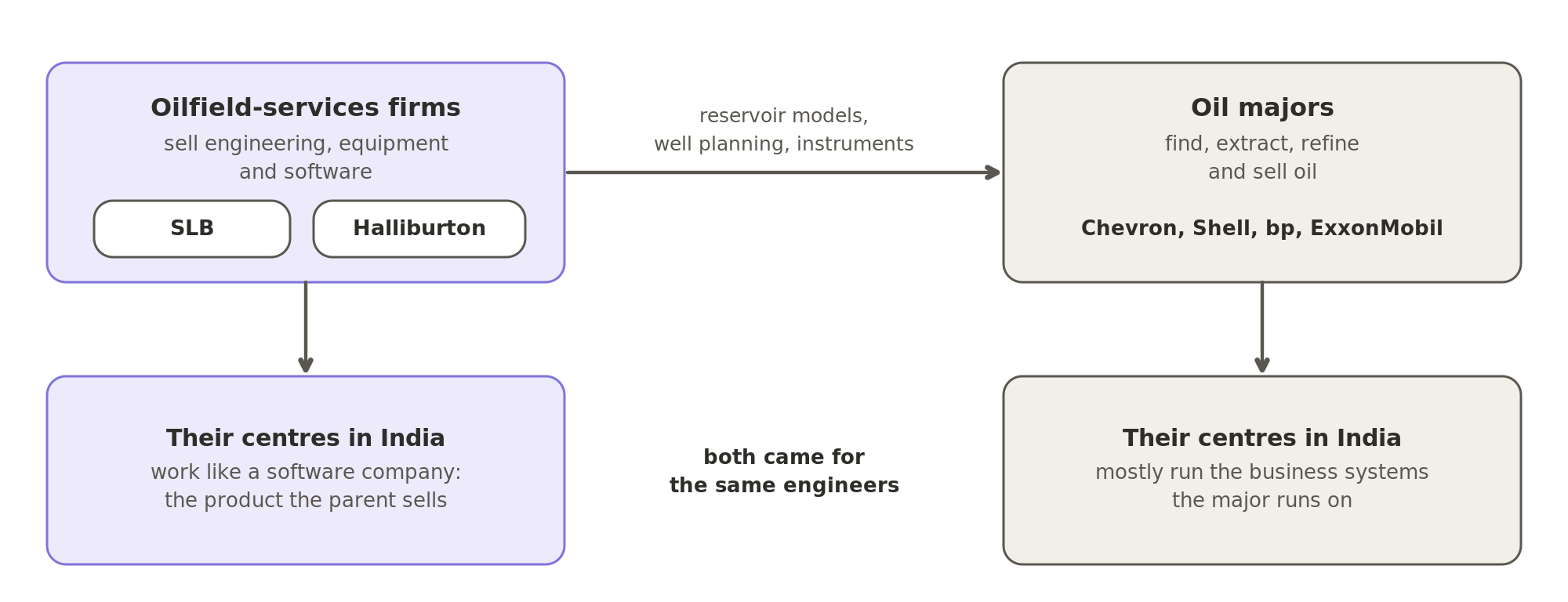
Oil majorsthe largest oil and gas companies, such as Chevron, Shell and bp Oilfield-services firmswhich sell engineering, equipment and software to the majors, such as SLB and Halliburton The oilfield-services firms, SLB and Halliburton, sell engineering, equipment and software to the oil majors. Their Indian centres work like a software company, building the product the parent sells, while the majors' Indian centres mostly run the business systems the major runs on.The oilfield-services firms, SLB and Halliburton, sell engineering, equipment and software to the oil majors. Their Indian centres work like a software company, building the product the parent sells, while the majors' Indian centres mostly run the business systems the major runs on.

Only foreign companies are covered here. The energy industry itself, from the power station to the oilfield's accounts, is explained in the product-companies collection. "Where this industry is explained", at the end, says where.

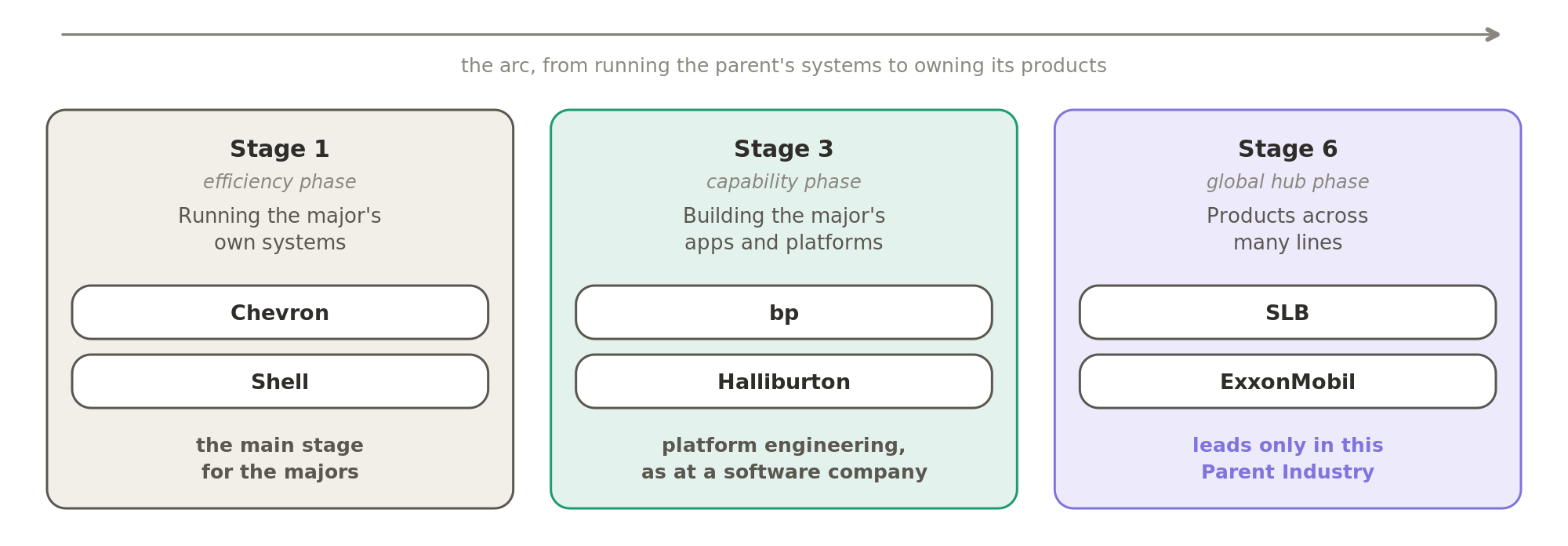
The centres here are recent. Most opened in the last five years. And the arc runs in an unusual order. The oilfield-services firms sell software as a product, so their centres work like software companies, at stage 6. The majors' own centres mostly run their business systems. The GCCs here do three kinds of work:

  • Running the major's own systems (stage 1)
  • Building the major's apps and platforms (stage 3)
  • Products across many lines (stage 6)
The stages present here, with each centre placed in its stage. Chevron and Shell run the majors' business systems, bp and Halliburton build platforms, and SLB and ExxonMobil work across many product lines, the only Parent Industry where that stage leads.The stages present here, with each centre placed in its stage. Chevron and Shell run the majors' business systems, bp and Halliburton build platforms, and SLB and ExxonMobil work across many product lines, the only Parent Industry where that stage leads.

Every centre named here has posted software engineering jobs in India. Companies not placed under a mandate are listed at the end, in The names with a desk here.

Keep reading, free

Six more sections are on this page: Why the oil majors came, Running the major's own systems, Building the major's apps and platforms, Products across many lines, The names with a desk here, and Where this industry is explained. Sign in to read them here, in full.

Continue with Google
  • Why the oil majors came
  • Running the major's own systems
  • Building the major's apps and platforms
  • Products across many lines
  • The names with a desk here
  • Where this industry is explained
Why the oil majors came

They came late, and for the engineers. The majors ran their technology from Houston, London and The Hague for a century. They handed the routine part of it to Indian IT services firms, rather than to centres of their own.

That changed between 2017 and 2023, when most of the majors decided to build their own technology centres in India. These centres would do engineering, not just support: first the business platforms, then data and digital products. Only Bengaluru and Pune could supply engineers at that scale.
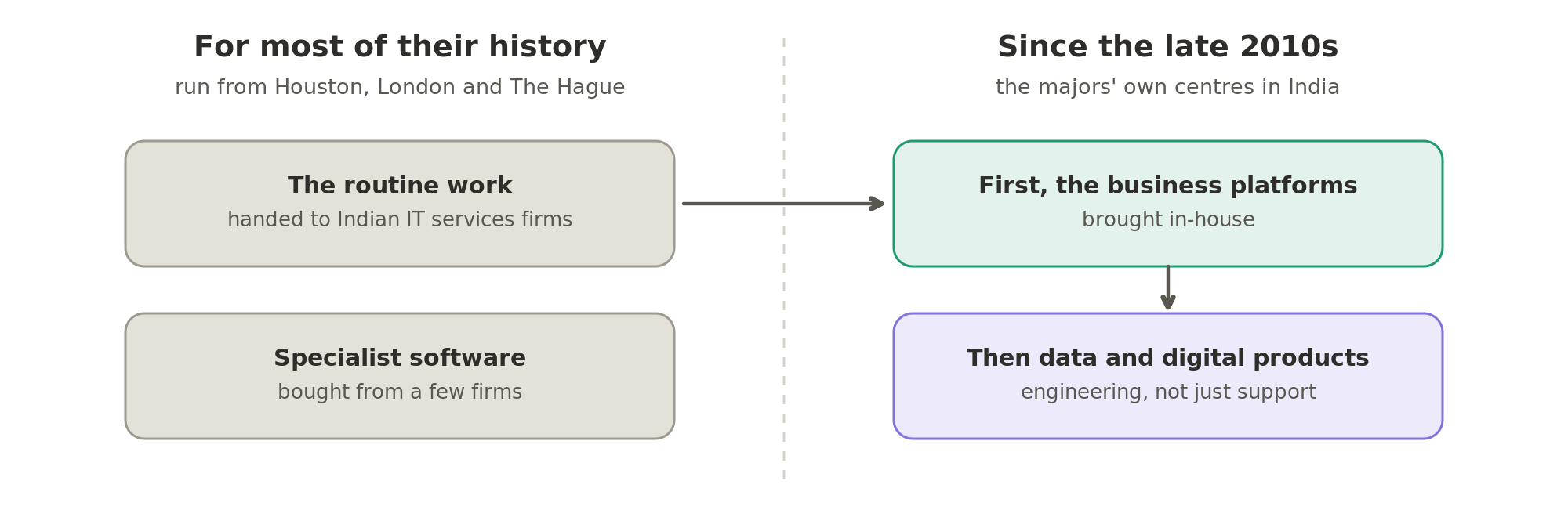
For most of their history the majors ran their technology from Houston, London and The Hague, handing the routine work to IT services firms and buying specialist software. Their own Indian centres, opened since the late 2010s, brought the business platforms in-house first, then data and digital products.For most of their history the majors ran their technology from Houston, London and The Hague, handing the routine work to IT services firms and buying specialist software. Their own Indian centres, opened since the late 2010s, brought the business platforms in-house first, then data and digital products.

The oilfield-services firms came for the same engineers. Their business is selling engineering and software to the majors, so they put their software product development here.

The companies are:

Oil majorsChevron, Shell, bp, ExxonMobil and Woodside Oilfield-services firmsSLB, formerly called Schlumberger, and Halliburton

The majors' centres are mostly in Bengaluru. The two largest centres here are in Pune.

Running the major's own systems Stage 1 of the arc · efficiency phase

For the majors themselves, this is the main stage. An oil major's real product is the barrel of oil, and the decision of where to drill for it. Neither is made in a business-systems centre.

Chevronin Bengaluru, is the largest of the majors' centres here. Almost all of its work is the business platforms the company runs on, with a security team beside them. It is a recent centre, built to bring in-house work that IT services firms used to run. Shellin Bengaluru, with a team in Chennai, does similar work. Its Bengaluru technology centre is one of the largest of any energy company in India, with thousands of people.
You're reading as a guest. Sign in free to follow links for five minutes, once an hour. Building the major's apps and platforms Stage 3 of the arc · capability phase

Only one major has a centre with this mandate.

bpin Pune, is the second-largest centre in this Parent Industry. Its work is platform engineering, as at a software company: cloud infrastructure, backend and applications. The parent has been rebuilding its business and its systems together. Halliburtonwith a small team in Bengaluru, does the same kind of work.
Products across many lines Stage 6 of the arc · global hub phase

This is the only Parent Industry where this stage leads. The centres work like a software company with several product lines, because for an oilfield-services firm, software is something it sells.

SLBin Pune, is the largest centre in this Parent Industry. SLB sells the majors the platforms they use to model reservoirs and plan wells. A large part of its Pune work is also embedded software for the instruments lowered down a well. ExxonMobilin Bengaluru, is the one major with this mandate. It builds across the company's businesses, including embedded software and software made for the oil industry.
The names with a desk here

These companies are not placed under a mandate here:

Woodside Energythe Australian gas producer, with a first team in Bengaluru. It is the newest of the majors to arrive. BRITAthe German water-filter maker Vireona Nordic company that runs hydrogen-refuelling stations

TotalEnergies and Equinor are not covered in this Parent Industry. Baker Hughes, the third large oilfield-services firm, is covered as an equipment maker in the product-companies collection. (More on it in Market Segment 40.5, Asset performance management and digital twins, in Industry Vertical 40, Energy and climate tech, in the product-companies collection.)

The oilfield-services firm as a software company.

SLB's Pune centre is the clearest case here of a centre building a software product the parent sells, with embedded work for its instruments beside it. bp's Pune centre is the major that has moved furthest from running systems to building platforms. AI is changing the engineering itself: reading seismic data, modelling reservoirs and planning the maintenance of platforms. The counter-current: Chevron's and Shell's centres are still, mostly, the keepers of the business systems.

Where this industry is explained

Industry Vertical 40, Energy and climate tech, in the product-companies collection, explains what these companies do:

Market Segment 40.1, Renewable energy and battery storage Market Segment 40.2, Smart grid and smart meter technologythe software that runs the electricity grid Market Segment 40.3, Home energy management and community solarsolar panels, batteries and chargers at home Market Segment 40.4, Energy market analytics and trading software Market Segment 40.5, Asset performance management and digital twinsmaintaining power plants and oilfields Market Segment 40.6, Upstream oil and gas softwarethe accounts of oil and gas production Market Segment 40.7, Carbon accounting and sustainability software

The majors here buy much of that software. SLB and Halliburton are among the companies that sell it, which is why their centres work like software companies.

That is the energy GCC: oil majors that run their business systems from India, and oilfield-services firms that build their software products here.

Who they hire

Who these centres hire, role by role, is on the collection's role pages for Java backend and full-stack engineers, cloud and DevOps engineers, data engineers, test engineers, frontend and mobile engineers, .NET engineers, GenAI engineers and the other roles.

Privacy Terms Refunds and cancellation Shipping and delivery © 2026 ingrid.fyi · Payments by Razorpay
You're browsing as a guest. Sign in free to follow links for five minutes, once an hour.