When a UPS parcel is scanned at a sorting centre in the United States, the software doing the scanning was tested in Chennai, by UPS's own engineering centre in India.
A logistics company owns the things that move goods: ships, planes, trucks, ports, warehouses and pallets. What it sells is a promise about where a thing will be, and when. Keeping that promise is a software problem: tracking, routing, customs filing and billing, laid over a physical network the size of the world.
This Parent Industry covers two kinds of company:
Logistics operatorswhich own those networks: parcel carriers, shipping lines and port operators
Distributorswhich buy goods in bulk and deliver them to businesses: medicine to hospitals, electrical parts to electricians, computers to shops
Their Indian centres are where the software behind the promise is tested, run and, at a few of them, built.
Only foreign companies are covered here. The industry itself, and the companies that sell logistics software, are explained in the product-companies collection. "Where this industry is explained", at the end, says where.
This is one of the smallest Parent Industries, and the arc starts in an unusual place. Its largest centre is a testing centre, stage 2, which appears nowhere else at this size. The GCCs here do four kinds of work:
- Running the operator's own systems (stage 1)
- Testing what was built elsewhere (stage 2)
- Building the operator's apps and platforms (stage 3)
- The whole engineering function, moved here (stage 4)
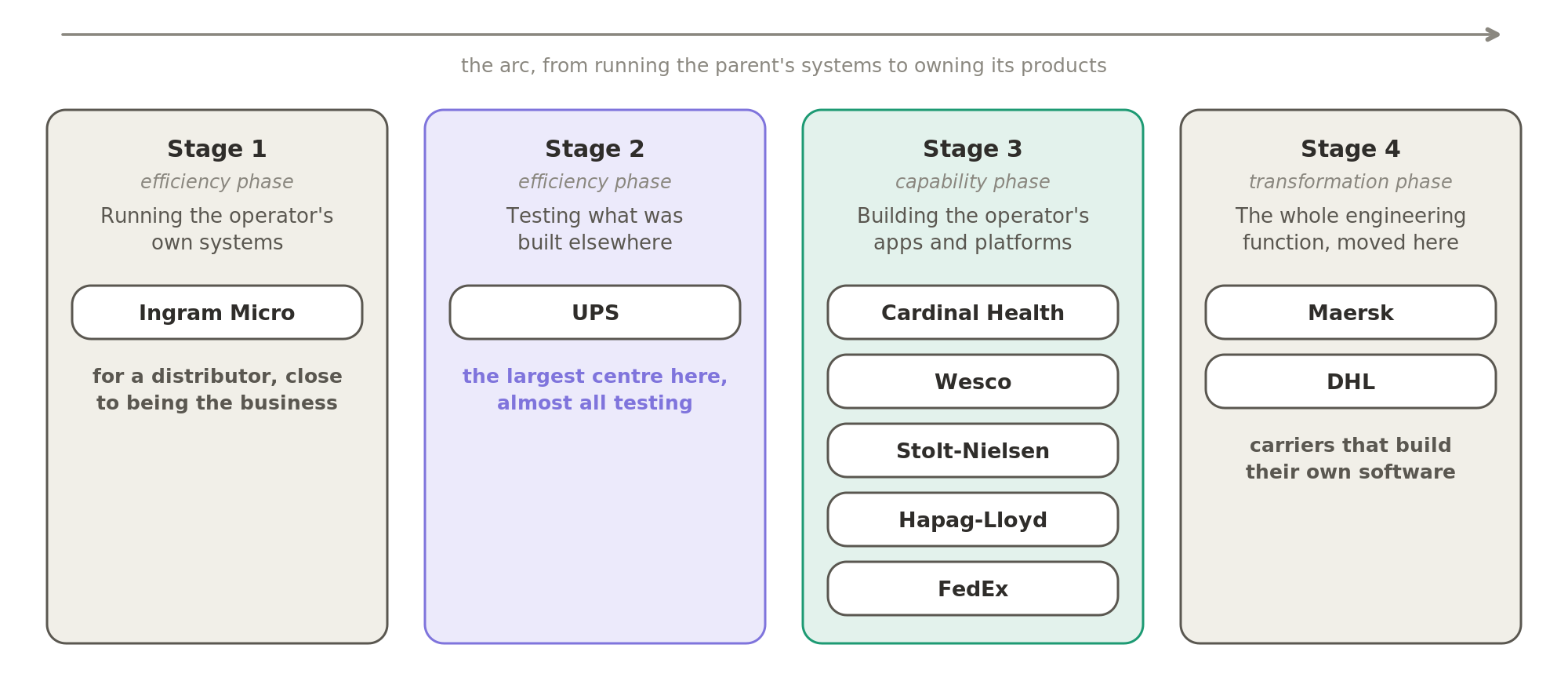 The stages of the arc, with each centre on this page placed in its stage. UPS's testing centre, the largest here, sits in stage 2, the distributors and some carriers build apps and platforms in stage 3, and Maersk and DHL have moved the whole engineering function in stage 4.
Every centre named here has posted software engineering jobs in India. Companies not placed under a mandate are listed at the end, in The names with a desk here.
Keep reading, free
Seven more sections are on this page: Why the logistics companies came, Running the operator's own systems, Testing what was built elsewhere, Building the operator's apps and platforms, The whole engineering function, moved here, The names with a desk here, and Where this industry is explained. Sign in to read them here, in full.
Continue with Google
Why the logistics companies came
They came because their software is huge, and getting it wrong is costly. A parcel carrier's systems touch every package it carries, millions a day. A shipping line's systems touch every container, and every customs border on its route. A fault in either is not just a bug. It stops the network.
So the first work these companies moved to India was making sure nothing broke. That meant testing the systems that track, sort, route and bill, and running the business software underneath them. Chennai, with its port and its long history of back-office work for the carriers, is where most of them settled. Bengaluru has the rest.
In the last few years, the shipping lines decided to build their own technology. Container shipping ran for decades on old systems and phone calls with brokers. The largest lines have since built their own booking platforms, tracking products and logistics services. Their Indian centres were opened, or rebuilt, to engineer them.
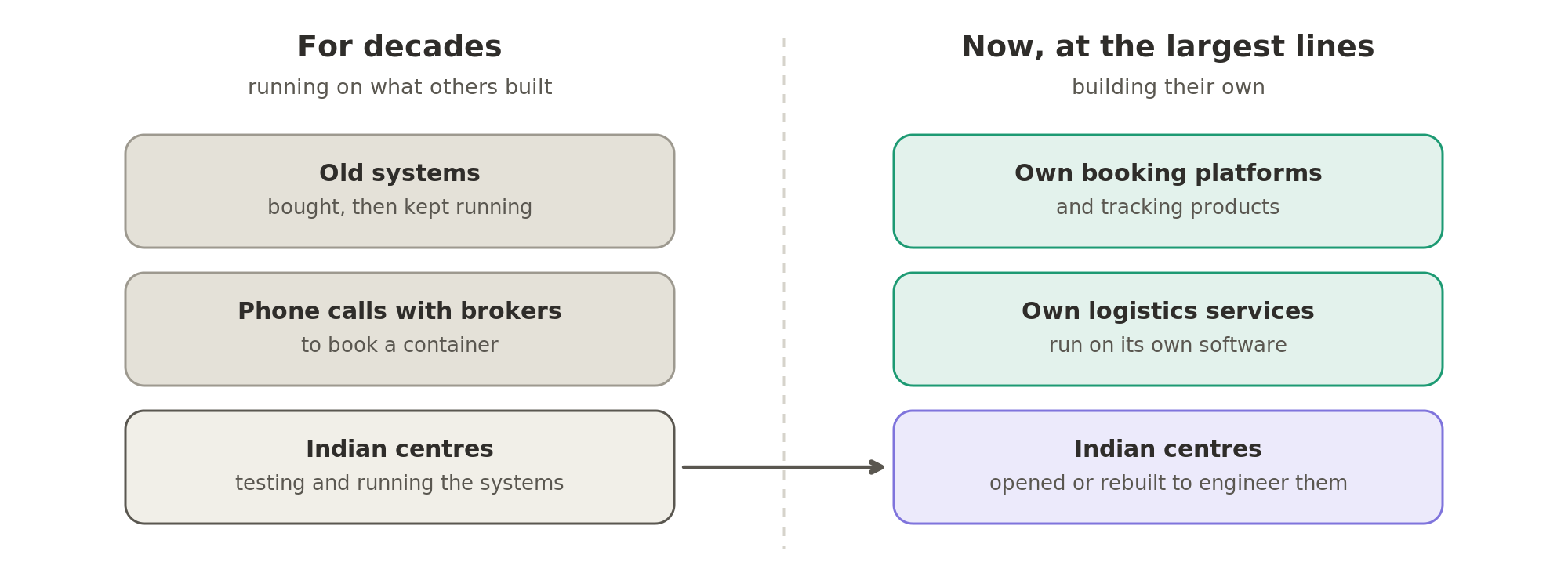 For decades, container shipping ran on old systems and phone calls with brokers, and the Indian centres tested and ran those systems. The largest lines now build their own booking platforms, tracking products and logistics services, and their Indian centres were opened or rebuilt to engineer them.
The companies are:
Parcel carriersUPS, DHL and FedEx
Shipping lines and port operatorsMaersk, Hapag-Lloyd, Stolt-Nielsen, APM Terminals and DP World
Pallet and container poolersBrambles, which rents out reusable pallets that companies share
DistributorsCardinal Health, Wesco and Ingram Micro
Running the operator's own systems
Stage 1 of the arc · efficiency phase
For a distributor, the business software is close to being the business itself: the order, the stock and the invoice. So this stage matters more here than in most industries.
Ingram Microin Mumbai, where its Indian business has its headquarters, with small teams in Pune and Chennai. The computer and electronics distributor runs its business systems here, with some embedded software work beside them.
You're reading as a guest. Sign in free to follow links for five minutes, once an hour.
Sign in
Testing what was built elsewhere
Stage 2 of the arc · efficiency phase
This stage defines this Parent Industry. A testing centre is where a parent's software is made safe, not where it is decided. Most centres pass through this stage. At UPS, it is a destination in itself.
UPSin Chennai, is the largest centre in this Parent Industry by a wide margin. Almost all of its work is testing the parent's software. The systems that scan, sort, route and bill parcels are written elsewhere and proven here, at scale, before they touch a package. It is the only Parent Industry where a testing centre is the largest.
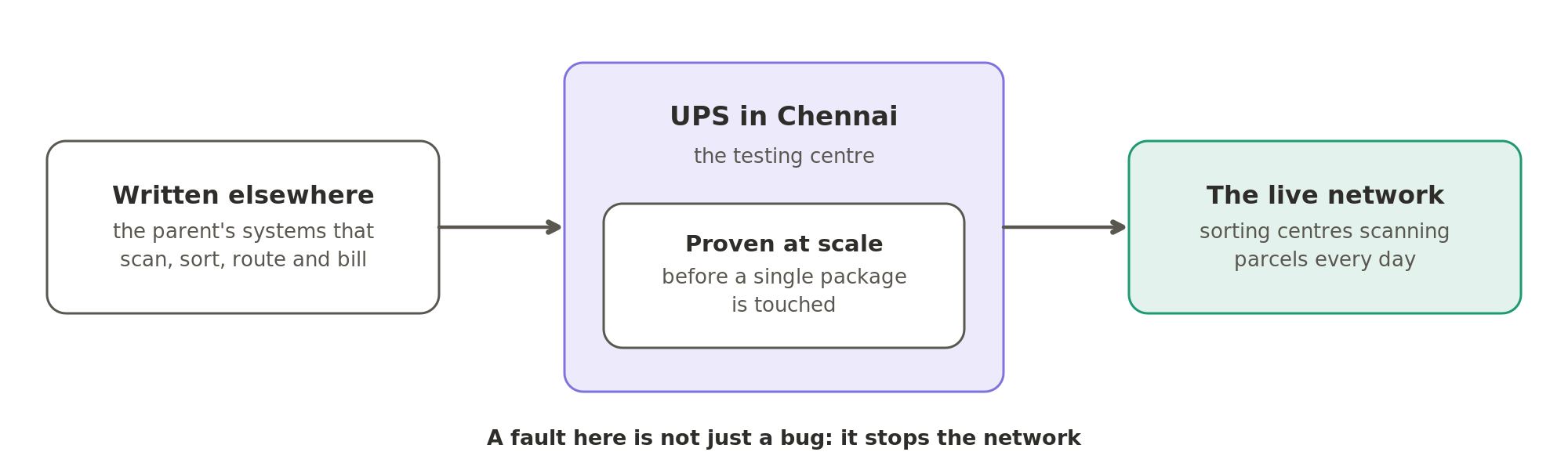 The systems that scan, sort, route and bill parcels are written elsewhere and proven at UPS's Chennai centre before they reach the live network of sorting centres, because a fault there stops the network.
Building the operator's apps and platforms
Stage 3 of the arc · capability phase
The systems that scan, sort, route and bill parcels are written elsewhere and proven at UPS's Chennai centre before they reach the live network of sorting centres, because a fault there stops the network.
Building the operator's apps and platforms
Stage 3 of the arc · capability phase
The distributors have reached this stage, and the carriers are reaching it. These centres build what customers use: the customer portal, the tracking product, the booking platform, and the ordering system a hospital or an electrician uses.
Cardinal Healthin Bengaluru, is the largest centre with this mandate. The American medical and pharmaceutical distributor builds the ordering and distribution platforms its hospital customers run on.
Wescoin Bengaluru, the electrical and industrial distributor. Much of its work is front-end: the online catalogue its customers order from.
Stolt-Nielsenwith a small centre in Hyderabad. It runs tankers, ships that carry liquids, and the terminals where they load.
Hapag-Lloydin Chennai, a recent centre for the German shipping line, building its booking and tracking platforms
FedExin Chennai and Hyderabad. It runs one of the largest technology centres of any logistics company in India, in Hyderabad, with thousands of engineers.
The whole engineering function, moved here
Stage 4 of the arc · transformation phase
Two carriers have moved so much work here that their centres do every kind at once. Both are carriers that decided to build their own software. As everywhere, one building holds the parent's oldest systems and its newest work, and the name on the door does not say which floor a job is on.
A.P. Moller - Maerskin Bengaluru, with a team in Pune, is the second-largest centre in this Parent Industry. It is the clearest case of a shipping line becoming a technology company. It does business systems, app engineering and new AI work together, for a parent that has spent a decade rebuilding itself as a logistics business run on its own software.
DHLin Chennai, with a team in Bengaluru, is smaller and works the same way.
The names with a desk here
These companies are not placed under a mandate here:
APM TerminalsMaersk's port arm, with a first team in Bengaluru
BXB Digital and CHEPtwo names for one company, Brambles. Its Bengaluru digital arm builds the tracking of its pallets.
DP Worldthe Dubai port operator, with a first team in Bengaluru
Abrao Groupa shipping agency in Mumbai
The freight forwarders Kuehne+Nagel, DSV and Expeditors, and the French shipping line CMA CGM, are large in India but are not covered in this Parent Industry. A freight forwarder arranges the whole journey of a shipment for its customer, using other companies' ships, planes and trucks.
The shipping line as a technology company.
Maersk's Bengaluru centre is the clearest case of an operator that built its own platforms, rather than buying them, and engineers them from India. Hapag-Lloyd's new Chennai centre was built the same way. Cardinal Health's Bengaluru centre owns parts of the distributor's ordering platforms. AI is also reaching this industry's paperwork: a shipment passes through a dozen documents, such as the booking, the bill of lading, the customs declaration and the invoice, and reading them is exactly what AI models do first. It is also reaching testing, which puts the largest centre here, UPS's, most exposed. The counter-current: UPS's Chennai centre is still a testing centre, a decade on.
Where this industry is explained
Industry Vertical 30, Supply chain and logistics, in the product-companies collection, explains what these companies do:
Market Segment 30.1, Supply chain planning software
Market Segment 30.2, Warehouse management systems (WMS) and warehouse robotics
Market Segment 30.3, Transportation management (TMS) and digital freight marketplaces
Market Segment 30.4, Shipment tracking and supply chain visibility platforms
Market Segment 30.5, Last-mile delivery and shipping softwarethe final step, from the local depot to your door
Market Segment 30.6, Freight forwarding, customs and trade platformsports, ships and forwarders
The operators here buy much of that software. At Maersk, and more and more at the other shipping lines, they also compete with it, building in India what they once bought.
That is the logistics GCC: testing and running the software that keeps parcels and containers moving, and at the shipping lines, building it.