When an American's health-insurance claim is checked and approved, the software doing it may have been built in Delhi NCR or Bengaluru, by Optum's or Carelon's own engineering centres in India.
Two industries share this Parent Industry, and they came to India for different reasons:
Drugmakerssuch as Amgen, Bristol Myers Squibb, Pfizer, Eli Lilly, Takeda, MSD and Bayer. They make molecules, the active substance in a medicine, and a molecule is not written in code. Their Indian centres run the systems a drug company runs on, and more and more, the data it lives on.
American healthcare-services companiessuch as Optum, Carelon, Evernorth and HCA Healthcare. They run the paying for and providing of American healthcare. That is a paperwork business the size of a country, and their Indian centres are where much of that paperwork became software.
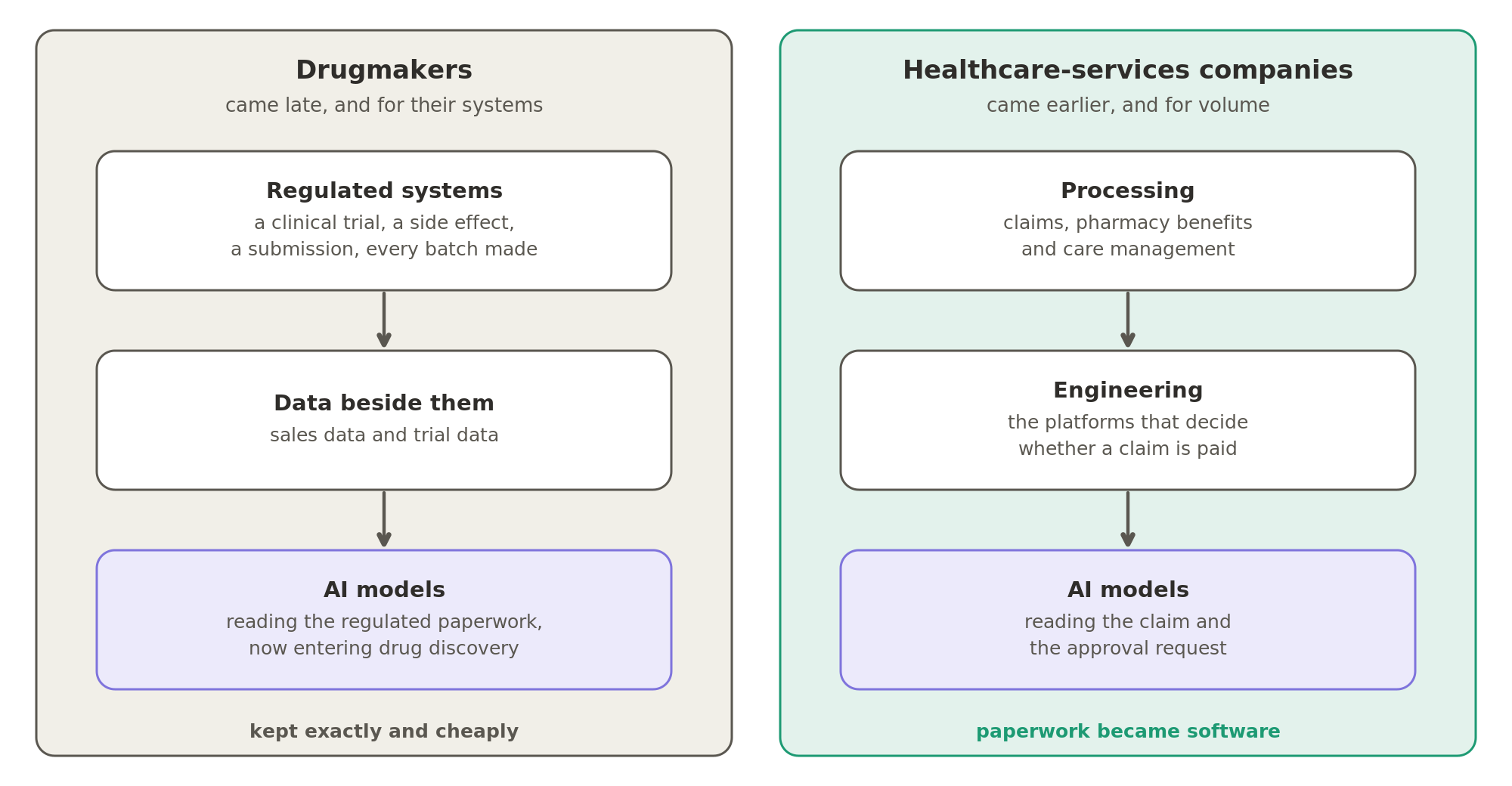 The drugmakers came late, for their regulated systems, with data and now AI models growing beside them. The healthcare-services companies came earlier, for volume, and their processing work became engineering and then AI that reads the claim.
Only foreign companies are covered here. The health industry itself, from finding a drug to billing a hospital stay, is explained in the product-companies collection. "Where this industry is explained", at the end, says where.
One stage of the arc is missing here. Stage 5, engineering the product itself, cannot exist, because the product is a molecule or a hospital, not a machine. The stage nearest to the product is the data and AI centre. That is why the one drugmaker centre built for a single kind of work was built for AI. The GCCs here do five kinds of work:
- Running the parent's own systems (stage 1)
- Building the parent's apps and platforms (stage 3)
- The whole engineering function, moved here (stage 4)
- Products across many lines (stage 6)
- The data and AI centre (stage 7)
Every centre named here has posted software engineering jobs in India. Companies not placed under a mandate are listed at the end, in The names with a desk here.
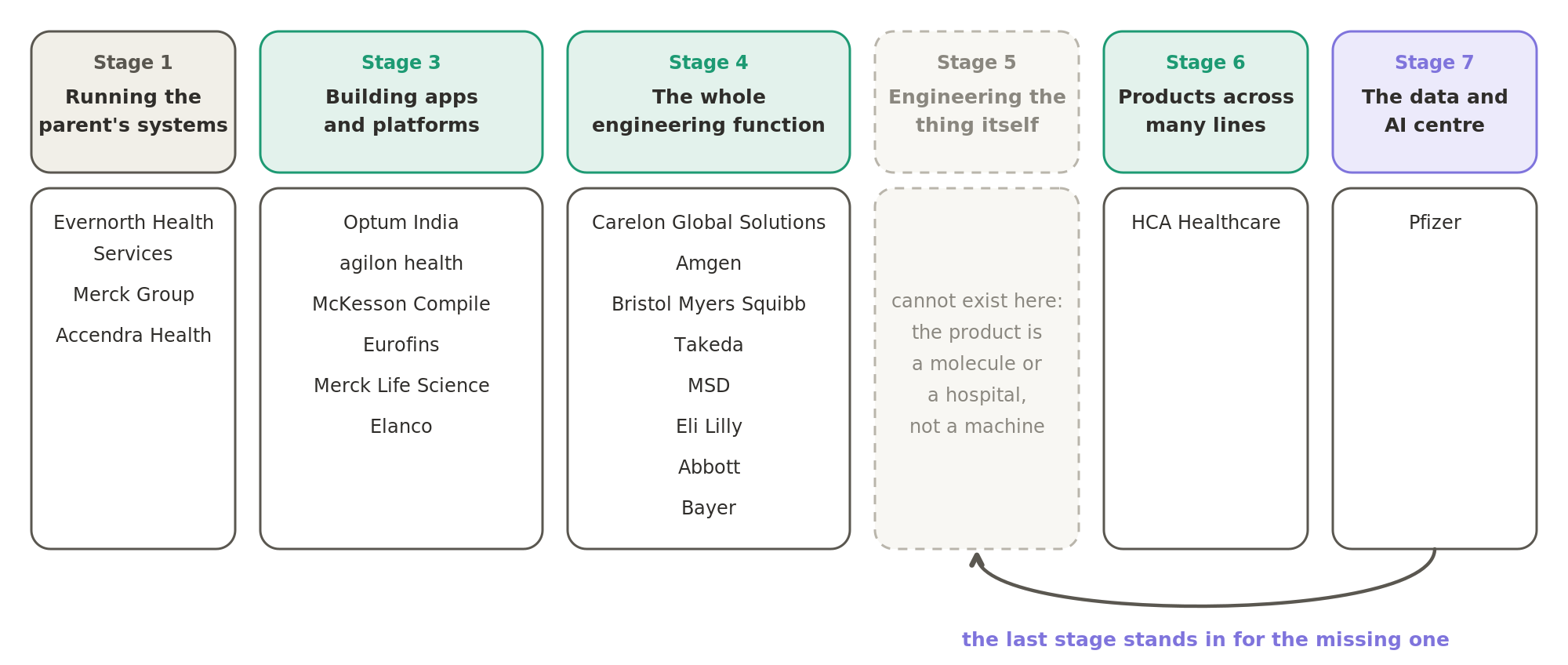 The pharma and healthcare centres sit along the arc, but stage 5, engineering the product itself, cannot exist here, because the product is a molecule or a hospital, not a machine. Pfizer's data and AI centre, the last stage, stands in for it.
Keep reading, free
Eight more sections are on this page: Why the pharma and healthcare companies came, Running the parent's own systems, Building the parent's apps and platforms, The whole engineering function, moved here, Products across many lines, The data and AI centre, The names with a desk here, and Where this industry is explained. Sign in to read them here, in full.
Continue with Google
Why the pharma and healthcare companies came
The drugmakers came late, and for their systems. A drug company runs on regulated software, which the law requires it to keep exactly and prove it has kept. This includes the systems that:
- track a clinical trial, the tests of a new drug on patients
- report a side effect once a drug is on sale
- file a submission, the application to a regulator to approve a drug
- record every batch of medicine made
That software has to be kept exactly and cheaply. The first pharma centres in India kept it, and most still do. Data work has grown beside it: sales data, trial data, and now the AI models that read both. Most drugmaker centres are in Hyderabad, India's own pharma city, where India's generic drugmakers are. A generic drug is a cheaper copy of a medicine whose patent has ended. The newest centres, opened in the last few years, are the largest on the drugmakers' side.
The healthcare-services companies came earlier, and for volume. Optum, part of UnitedHealth, Carelon, part of Elevance, and Evernorth, part of Cigna, handle a large share of insured Americans' healthcare between them. That covers:
claimsthe bills sent to a health insurer for payment
pharmacy benefitswhat a health plan pays for medicines
care managementhelping patients with long-term illnesses get the right care
This work moved to India more than a decade ago, often into the same buildings as the insurers' work. (More on it in Parent Industry 2, Inside the insurers.) What began as processing became engineering: the platforms that decide whether a claim is paid, the data that decides what care is approved, and now the AI models that read the claim. Optum India is the largest centre in this Parent Industry by a wide margin, across Delhi NCR, Hyderabad and Bengaluru.
Running the parent's own systems
Stage 1 of the arc · efficiency phase
This stage appears on both sides. These centres are the parent's IT department. The medicines and the health plans are not decided in them.
Evernorth Health Servicesin Hyderabad, Cigna's health-services arm, runs its business platforms here, with a data team beside them.
Merck Groupin Bengaluru, is a small systems centre for the German chemicals and pharmaceuticals company. It is a separate company from the American MSD, below.
Accendra Healthin Pune, with a team in Kolkata. Its work is business systems, plus some embedded software, which no other centre here does.
Bristol Myers Squibbhas a second, smaller unit here. Its main centre is under the whole engineering function, below.
You're reading as a guest. Sign in free to follow links for five minutes, once an hour.
Sign in
Building the parent's apps and platforms
Stage 3 of the arc · capability phase
The healthcare-services companies reached this stage first, because their product is already software: the platform a claim runs through, the portal a doctor uses, and the app a patient opens.
Optum Indiais the largest centre in this Parent Industry, and one of the largest healthcare GCCs in the country. It builds the platforms UnitedHealth's businesses run on, with a large amount of AI and platform-infrastructure work. Optum also appears under a second, smaller name for the same business.
agilon healthin Delhi NCR, builds the platform behind a newer American model of primary care, the everyday care a family doctor gives.
McKesson Compilein Bengaluru, is the healthcare-data business of McKesson, the drug distributor.
The drugmakers' side of this stage is smaller:
Eurofinsin Bengaluru, is the second-largest centre in this Parent Industry. The laboratory-testing group builds the software its thousands of labs run on.
Merck Life Sciencein Bengaluru, is the German Merck's lab-supplies division.
Elancowith a small team in Bengaluru, is the animal-health company spun out of Eli Lilly.
The whole engineering function, moved here
Stage 4 of the arc · transformation phase
Eight companies have centres that do every kind of work at once. This is where most of the drugmakers are. When a drug company moves its technology function to India, it moves everything together: the regulated systems, their testing, the app work and the new data and AI work. At home, these were never separate.
As everywhere, one building holds the parent's oldest systems and its newest work. The name on the door does not say which floor a job is on.
Carelon Global Solutionsin Bengaluru, Delhi NCR and Hyderabad, is the largest. It is Elevance Health's centre. Data engineering and AI models are the largest part of its work, ahead of apps. For a health insurer, that means claims being read by machine.
Amgenin Hyderabad, is the largest drugmaker centre in this Parent Industry. It is a recent one, holding the company's business systems, app work and AI together.
Bristol Myers Squibbin Hyderabad, is also recent, and works the same way.
Takedain Bengaluru, does a large amount of testing beside its systems work.
MSDin Hyderabad. It is the American Merck & Co, which trades as MSD outside North America.
Eli Lillyin Hyderabad. AI and models are the largest single part of its work, which no other drugmaker here shows.
Abbottin Mumbai, where its Indian business has its headquarters
Bayerin Bengaluru, with a team in Mumbai
Products across many lines
Stage 6 of the arc · global hub phase
One centre works like a software company with several product lines.
HCA Healthcarein Hyderabad, is the engineering arm of the American hospital operator. It builds across the hospital's clinical, financial and operational systems at once. It is the only hospital company here with a mandate.
The data and AI centre
Stage 7 of the arc · capability phase
Here, this last stage stands in for the missing stage 5. It is the kind of work nearest to the molecule.
Pfizerin Chennai, with a team in Mumbai. Its work is almost entirely AI and models. Pfizer built a centre in India for one kind of work, and chose the last stage of the arc as its first.
The names with a desk here
These companies are not placed under a mandate here. The three drugmakers in the first line each run large technology centres in India, in Chennai and Bengaluru, with thousands of people between them.
Large drugmakersAstraZeneca, Novo Nordisk and GSK
Other drug and medical companiesBiocon Biologics, India's own maker of biosimilars (near-copies of complex biological medicines), and Merck Healthcare, another unit of the German Merck
Healthcare and suppliesMedline, the medical-supplies distributor, with a first team in Pune. enGen Global, the technology arm of an American health system, with a first team in Chennai. Faeth Therapeutics, a small American biotech company, with a few engineers in Mumbai.
OthersEcolab Life Sciences, part of Ecolab (More on it in Parent Industry 4, Inside the manufacturers and carmakers.), Providence, the American hospital system, and Becton Dickinson
Novartis and Sanofi, which run technology centres of the same kind in Hyderabad, are not covered in this Parent Industry.
The centre built for AI.
Pfizer's Chennai centre is the clearest case of a parent starting at the last stage of the arc. Eli Lilly's and Carelon's centres have moved the same way from broader beginnings. Amgen's and Bristol Myers Squibb's new Hyderabad centres had data and AI work inside them from the first day. AI is changing both sides. For the healthcare-services companies, it is reading the claim, the approval request and the coding of a doctor's visit. For the drugmakers, it reads the regulated paperwork first, and is now entering drug discovery itself. The counter-current: most drugmaker centres are still the keepers of regulated systems.
Where this industry is explained
Domain VI, Healthtech and life sciences, in the product-companies collection, explains what these companies do:
Industry Vertical 22, Digital healthelectronic health records, AI medical scribes, telemedicine and online pharmacies
Industry Vertical 23, Health insurance and billingrevenue cycle management, health payer platforms and healthcare data platforms
Industry Vertical 24, Hospitals, diagnostics and medical devicesthe hospital's systems, lab tests and medical imaging
Industry Vertical 25, Pharma and life sciencesfinding, testing, making and selling a drug
The drugmakers here buy most of that software, and their Indian centres keep it running. The healthcare-services companies compete with it, and their centres build what they chose not to buy.
That is the healthcare GCC: drugmakers that keep their regulated systems and build AI in India, and American health companies whose paperwork became software here.