The software inside a Jeep's dashboard may have been written in Bengaluru, by Stellantis, the carmaker that owns Jeep, in its own engineering centre in India.
A manufacturer makes a thing: a car, a tyre, a turbine, a bottle of detergent, a sack of fertiliser. For most of the companies here, software is what the business runs on. That means the ERP, the large business software that runs finance, purchasing and production, and the systems that run the factory. Their Indian centres exist to run it.
But for one group, the carmakers and the electronics makers, software is now inside the product itself. Their Indian centres write it. That makes this Parent Industry different from every other: it is the only one where stage 5 of the arc, engineering the product itself, appears in numbers.
Only foreign companies are covered here. What these industries make, and the companies that sell them software, are explained in the product-companies collection. "Where this industry is explained", at the end, says where.
The arc has two ends here. The chemical, food and materials makers mostly stopped at stage 1, running the parent's systems from India. The carmakers and electronics makers have centres at the far end, writing the code in the engine and the dashboard. Their GCCs here do all seven kinds of work:
- Running the maker's own systems (stage 1)
- Testing what was built elsewhere (stage 2)
- Building the maker's apps and platforms (stage 3)
- The whole engineering function, moved here (stage 4)
- Engineering the thing itself (stage 5)
- Products across many lines (stage 6)
- The data and AI centre (stage 7)
Every centre named here has posted software engineering jobs in India. Companies not placed under a mandate are listed at the end, in The names with a desk here.
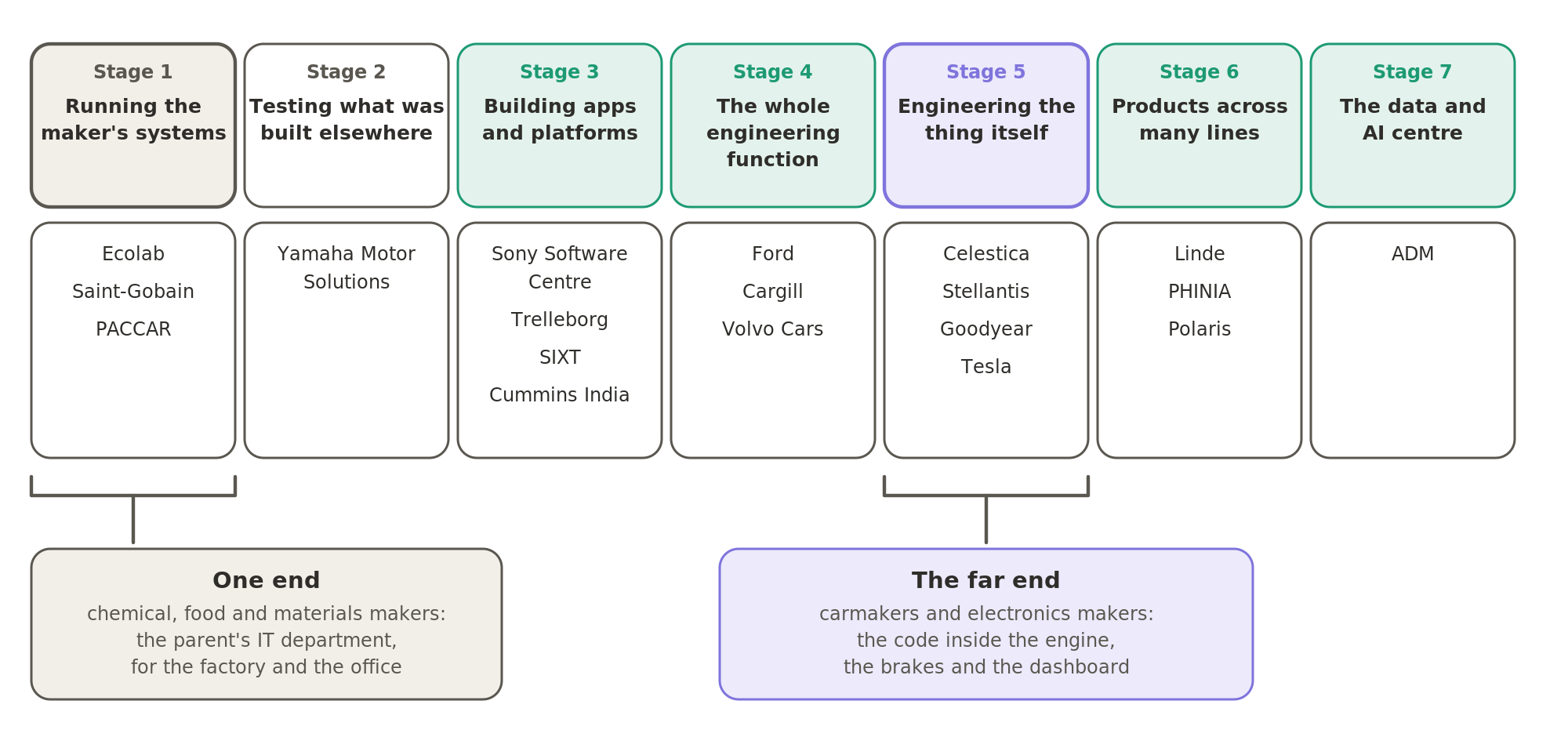 The makers' centres cover every stage of the arc. At one end, the chemical, food and materials makers run the parent's systems for the factory and the office; at the far end, the carmakers and electronics makers engineer the product itself.
Keep reading, free
Ten more sections are on this page: Why the manufacturers came, Running the maker's own systems, Testing what was built elsewhere, Building the maker's apps and platforms, The whole engineering function, moved here, Engineering the thing itself, Products across many lines, The data and AI centre, The names with a desk here, and Where this industry is explained. Sign in to read them here, in full.
Continue with Google
Why the manufacturers came
Two kinds of maker came for two different reasons.
Makers of things with no software insidesuch as chemicals, food and materials, came for the reason every back office came. Their SAP and factory systems had to be run and slowly modernised, and India had the people.
Carmakerscame for something else. A modern car is a computer on wheels. There is software in the engine, the brakes, the dashboard and, more and more, the driving. The amount of software grew faster than the carmakers could write at home. India had engineers who write embedded software, the code that runs inside a machine rather than on a computer. Many of them were trained in IT services firms that did this work for the carmakers first. So the carmakers built their own centres here, mostly in Bengaluru, Pune and Chennai.
The companies are:
Carmakers and their suppliersFord, Stellantis, Volvo Cars, Volvo Group, Jaguar Land Rover, Tesla, PACCAR, Cummins, Goodyear and Trelleborg
Electronics makers and contract manufacturersSony, Toshiba, Dell and Celestica. A contract manufacturer builds products for other companies, under their brand names.
Industrial and agricultural giantsCargill, Ecolab, Saint-Gobain, ADM, PepsiCo and Linde
Most of their centres are in Bengaluru. Chennai, India's car-making city, is second, then Pune and Hyderabad.
Running the maker's own systems
Stage 1 of the arc · efficiency phase
For makers of things with no software inside, this is the only stage. These centres are the parent's IT department. They build for the factory and the office, not for the product.
Ecolabin Bengaluru, Pune and Mumbai, is the largest centre with this mandate. The water and hygiene chemicals company runs the business software its operations depend on.
Saint-Gobainin Mumbai. The French materials group runs its systems here, with a large amount of data engineering beside them.
PACCARin Pune, a small systems centre for the truck maker
You're reading as a guest. Sign in free to follow links for five minutes, once an hour.
Sign in
Testing what was built elsewhere
Stage 2 of the arc · efficiency phase
A testing centre checks the parent's software rather than writing it. Most centres pass through this stage, and few stay in it. It is rare to see on its own, because it usually sits inside a broader centre.
Yamaha Motor Solutionsin Delhi NCR
Building the maker's apps and platforms
Stage 3 of the arc · capability phase
Here, a maker's centre builds the software its customers, dealers and fleet owners use, rather than the software the factory runs on. Examples are the platform behind a connected car, the portal a car dealer uses, a car-rental app, and the analytics a customer buys with a machine.
Sony Software Centrein Bengaluru, is the largest. It is the Japanese group's software arm in India.
Trelleborgin Bengaluru, through two companies: the Swedish group that makes engineered polymers, and its sealing division
SIXTin Bengaluru, the research and development centre that builds the car-rental company's software
Cummins Indiain Pune, the engine maker's software arm
Clean Harborsin Hyderabad, the American environmental-services company
Volvo Groupin Bengaluru, the truck and bus maker. It is a separate company from Volvo Cars, below.
PepsiCowith a small team in Hyderabad
The whole engineering function, moved here
Stage 4 of the arc · transformation phase
Three companies have moved so much work here that their centres do every kind at once. As everywhere, one building holds the parent's newest work and its oldest, and the name on the door does not say which a job belongs to.
Fordin Chennai, is the largest centre in this Parent Industry, and one of the oldest carmaker GCCs in India. It holds the company's business platforms, its internal systems and now its AI work under one roof.
Cargillin Bengaluru, is the agricultural giant's whole technology function in India, at nearly the same size.
Volvo Carsin Bengaluru, a smaller centre for the Swedish carmaker, separate from the truck group
Engineering the thing itself
Stage 5 of the arc · transformation phase
Only this Parent Industry has this stage in numbers. It is why a carmaker's Indian centre is unlike a bank's. The software in a modern vehicle is written in centres like these: the code in the engine control unit, the small computer that runs the engine, and in the brakes, the dashboard and the driver-assistance features. The electronics makers' centres write the software inside the devices they build.
Here the reputation gap is at its narrowest, because the centre works on the product itself. What the centre still does not usually own is the architecture, the overall design of the system. That is decided at the parent.
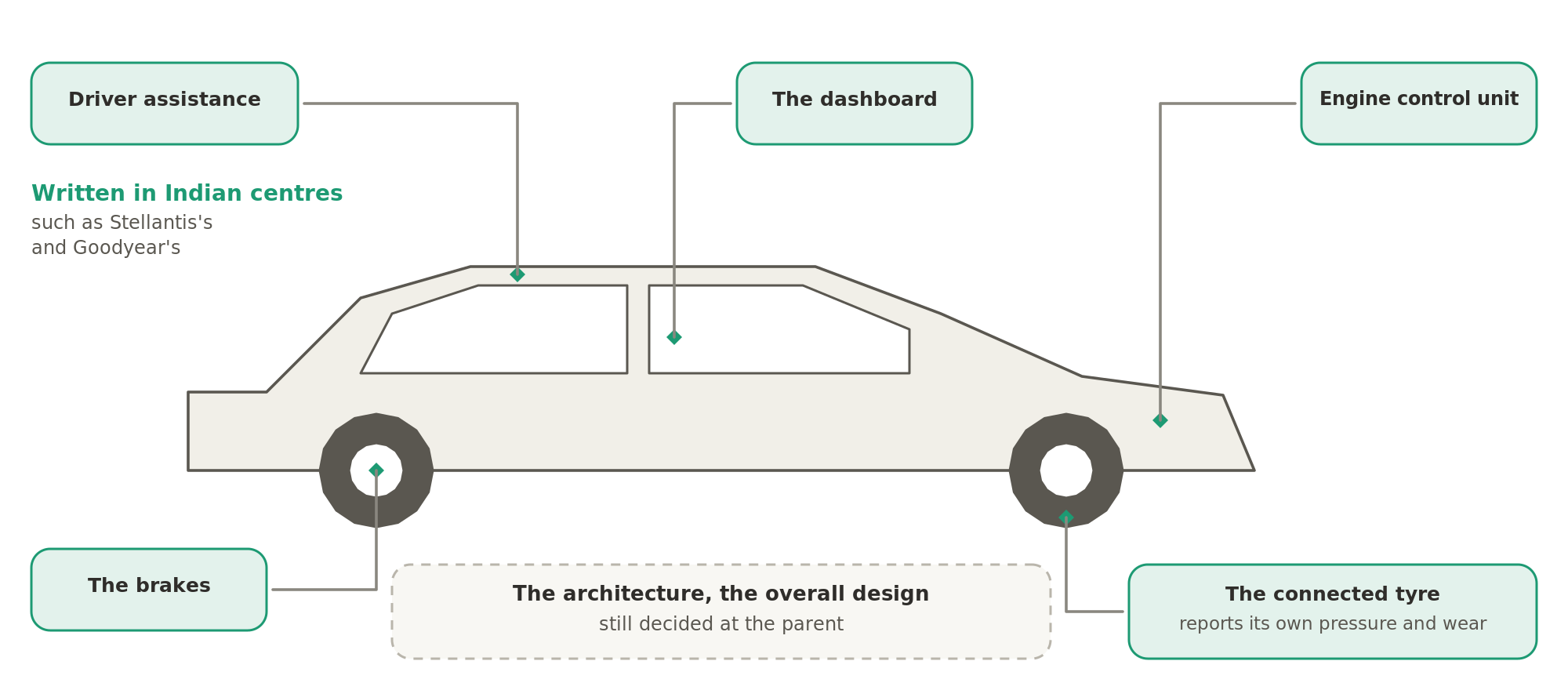 The software in a modern vehicle, in the engine control unit, the brakes, the dashboard, the driver assistance and the connected tyre, is written in Indian centres such as Stellantis's and Goodyear's. The architecture, the overall design of the system, is still decided at the parent.
Celesticain Chennai, is the largest. The contract manufacturer does product engineering for the hardware it builds for other companies, almost all of it embedded software.
Stellantisin Bengaluru, is the largest carmaker's centre, writing the software inside the group's vehicles.
Goodyearin Hyderabad. The connected tyre, which reports its own pressure and wear, is now a software product.
Toshiba Softwarein Bengaluru
Sony Indiain Bengaluru
Teslawith small teams in Bengaluru, Mumbai and Pune
Jaguar Land Roverin Bengaluru
Dell International Servicesin Pune, the hardware maker's engineering centre here. (More on Dell's servers in Market Segment 3.2, Server and storage hardware, in Industry Vertical 3, Data centres and servers, in the product-companies collection.)
Products across many lines
Stage 6 of the arc · global hub phase
The software in a modern vehicle, in the engine control unit, the brakes, the dashboard, the driver assistance and the connected tyre, is written in Indian centres such as Stellantis's and Goodyear's. The architecture, the overall design of the system, is still decided at the parent.
Celesticain Chennai, is the largest. The contract manufacturer does product engineering for the hardware it builds for other companies, almost all of it embedded software.
Stellantisin Bengaluru, is the largest carmaker's centre, writing the software inside the group's vehicles.
Goodyearin Hyderabad. The connected tyre, which reports its own pressure and wear, is now a software product.
Toshiba Softwarein Bengaluru
Sony Indiain Bengaluru
Teslawith small teams in Bengaluru, Mumbai and Pune
Jaguar Land Roverin Bengaluru
Dell International Servicesin Pune, the hardware maker's engineering centre here. (More on Dell's servers in Market Segment 3.2, Server and storage hardware, in Industry Vertical 3, Data centres and servers, in the product-companies collection.)
Products across many lines
Stage 6 of the arc · global hub phase
Three small centres work like a software company with several product lines. Each combines embedded, platform and business-systems work for more than one of the parent's businesses.
Lindein Bengaluru, for the industrial-gases group
PHINIAthe fuel-systems company spun out of BorgWarner
Polaristhe maker of off-road vehicles
The data and AI centre
Stage 7 of the arc · capability phase
One small centre was built for data work alone. The last stage of the arc has reached agriculture before it has reached cars.
ADMin Bengaluru, the agricultural processor
The names with a desk here
These companies are not placed under a mandate here. The four automotive centres in the first line are among the largest automotive engineering centres in India, with thousands of engineers each.
Automotive engineering centresBosch Global Software Technologies, Mercedes-Benz Research and Development India, Volkswagen Group Digital Solutions and Daimler Truck Innovation Center
Contract manufacturers in electronicsFoxconn, Flex and Sanmina
Car-parts makersTenneco, Dauch, Dura, Flex-N-Gate, MANN+HUMMEL and Gates
Food and agriculture makersHershey, Tyson, ofi, Yara, IFF and Kimberly-Clark
OthersEverpure and Titan Engineering and Automation
The software-defined vehicle, engineered in India.
A software-defined vehicle is a car whose features are controlled mostly by software, and can be updated over the air like a phone. Stellantis's Bengaluru centre and Celestica's Chennai centre are the clearest cases here of centres that engineer the product itself, not the software around it. The largest such centres in India, Bosch Global Software Technologies and Mercedes-Benz Research and Development India, are the frontier too. AI is also moving into the product: the car's driver assistance, the connected tyre, and the machine that predicts its own breakdowns. The counter-current: most makers' centres are still the parent's IT department.
Where this industry is explained
The product-companies collection explains what these companies make:
Industry Vertical 37, Manufacturing techthe factory, the design tools, the machines and the materials
Industry Vertical 38, Automotive and mobilitythe car, its software and its parts
Industry Vertical 36, Electronics and devicesthe electronics
Industry Vertical 35, Semiconductors and chip designthe chips inside all of it
Industry Vertical 40, Energy and climate techand Industry Vertical 45, Agritech: the rest
The makers here buy from those companies. The carmakers also compete with them for the same embedded-software engineers.
That is the manufacturing GCC: back offices at the makers of chemicals and food, and at the carmakers and electronics makers, centres that write the software inside the product.