When a shopper in Texas searches for a television in the Walmart app, the search behind that screen may have been built in Bengaluru, by Walmart's own engineering centre in India.
A retailer sells things. For most of its history, the software it needed was the till and the stock ledger, the record of what is on the shelves. Then Amazon arrived. Every large retailer found that it was now also a software company. It had to compete on its website, its app, its search and its delivery promise, against a rival that had been a software company from the start. The Indian centres here are, more than anything else, where retailers acted on that.
This Parent Industry covers two kinds of company:
Retailersthe chains that run shops and online stores, such as Walmart and Tesco
Consumer-goods companieswhich make the everyday products those shops sell: food, drink, clothing and toys
Only foreign companies are covered here. Retail itself, and the companies that sell software to retailers, are explained in the product-companies collection. "Where this industry is explained", at the end, says where.
The two kinds went different distances along the arc. Most consumer-goods makers stopped at the first stage. Their business runs on the parent's SAP, and their Indian centres run that. The retailers went further, because the online store was theirs alone to build. Their GCCs here do four kinds of work:
- Running the parent's own systems (stage 1)
- Building the retailer's apps and platforms (stage 3)
- The whole engineering function, moved here (stage 4)
- The data and AI centre (stage 7)
Every centre named here has posted software engineering jobs in India. Companies not placed under a mandate are listed at the end, in The names with a desk here.
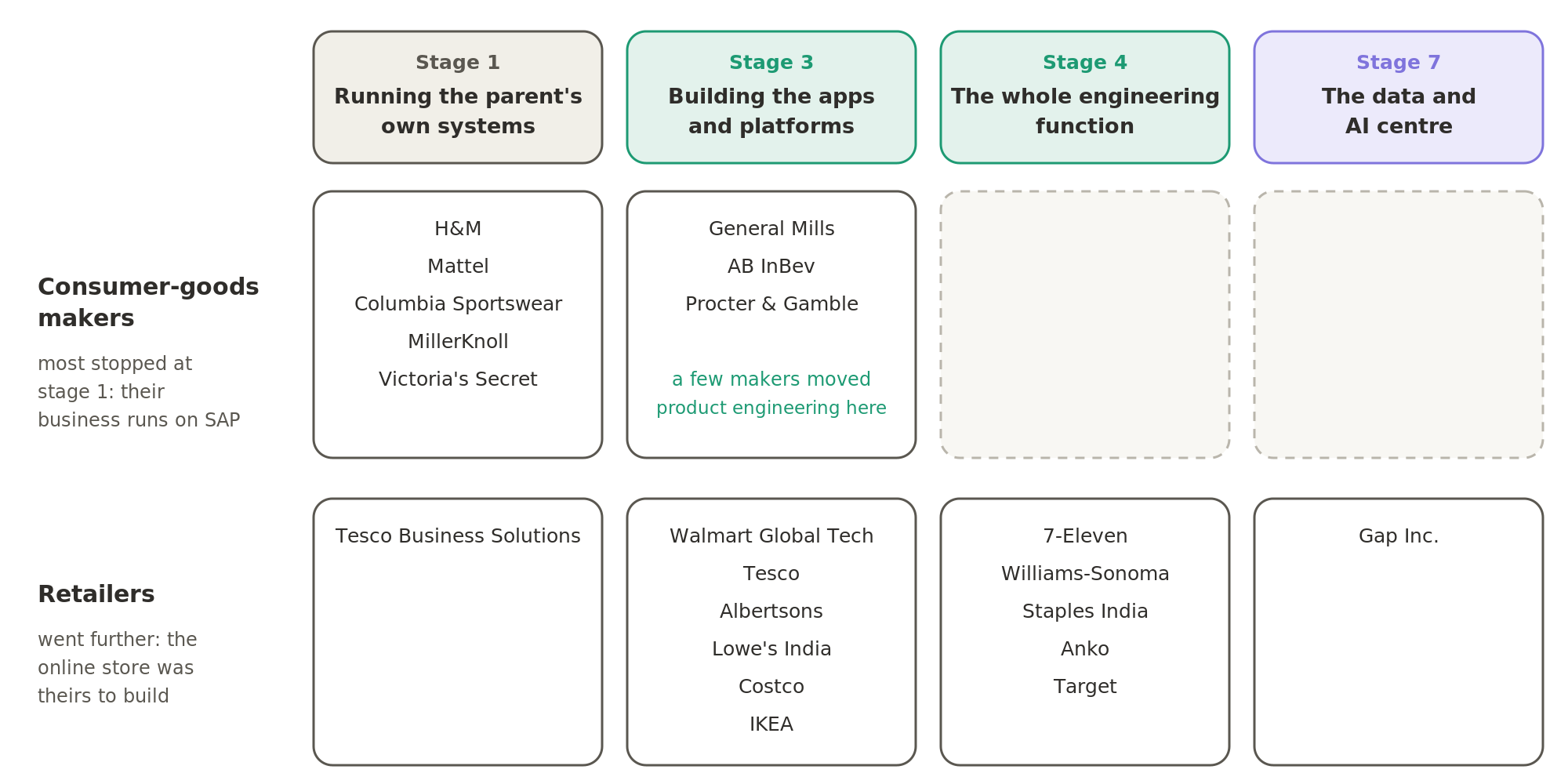 Consumer-goods makers mostly stopped at running the parent's own systems, with a few moving product engineering here. The retailers went further, to building the apps and platforms and the whole engineering function, and Gap Inc. reached the data and AI centre.
Keep reading, free
Seven more sections are on this page: Why the retailers came, Running the parent's own systems, Building the retailer's apps and platforms, The whole engineering function, moved here, The data and AI centre, The names with a desk here, and Where this industry is explained. Sign in to read them here, in full.
Continue with Google
Why the retailers came
The first retail centres in India opened in the mid-2000s. Target's and Tesco's were among the earliest of any industry. They came for the reasons every industry came: cost, and the number of engineers Bengaluru could supply.
What kept them growing was the online store. A retailer's website and app are its own products. It cannot buy them from a vendor and forget them. So building them became the centres' main work: the search, the checkout, the recommendations, and the promise of what can be delivered tomorrow.
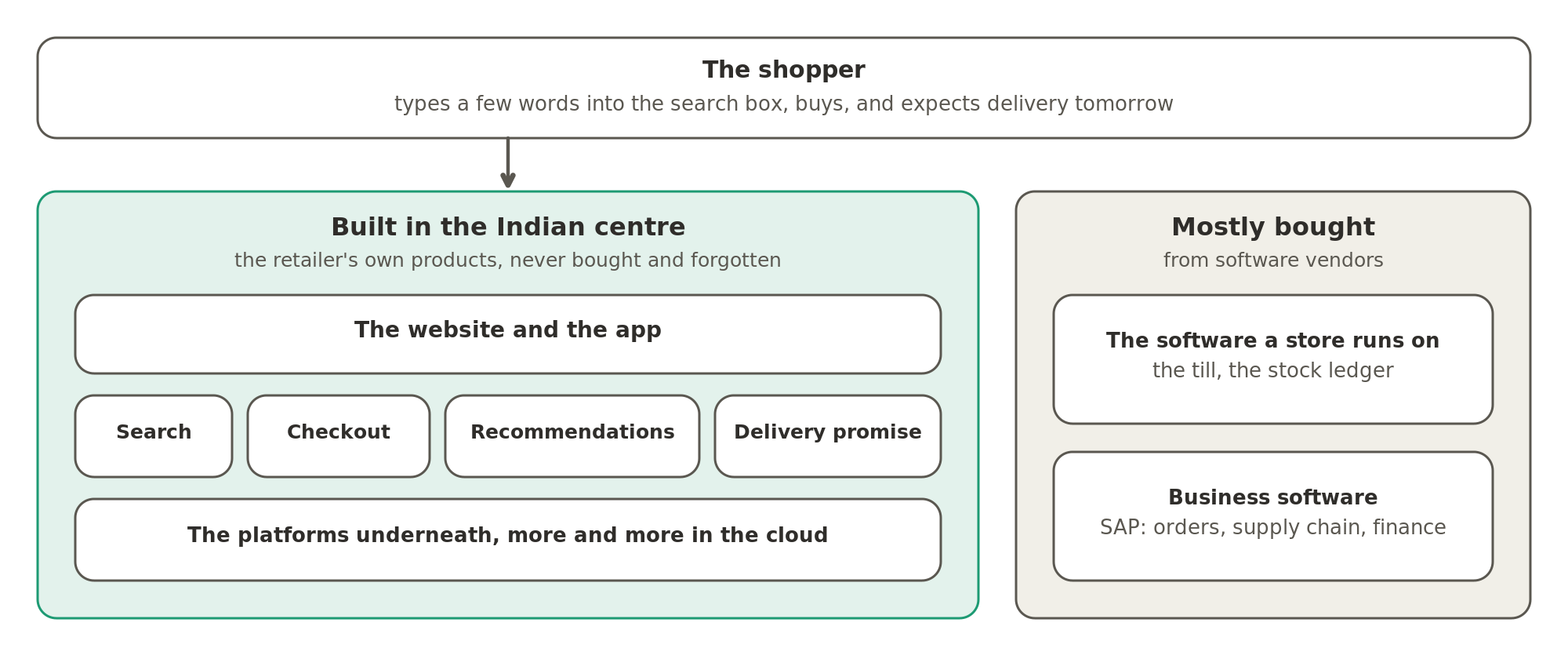 A retailer's website and app, with the search, the checkout, the recommendations and the delivery promise behind them, are its own products, so they are built in the Indian centre. The software a store runs on and the business software are mostly bought.
Walmart is the extreme case. Its Indian centre is one of the largest engineering organisations it has anywhere. Walmart also owns Flipkart, India's large online marketplace, which is a separate company. (More on it in Market Segment 26.1, Online marketplaces, in Industry Vertical 26, E-commerce and D2C brands, in the product-companies collection.)
The companies are:
American and British chainsWalmart, Target, Tesco, Lowe's, Albertsons, Best Buy, Costco, 7-Eleven, Williams-Sonoma and Staples
Swedish chainsIKEA and H&M
Consumer brandsfrom Procter & Gamble and General Mills to Mattel, lululemon and AB InBev
Nearly all of their centres are in Bengaluru, with the rest in Hyderabad, Chennai and Pune.
Running the parent's own systems
Stage 1 of the arc · efficiency phase
Most consumer-goods makers and fashion brands stopped at this stage. Their business is making, moving and selling goods, and it runs on large business software, SAP above all. Their Indian centres set that software up, connect it to other systems and keep it running. The work serves the company's own operations:
order-to-cashthe steps from taking an order to collecting the money
the supply chainhow goods get from the factory to the shop
the finance closeclosing the accounts at the end of each month
This is the parent's IT department, and often a good one. But these companies' products are clothes, toys and furniture, and none of those are decided here.
H&Min Bengaluru, is the largest centre with this mandate.
Mattelin Hyderabad, is the toy maker's systems arm.
Columbia Sportswear
MillerKnollthe furniture group
Fergusonthe plumbing and building-products distributor
Victoria's Secret
Tesco Business Solutionsthe older name of Tesco's Bengaluru operation
You're reading as a guest. Sign in free to follow links for five minutes, once an hour.
Sign in
Building the retailer's apps and platforms
Stage 3 of the arc · capability phase
The retailers reached this stage, and most brands did not. These centres build the online store and the platforms under it. The work is backend, full-stack, mobile and data engineering, like at an e-commerce company, because in effect that is what they are.
Walmart Global Techin Bengaluru and Chennai, is the largest centre in this Parent Industry by a wide margin. It is one of the largest retail engineering organisations in the world.
Tescoin Bengaluru, is the second largest, and one of the oldest.
Albertsonsin Bengaluru, a recent centre for the American grocery chain
Lowe's Indiain Bengaluru, the technology arm of the home-improvement chain
Best Buy India
lululemon
Costcoin Hyderabad
IKEAin Bengaluru
Three consumer-goods makers did move product engineering here:
General Millsin Mumbai
AB InBevin Bengaluru
Procter & Gamblein Hyderabad
The whole engineering function, moved here
Stage 4 of the arc · transformation phase
Five retailers have centres that do every kind of work at once: the business systems and the testing, beside the online-store platforms.
7-Elevenin Bengaluru, is the largest, and a recent one.
Williams-Sonomain Pune, the kitchen and home retailer
Staples Indiain Chennai
Ankoin Bengaluru, the product arm of Kmart Group in Australia
TargetIts Indian centre is one of the oldest and largest retail centres in the country.
The data and AI centre
Stage 7 of the arc · capability phase
This mandate appears for the first time in this collection here, with one centre. It was built for data and AI work, not for the store's apps.
Gap Inc.in Hyderabad. Its work is data engineering and building AI models.
The names with a desk here
These companies are not placed under a mandate here:
Large brandsNike, Mondelēz, Ralph Lauren, Diageo, Levi Strauss and PUMA
Restaurant groupsPapa Johns, with a new centre in Bengaluru, Yum! Brands, Taco Bell and Inspire Brands
OthersFossil, Giant Eagle, Nespresso, Kenvue, Haleon, AutoZone, Woolworths, Herbalife and Mountain Trail Foods
The retail centre that owns the core platforms.
Walmart Global Tech is the clearest case of an Indian centre that builds, and in parts owns, the parent's core platforms. Tesco's and Lowe's centres have moved the same way. The newest centres, 7-Eleven's, Albertsons' and Papa Johns', were built to this model from the start. Gap's Hyderabad centre shows the last stage of the arc arriving in retail. AI models are also taking over questions that retail data teams used to answer: what to stock, where to put it, what to charge, and what to show a shopper who has typed three words into the search box.
Where this industry is explained
Domain VII, E-commerce, travel and logistics, in the product-companies collection, explains what these companies do:
Industry Vertical 26, E-commerce and D2C brandsonline marketplaces, direct-to-consumer (D2C) brands and omnichannel retailers
Industry Vertical 27, Retail techthe software a store runs on
Industry Vertical 28, Foodtech and quick commercethe restaurant groups' industry
Industry Vertical 30, Supply chain and logisticsthe warehouse, the trucks and the last mile
The retailers here buy much of that software. Their Indian centres are where they build what they chose not to buy.
That is the retail GCC: consumer brands that run their business systems from India, and retailers that build their online stores here.