An insurer sells a promise, and then spends decades keeping it. The keeping runs on some of the oldest software in business:
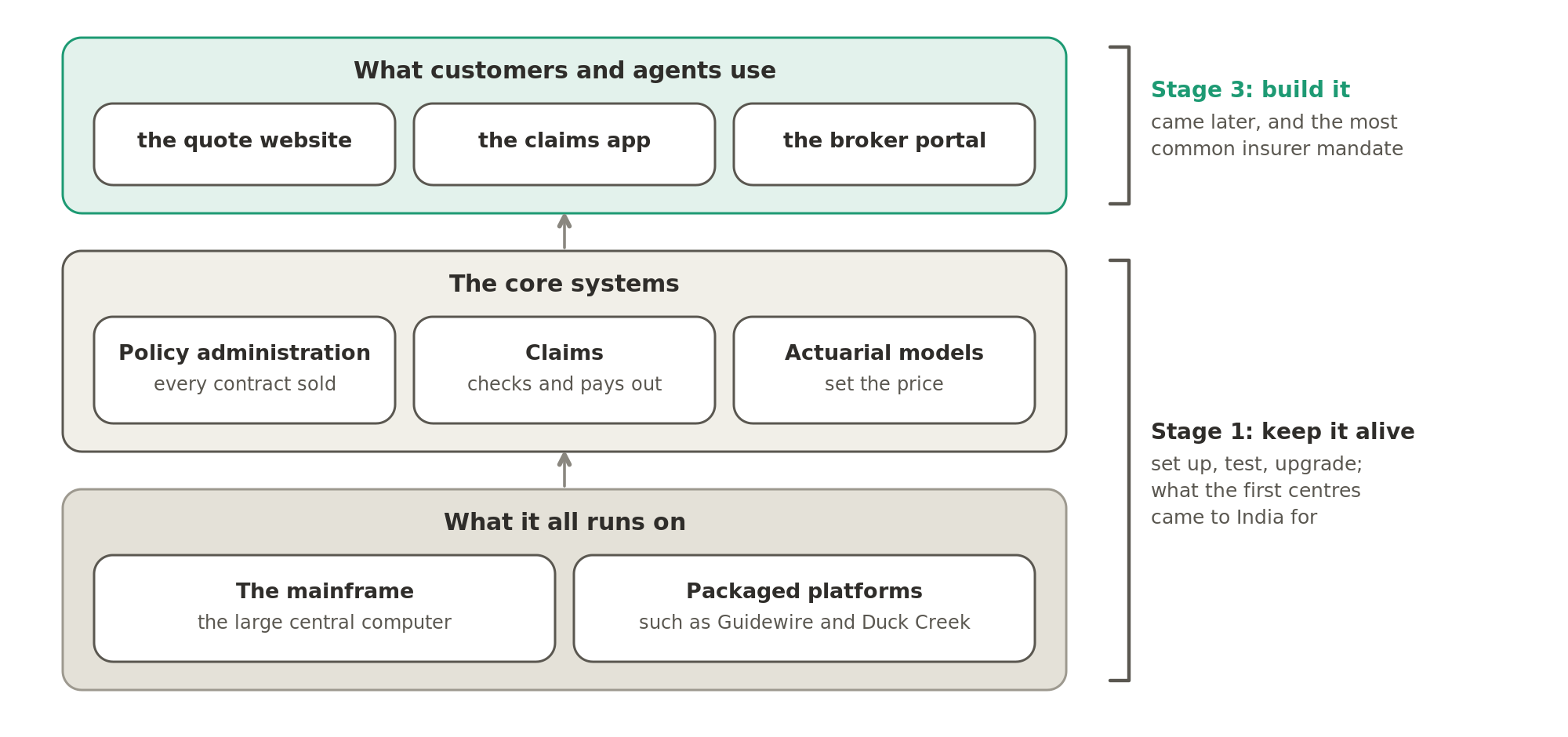
- the policy-administration system, which records every contract the insurer has sold
- the claims system, which checks and pays out claims
- the actuarial models, which work out how likely a loss is and so set the price
That software is what the insurers brought to India. This Parent Industry is about what came, in what order, and how much of each insurer is really here.
Only foreign insurers are covered here. Insurance itself, and the companies that sell software to insurers, are explained in the product-companies collection. "Where this industry is explained", at the end, says where.
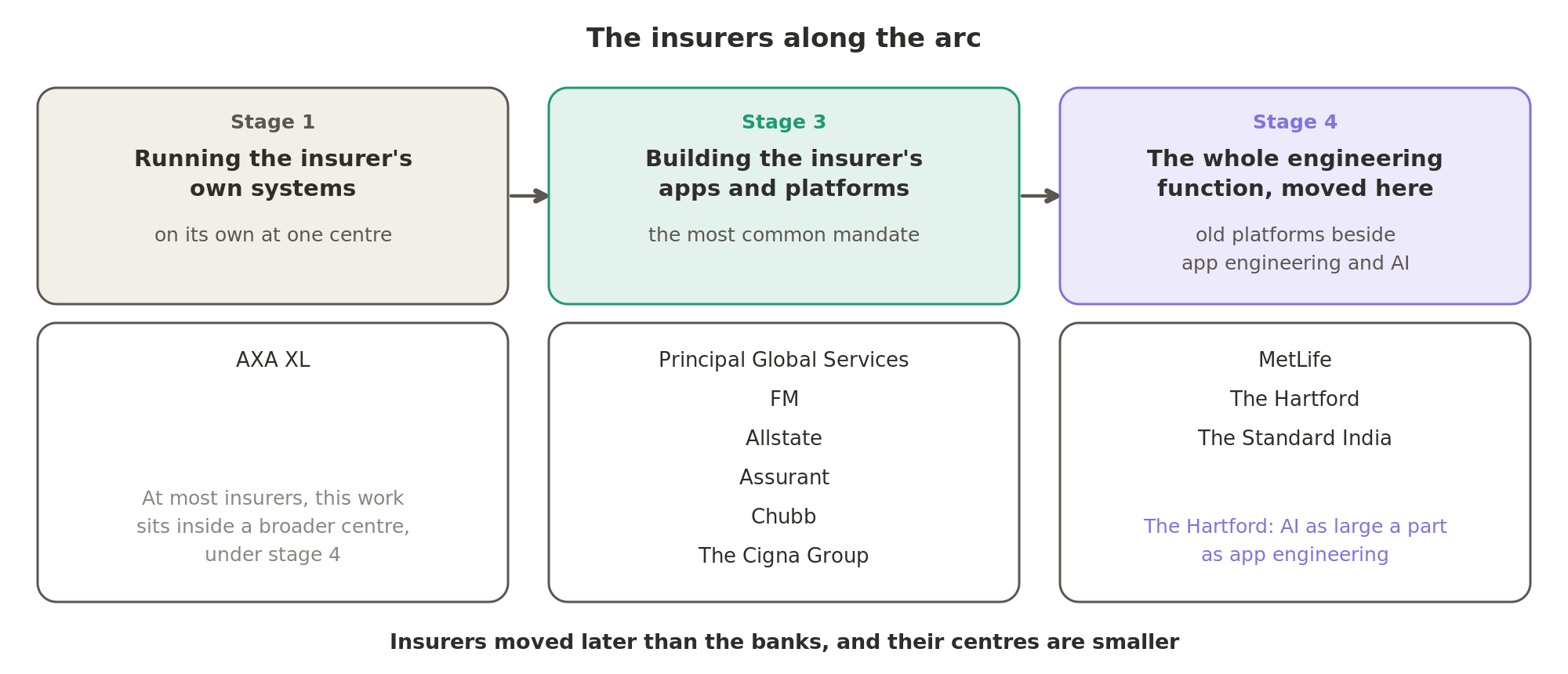
The insurers moved later than the banks, and their centres are smaller. Their GCCs here do three kinds of work:
- Running the insurer's own systems (stage 1)
- Building the insurer's apps and platforms (stage 3)
- The whole engineering function, moved here (stage 4)
Every centre named here has posted software engineering jobs in India. Companies not placed under a mandate are listed at the end, in The names with a desk here.
Keep reading, free
Six more sections are on this page: Why the insurers came, Running the insurer's own systems, Building the insurer's apps and platforms, The whole engineering function, moved here, The names with a desk here, and Where this industry is explained. Sign in to read them here, in full.
Continue with Google- Why the insurers came
- Running the insurer's own systems
- Building the insurer's apps and platforms
- The whole engineering function, moved here
- The names with a desk here
- Where this industry is explained
Cost came first, as in every industry. But insurers had a particular reason too. Their core systems are old, expensive to keep and risky to replace. And India had the people who knew them.
So the first insurance centres kept the old systems alive:
- the mainframe, the large central computer many insurers still run their policies on
- the packaged platforms, ready-made insurance software such as Guidewire and Duck Creek, which the centres set up, tested and upgraded
Owning anything, such as a product the insurer's customers use, came later. At most insurers, it has not come yet.
The insurers are:
Most of their centres are in Hyderabad and Pune, with the newer ones in Bengaluru. There are almost none in Mumbai, where India's own insurers are based.
Only one centre here does this work on its own. At most insurers, it is part of a broader centre, under the whole engineering function below.
These centres build what customers and agents use: the website where you get a quote and buy a policy, the app where you file a claim, and the portal an insurance broker uses. They also build the platforms underneath, and more and more of these are being rebuilt in the cloud. The work looks like a software company's. This is the most common mandate among the insurers.
Three insurers have moved so much work to India that their centres do every kind at once. The packaged-platform work and the testing sit beside app engineering and new AI work.
As at the banks, one building holds the insurer's oldest systems and its newest work. The name on the door does not say which a job belongs to.
These insurers and brokers are not placed under a mandate here:
Industry Vertical 21, Insurtech, in the product-companies collection, explains each part of insurance:
The insurers here buy these systems from the companies in Industry Vertical 21. To a large degree, their Indian centres are where those systems are set up and kept running.
That is the insurance GCC: centres that keep old systems alive, build the apps customers use, and at a few insurers are starting to build around AI.
Who these centres hire, role by role, is on the collection's role pages for Java backend and full-stack engineers, cloud and DevOps engineers, data engineers, test engineers, frontend and mobile engineers, .NET engineers, GenAI engineers and the other roles.