When a trader in New York places an order on JPMorganChase's trading system, parts of that system were built in Bengaluru or Hyderabad. The bank built them itself, in its own engineering centre in India: its GCC.
A bank does not make software. It makes loans, moves money and trades. But a large bank now runs on more code than most software companies. For twenty years, the world's banks have been moving the writing of that code to India. This Parent Industry is about what came, in what order, and how much of each bank is really here.
Only foreign banks are covered here. India's own banks build their own technology. (More on them in Market Segment 18.4, Banks and NBFCs, in Industry Vertical 18, Lending and credit, in the product-companies collection.) Banking itself, and the companies that sell software to banks, are explained in the product-companies collection. "Where this industry is explained", at the end, says where.
The bank GCCs here do four kinds of work, and one centre fits none of them yet:
- Running the bank's own systems (stage 1)
- Building the bank's apps and platforms (stage 3)
- The whole engineering function, moved here (stage 4)
- Products across many lines (stage 6)
- No single mandate yet
Every centre named here has posted software engineering jobs in India. Companies not placed under a mandate are listed at the end, in The names with a desk here.
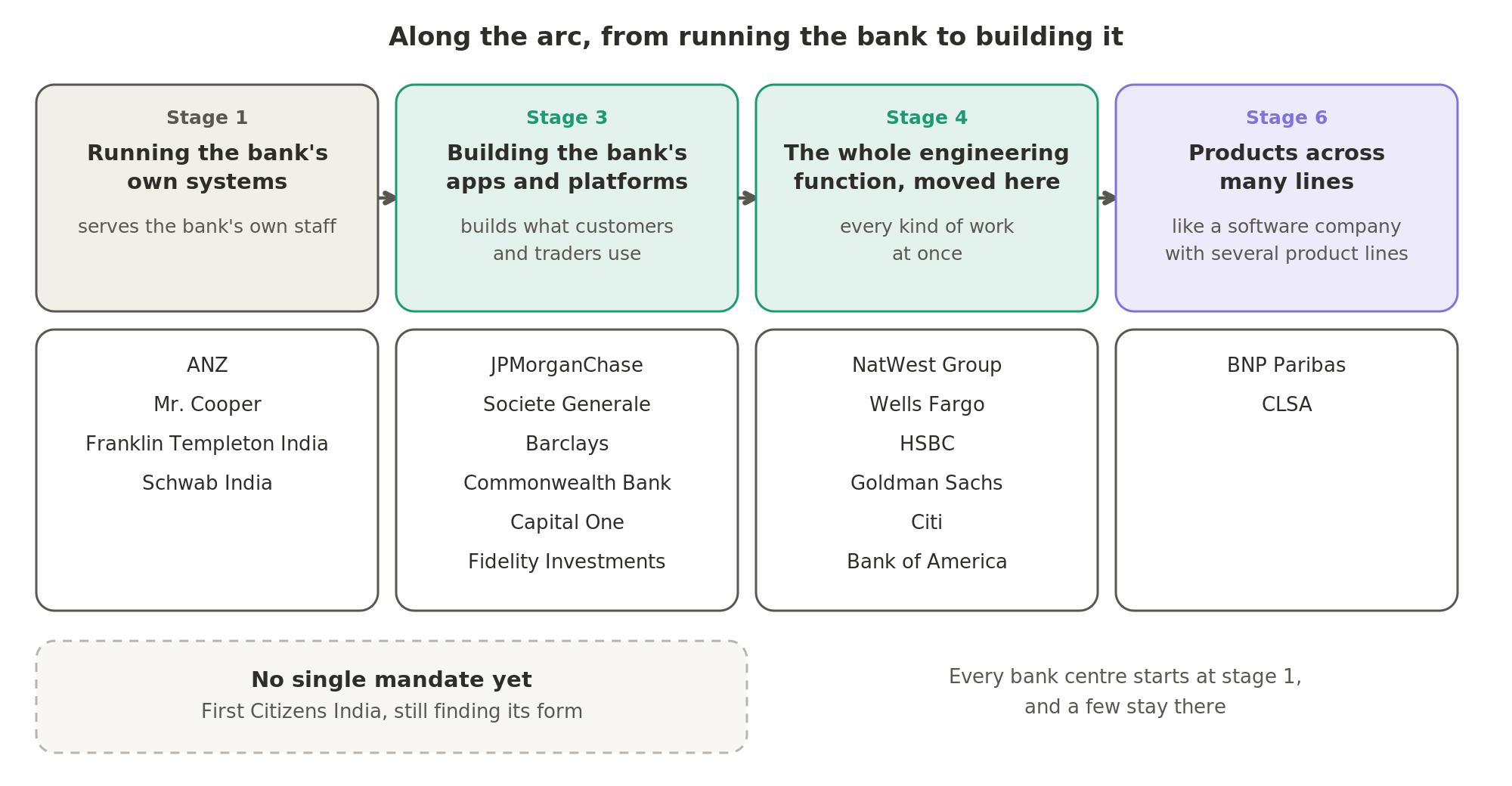 The bank centres sit at different points along the arc: running the bank's own systems, building its apps and platforms, holding its whole engineering function, and building products across many lines. First Citizens India has no single mandate yet, and every bank centre starts at the first stage.
Keep reading, free
Eight more sections are on this page: Why the banks came, Running the bank's own systems, Building the bank's apps and platforms, The whole engineering function, moved here, Products across many lines, No single mandate yet, The names with a desk here, and Where this industry is explained. Sign in to read them here, in full.
Continue with Google
Why the banks came
Four things brought the banks to India, roughly in this order:
CostIn 2003, an engineer in Pune cost a fraction of one in London. Cost explains why the first centres opened, but not why they grew.
ScaleBanks found they could hire thousands of engineers a year in one Indian city. No other country offered that.
Trust earnedA centre that had proved it could run the bank's nightly payments processing could then be trusted with the bank's trading platform.
SkillsLast came the centre as the place where the bank builds what it has never built before, because the people who can build it are here.
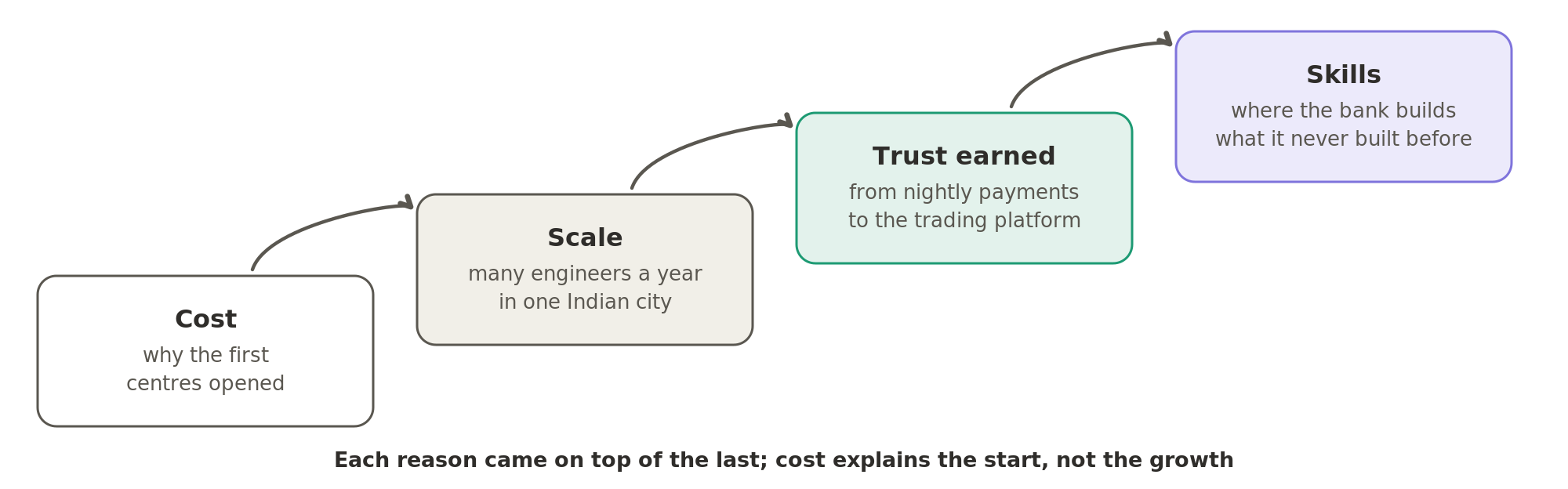 The reasons came one on top of another: cost opened the first centres, scale let them grow, trust earned on the nightly payments brought the trading platform, and skills made India the place where the bank builds what it has never built before.
The banks are the world's big financial institutions:
American banksJPMorganChase, Wells Fargo, Bank of America, Citi, Goldman Sachs and Morgan Stanley
British banksBarclays, NatWest Group, HSBC and Standard Chartered
European banksSociete Generale, BNP Paribas, Deutsche Bank and UBS
Australian banksCommonwealth Bank, NAB and ANZ
Asset managers, custodians and card companiesFidelity, State Street, Franklin Templeton, Northern Trust and American Express. An asset manager invests other people's money. A custodian holds investments safely for their owners.
Nearly all of their centres are in Bengaluru, Pune, Hyderabad, Chennai and Mumbai.
Running the bank's own systems
Stage 1 of the arc · efficiency phase
This is the oldest work a bank sends to India: its back office. The back office is the work customers never see. It runs on business software such as SAP for finance and operations, Salesforce for customer records and ServiceNow for IT requests. It includes the general ledger, the bank's master record of its accounts. And it produces the reports the regulator asks for. The centre keeps all of this running, and slowly modernises it.
Every bank centre starts here, and a few stay. A centre doing only this work is the bank's IT department, moved to India. The systems are large and the work is real. But it serves the bank's own staff, not its customers.
ANZin Bengaluru
Mr. Cooperin Chennai. It is a US mortgage servicer, a company that collects home-loan payments on behalf of lenders. It is not a bank.
Franklin Templeton Indiain Hyderabad
Schwab India
You're reading as a guest. Sign in free to follow links for five minutes, once an hour.
Sign in
Building the bank's apps and platforms
Stage 3 of the arc · capability phase
Most of the large centres have reached this stage. They build what the bank's customers and traders use: the mobile app, the payments platform, the trading system and the cloud they run on. The work is backend, full-stack and platform engineering, as at a software company. At this stage, the bank stops using India just to keep systems running. It starts building there.
JPMorganChasein Bengaluru, Hyderabad and Mumbai, is the largest centre in this Parent Industry by a wide margin. It is one of the largest engineering organisations the bank has anywhere.
Societe Generalein Bengaluru, is the size of a mid-sized software company.
Barclaysin Pune, is also the size of a mid-sized software company.
Commonwealth Bankin Bengaluru, is the newest of the large centres. It was built in the last few years and is already among the biggest.
Fidelity Investmentsin Bengaluru and Chennai
U.S. Bankin Chennai
Capital Onein Bengaluru, also recent
Synchronyin Hyderabad. It issues store credit cards, the cards a shop offers under its own name.
Emirates NBD
Jefferiesin Pune
NAB
The whole engineering function, moved here
Stage 4 of the arc · transformation phase
At some banks, the Indian centre does every kind of work at once: platform engineering, internal systems, testing and new AI work, side by side. The bank moved its whole engineering function here, not one kind of work. These centres look most like the bank itself, in miniature.
NatWest Groupin Bengaluru, Chennai and Delhi NCR, and Wells Fargo, in Bengaluru and Hyderabad, are the two largest.
American Expressin Bengaluru, Chennai and Delhi NCR
Morgan Stanleyin Bengaluru and Mumbai
Bank of Americain Chennai, Hyderabad and Mumbai
Standard Charteredthrough its services company in Bengaluru
HSBCin Pune, Hyderabad and Bengaluru. Its Pune centre is the oldest of the bank GCCs here.
Citiin Pune and Chennai
State Streetin Hyderabad
Goldman Sachsin Bengaluru, where its office is one of the largest the firm has outside New York
Fidelity Internationala separate company from Fidelity Investments
UBS and Deutsche Bankboth in Pune
Macquarie
Franklin Templeton
Northern Trust
Nationwidea US insurer and financial-services company, with a centre in Hyderabad
This is where the reputation gap is widest: the gap between how famous the parent's name is and the kind of work a centre actually does. The same building holds the bank's trading technology and the bank's help desk. The name on the door does not say which floor a job is on.
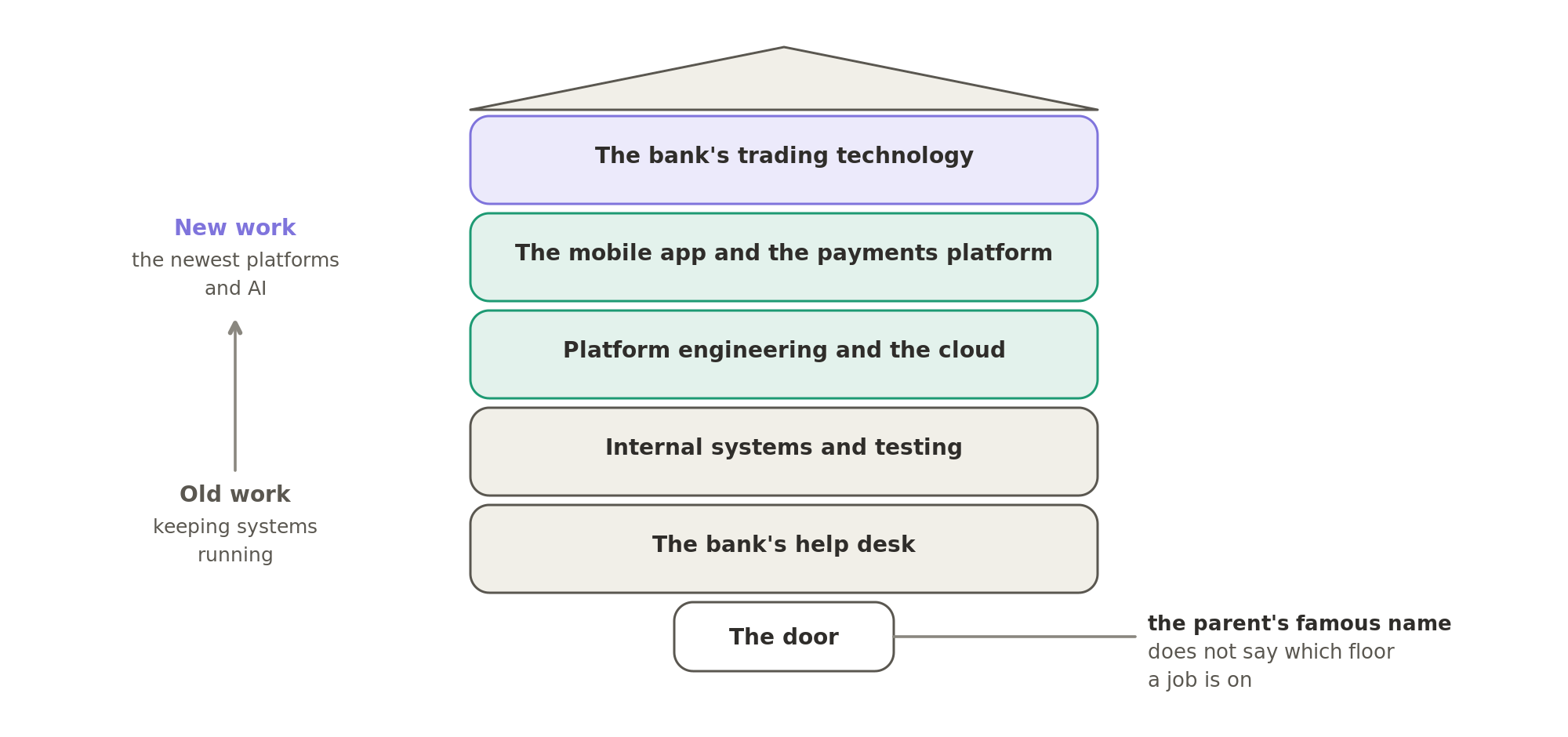 One bank centre can hold the trading technology, the mobile app, the platforms, the internal systems and the help desk under one roof. The famous name on the door does not say which floor a job is on.
Products across many lines
Stage 6 of the arc · global hub phase
One bank centre can hold the trading technology, the mobile app, the platforms, the internal systems and the help desk under one roof. The famous name on the door does not say which floor a job is on.
Products across many lines
Stage 6 of the arc · global hub phase
Two centres work like a software company with several product lines. Each builds platforms, and software for particular kinds of banking, for more than one of the parent's businesses.
BNP Paribasthrough BNP Paribas India Solutions in Mumbai, Bengaluru and Chennai, serves the bank's corporate, retail and securities businesses at once.
CLSAin Pune, does the same for the broker's research and trading businesses.
No single mandate yet
One centre does a mix of work that fits none of the mandates above: part internal platforms, part testing, part applications.
First Citizens Indiain Bengaluru. The parent bank bought Silicon Valley Bank, and gained a technology organisation with it. The Indian centre is still finding its form.
The names with a desk here
These institutions are not placed under a mandate here:
MUFG, The World Bank, Blackstone, OSBIndia, Bankwest, Cantor Fitzgerald, KKR, Voya India, Mashreq, Sberbank India and True Beacon.
The bank centre that owns its work.
At some banks, the Indian centre no longer just builds what headquarters decided. It owns platforms outright. Goldman Sachs' Bengaluru office and JPMorganChase's centres are the clearest cases. Commonwealth Bank and Capital One built their new centres this way from the start. The largest banks are also building AI centres in India. So India is both where much of the routine work was, and where the software that automates it is now built.
Where this industry is explained
Domain V, Fintech, in the product-companies collection, explains each part of banking:
Industry Vertical 17, Paymentsthe payment networks and processors
Industry Vertical 18, Lending and creditlending
Industry Vertical 19, Banking and regtechthe core banking systems, and the software that stops financial crime
Industry Vertical 20, Wealthtech and capital marketstrading and custody
Industry Vertical 21, Insurtechinsurance
The banks here buy from those companies. More and more, they also build the same things themselves, in their Indian centres.
That is the bank GCC: back offices that became app builders, and at some banks the whole engineering function, now run from India.