When someone in the United States opens a streaming app from Warner Bros. Discovery, parts of that app may have been built in Bengaluru or Hyderabad, by the studio's own engineering centres in India.
A media company makes things people watch, read and listen to. Until recently, it delivered them through someone else's channel: the cable operator, the cinema, the newsstand or the record shop. Streaming changed that. Now a studio's film arrives through the studio's own app, a newspaper through its own website, and a song through a platform the record label deals with. The app, the website and the platform are software. A media company has to build them itself, or lose its customers to someone who did.
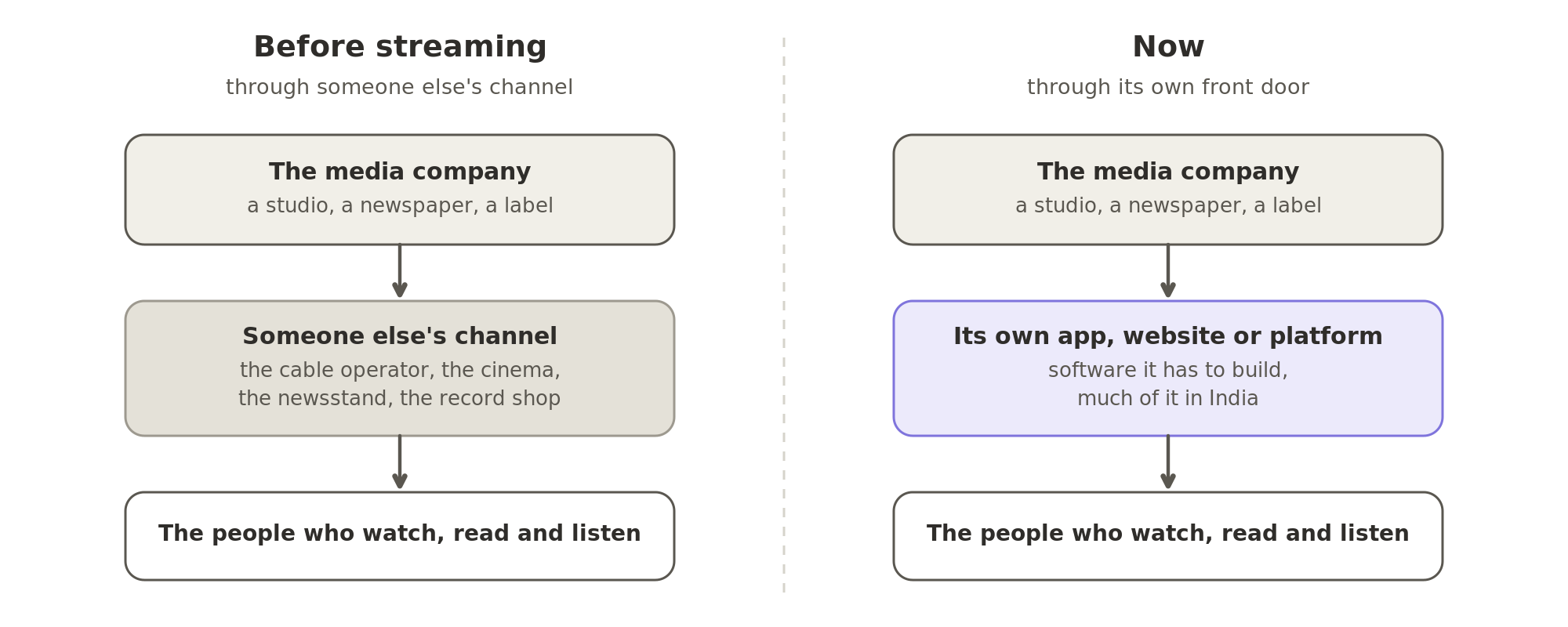 Before streaming, a studio, a newspaper or a label reached people through someone else's channel: the cable operator, the cinema, the newsstand or the record shop. Now it reaches them through its own app, website or platform, software it has to build, and the Indian centres here build much of it.
The Indian centres here exist because of that change. Nearly all of them build the same thing: the front door through which the parent's content now reaches people.
Only foreign companies are covered here. The media industry itself, from the studio to the advertising that pays for it, is explained in the product-companies collection. "Where this industry is explained", at the end, says where.
Most of the work here is at one stage: building apps and platforms. The GCCs here do four kinds of work:
- Testing what was built elsewhere (stage 2)
- Building the group's apps and platforms (stage 3)
- The whole engineering function, moved here (stage 4)
- Products across many lines (stage 6)
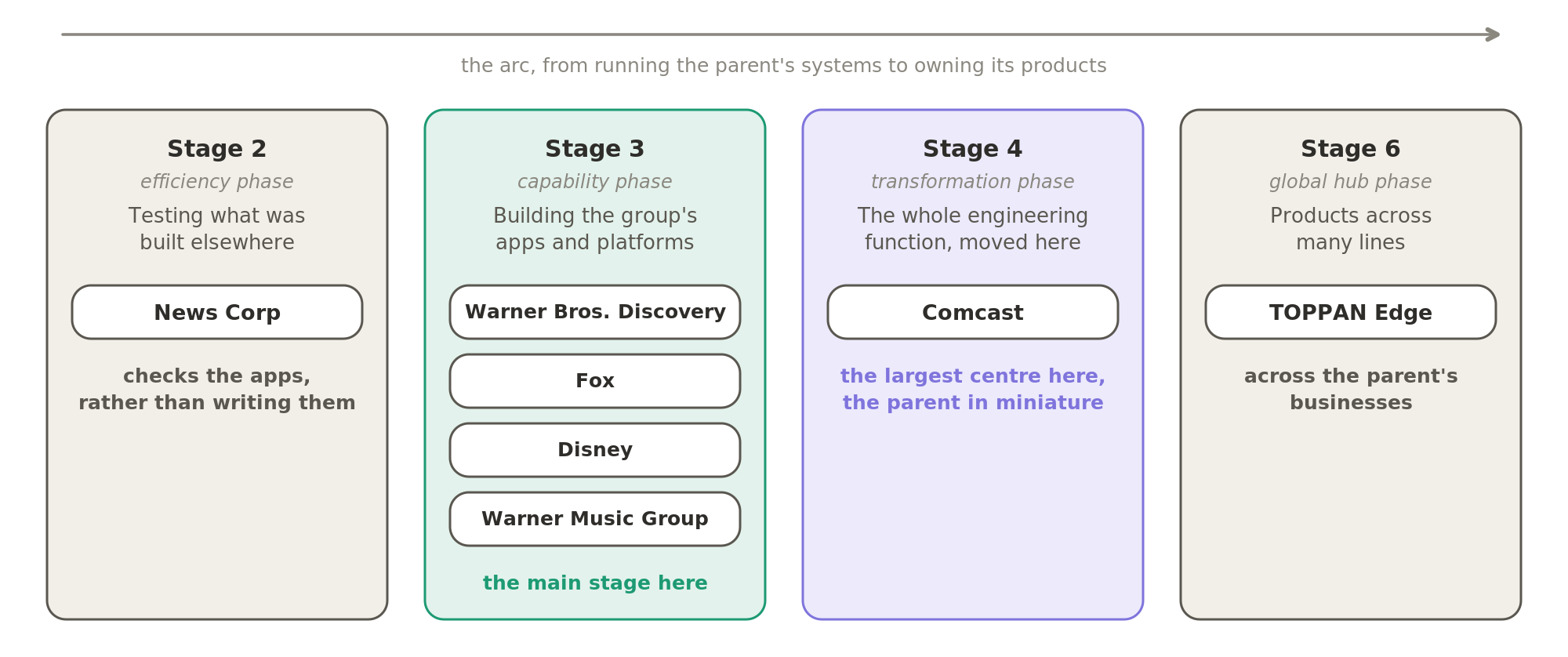 The stages present here, with each centre placed in its stage. Most of the work is at stage 3, building apps and platforms, while Comcast's Chennai centre, the largest here, holds the whole engineering function.
Every centre named here has posted software engineering jobs in India. Companies not placed under a mandate are listed at the end, in The names with a desk here.
Keep reading, free
Seven more sections are on this page: Why the media groups came, Testing what was built elsewhere, Building the group's apps and platforms, The whole engineering function, moved here, Products across many lines, The names with a desk here, and Where this industry is explained. Sign in to read them here, in full.
Continue with Google
Why the media groups came
The studios came for the streaming app, and the scale it needs. A studio that sells a subscription has to run a service as big as a technology company's:
- the video pipeline, which prepares and delivers video to millions of screens
- the apps on every kind of device
- the recommendations, what to show each viewer next
- the data about what people watch
None of the studios had enough of those engineers at home. India did. Many were trained at streaming companies and IT services firms that had built this for others first.
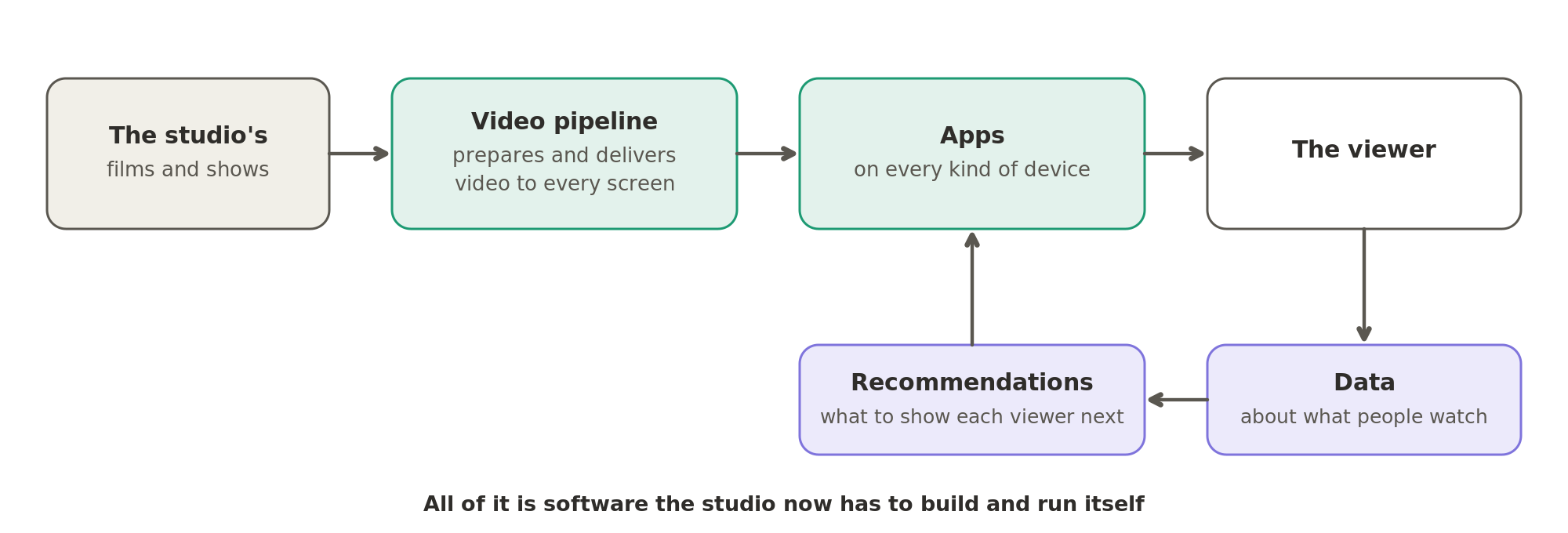 A streaming service runs the studio's films and shows through a video pipeline to apps on every kind of device. Data about what people watch feeds the recommendations of what to show each viewer next, and all of it is software the studio now has to build and run itself.
The cable and broadcast groups came earlier, to run the systems of a large business, and to test them.
The publishers came last, and in the smallest numbers, for their websites and the data behind the news.
The companies are:
American studios and TV networksWarner Bros. Discovery, Comcast, Disney, Fox and News Corp
Music and publishing housesWarner Music Group, Condé Nast and Dow Jones
A Japanese printer with a technology armTOPPAN
Nearly all of their centres are in Bengaluru. The one large exception is in Chennai.
Testing what was built elsewhere
Stage 2 of the arc · efficiency phase
One centre does this work on its own.
News Corpin Bengaluru. Its team checks the group's apps and websites, rather than writing them.
You're reading as a guest. Sign in free to follow links for five minutes, once an hour.
Sign in
Building the group's apps and platforms
Stage 3 of the arc · capability phase
This is the main stage in this Parent Industry. These centres build the streaming service, the app and the data behind them, as a technology company would.
Warner Bros. Discoveryin Bengaluru and Hyderabad, has the largest centres with this mandate. They build the streaming service's platform infrastructure, its applications, its data systems and its mobile apps.
Foxin Bengaluru, is the second. It is the TV network's technology arm. A large part of its work is testing and mobile apps, beside the backend. That fits a live-video business, whose app has to work on every device on the night of a big match.
Disneywith a team in Bengaluru. Disney's Indian entertainment business has merged into JioStar, which is covered in the product-companies collection. (More on it in Market Segment 32.1, OTT and live streaming platforms, in Industry Vertical 32, Streaming and broadcast, in the product-companies collection.)
Warner Music Groupin Bengaluru, is the one record label here. Its work centres on data: streams, royalties, the catalogue of songs, and the analytics a label now runs on.
The whole engineering function, moved here
Stage 4 of the arc · transformation phase
One centre does every kind of work at once, and it is the largest in this Parent Industry. As everywhere, one building holds the parent's oldest systems and its newest work, and the name on the door does not say which floor a job is on.
Comcastin Chennai, is one of the older media GCCs in India. It works like the parent in miniature: app engineering for the cable and streaming products, the business systems of a very large company, and the testing of both, under one roof.
Products across many lines
Stage 6 of the arc · global hub phase
One centre works like a software company with several product lines.
TOPPAN Edgethe technology arm of the Japanese printing and security-document group. Its Indian work spans more than one of the parent's businesses.
The names with a desk here
These companies are not placed under a mandate here:
SonySony Research India, the group's small AI research lab in Bengaluru, and Sony Pictures Networks, now called Culver Max
DISH Network Technologiesthe technology arm of the American satellite-TV group, with a large centre in Bengaluru
Condé Nast and Technology Labtwo names for the same publisher's engineering in Bengaluru
FOX Techanother unit of Fox, above
PublishersDow Jones, TMB, the former Reader's Digest, and Friday Media Group
OthersInforma Markets, TEGNA, MNC Group, an Indonesian broadcaster, and Sihamco, a restaurant and events business
The studio's own technology company.
Comcast's Chennai centre, the oldest and broadest here, and Warner Bros. Discovery's centres, built for the streaming service, are the clearest cases of media groups engineering their own front door from India. AI is taking over jobs that people used to do: choosing what to show a viewer next, describing a title, cutting a trailer, and subtitling a show for forty countries. That work lands in the data engineering at Warner Bros. Discovery's and Warner Music Group's centres. The routine work AI reaches first is testing, which is most of News Corp's centre and a large part of Fox's. The counter-current: the biggest media engineering in India is not in these GCCs, but in the streaming companies of the product-companies collection, and in JioStar.
Where this industry is explained
Domain VIII, Gaming, streaming and media, in the product-companies collection, explains what these companies do:
Industry Vertical 31, Gaming
Industry Vertical 32, Streaming and broadcastthe streaming service, the pipes behind it, the studio's tools and the broadcasters' equipment
Industry Vertical 33, News, publishing and social mediathe newsroom and the publisher's tools
Industry Vertical 34, Adtechhow all of it is paid for
The groups here buy tools from those companies, and compete with the streaming companies. Their Indian centres are where they build the front door they chose not to rent.
That is the media GCC: studios, networks and publishers building their own apps and streaming services in India.