ingrid.fyi India's software hiring trends, explained.
Sign in to ingrid.fyi with Google
Your Google account
name@gmail.com
Continue with Google
Home / Product companies / IX · Semiconductors and devices / Semiconductors and chip design / Memory chips and storage drives
On this page
Memory chips and storage drives Remembering, the RAM and the storage in every device A phone is sold as "8 GB RAM, 128 GB storage". The two numbers are two kinds of memory chip. The RAM is where the phone keeps what it is working on right now. The storage keeps photos and apps when the phone is switched off.

Three ways to store data
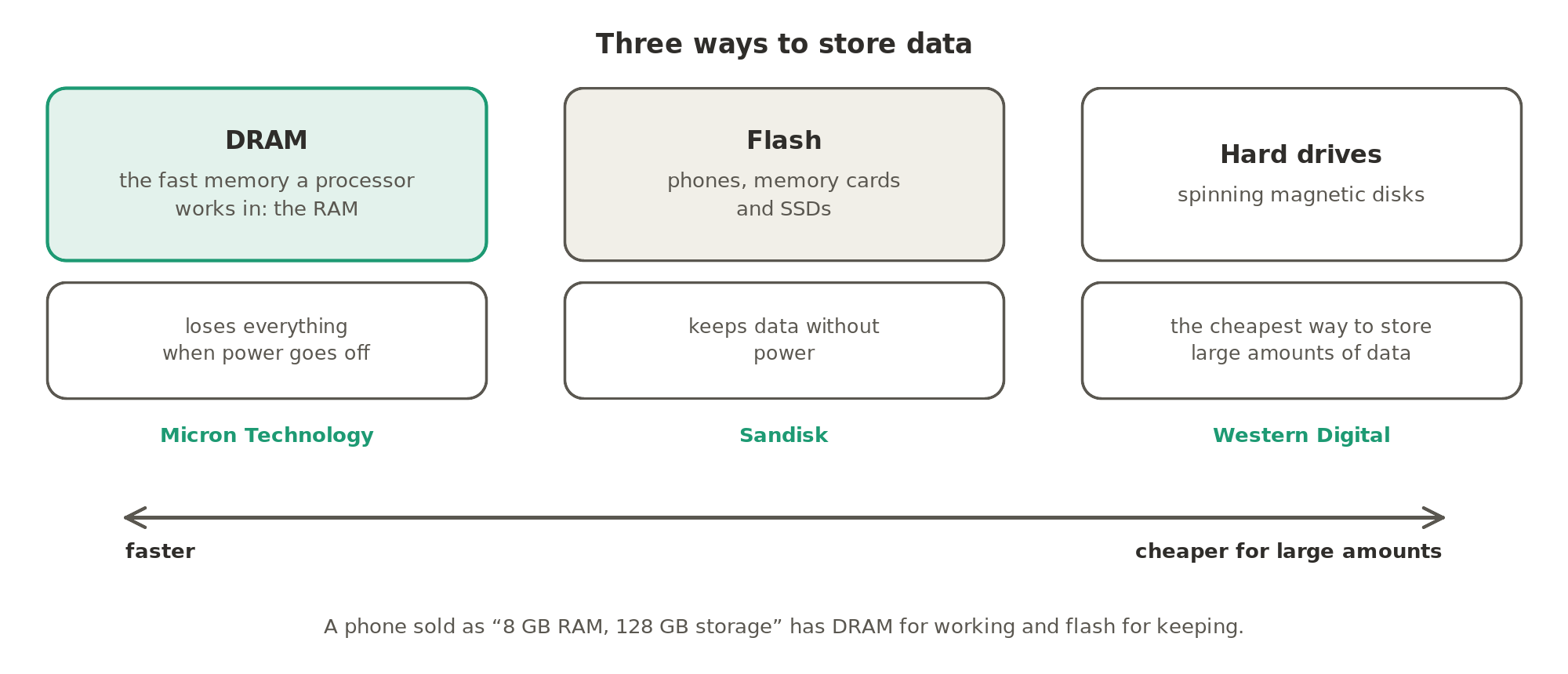
DRAMDRAM is the fast memory a processor works in, the RAM in a phone or laptop. It loses everything when the power goes off. FlashFlash memory keeps data without power. It is slower than DRAM, but much faster than a hard drive. It is used in phones, memory cards and solid-state drives, or SSDs. Hard drivesHard drives store data on spinning magnetic disks. They are the cheapest way to store large amounts of data, and still hold most of the world's data in cloud data centres. Three ways to store data: DRAM, the fast working memory that loses everything when the power goes off (Micron Technology); flash, which keeps data without power, in phones, memory cards and SSDs (Sandisk); and hard drives, the cheapest way to store large amounts of data (Western Digital).Three ways to store data: DRAM, the fast working memory that loses everything when the power goes off (Micron Technology); flash, which keeps data without power, in phones, memory cards and SSDs (Sandisk); and hard drives, the cheapest way to store large amounts of data (Western Digital).

Where software comes in. A flash chip wears out if the same cells are written too often. So every SSD has a controller chip and firmware. They spread the writing evenly across the cells, find and fix errors, and keep track of where each piece of data is. Designing those controllers and that firmware is software-heavy work.
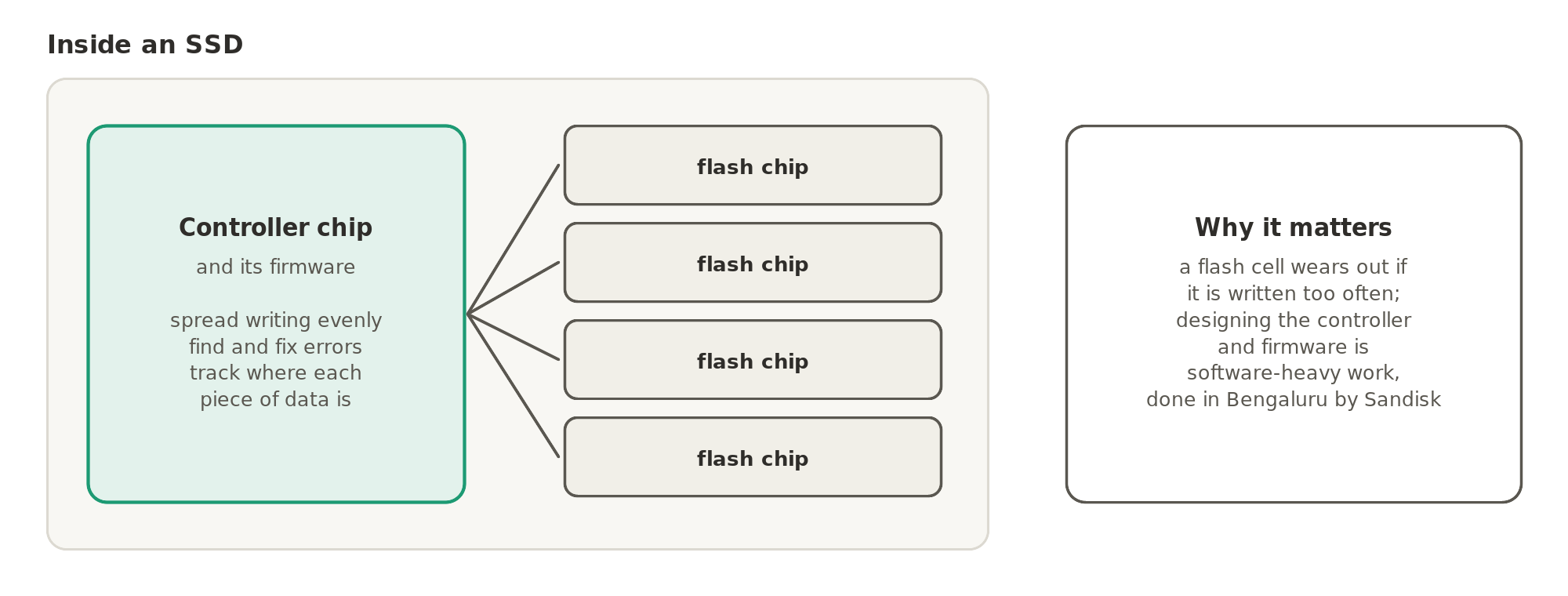
Inside an SSD, a controller chip and its firmware spread the writing evenly across the flash chips, find and fix errors and track where each piece of data is, because a flash cell wears out if it is written too often.Inside an SSD, a controller chip and its firmware spread the writing evenly across the flash chips, find and fix errors and track where each piece of data is, because a flash cell wears out if it is written too often.

How the business works. Memory chips from different makers are much alike, so buyers choose mainly on price. Prices rise and fall sharply as supply and demand change, and makers go through good and bad years in turn. The industry calls this the memory cycle. A memory factory costs tens of billions of dollars, so only a few companies make memory. Only three make DRAM.

Why AI made memory a bottleneck. An AI model is limited as much by how fast data reaches the processor as by the processor itself. High-bandwidth memory, or HBM, answers this. It stacks DRAM chips in layers right beside the processor, joined by thousands of connections.
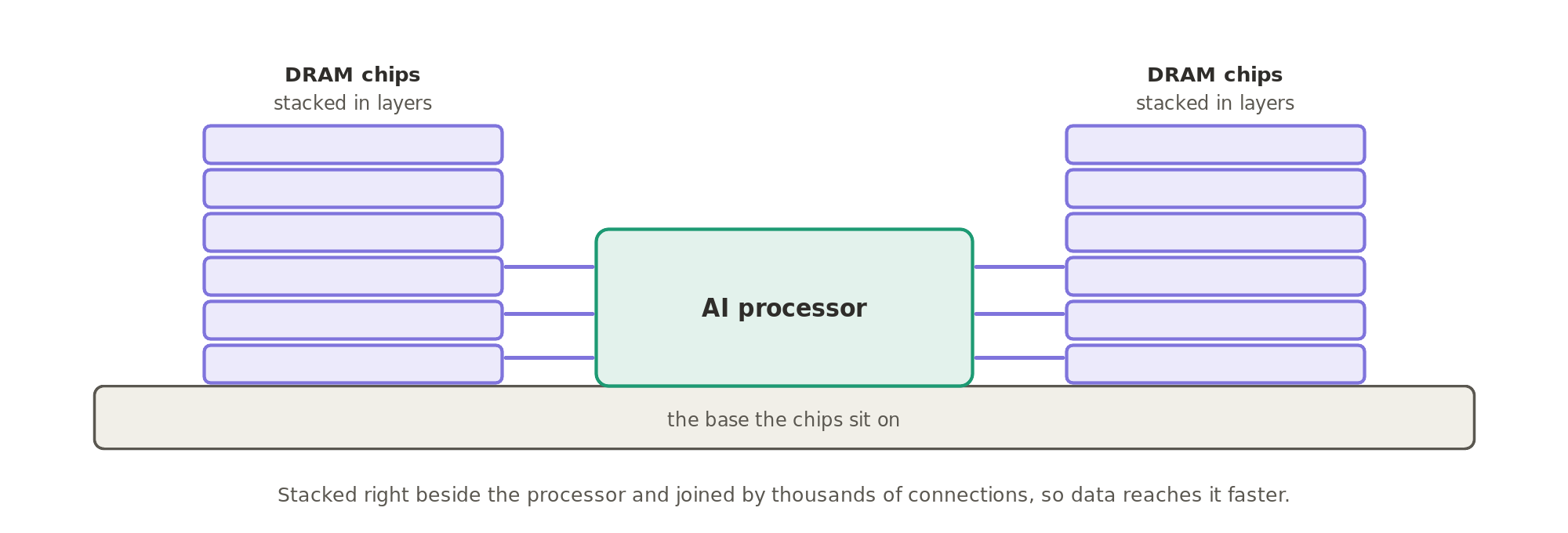
High-bandwidth memory stacks DRAM chips in layers right beside the AI processor, joined by thousands of connections, so that data reaches the processor faster.High-bandwidth memory stacks DRAM chips in layers right beside the AI processor, joined by thousands of connections, so that data reaches the processor faster.

Where India fits. Three of the companies here design in India. One of them is building India's first large plant for chip assembly and testing. Assembly and testing turns chips made elsewhere into finished, packaged chips, and checks each one. (More on how chips are made in Market Segment 35.8, Chip manufacturing and test equipment.)

Storage systems, the equipment that holds a company's data, are covered elsewhere. (More on them in Market Segment 7.2, Enterprise storage and backup, in Industry Vertical 7, Database and storage companies.)

Every company named here has posted software engineering jobs in India. Famous companies that don't actively hire software engineers in India are left out.

Keep reading, free

One more section is on this page: Memory chips, flash and hard drives. Sign in to read it here, in full.

Continue with Google
  • Memory chips, flash and hard drives
Memory chips, flash and hard drives Sandiskwith engineers in Bengaluru, makes flash memory: the chips in memory cards, phones and SSDs. It was separated from Western Digital in 2025. Its Bengaluru centre designs the controllers and firmware that manage the flash. Sandisk has the most job postings in this Market Segment. Micron Technologywith engineers in Hyderabad and Bengaluru, is one of the three makers of DRAM. It makes the high-bandwidth memory stacked beside AI processors. It is building India's first large chip assembly and test plant, at Sanand in Gujarat. Western Digitalwith engineers in Bengaluru, makes hard drives. The memory wall.

AI processors can compute far faster than memory can feed them. The industry calls this gap the memory wall. High-bandwidth memory has become one of the most sought-after products in the chip industry. The memory makers design it for each new AI chip. The plant in Gujarat is India's first step towards making memory chips itself.

That is the memory business: DRAM for working, flash for keeping, and hard drives for storing the most for the least. A few companies make it, and three of them design in India.
Who they hire

Who these companies hire, and for what, is on What semiconductor and chip design companies hire for.

Privacy Terms Refunds and cancellation Shipping and delivery © 2026 ingrid.fyi · Payments by Razorpay
You're browsing as a guest. Sign in free to follow links for five minutes, once an hour.