ingrid.fyi India's software hiring trends, explained.
Sign in to ingrid.fyi with Google
Your Google account
name@gmail.com
Continue with Google
Home / Product companies / VI · Healthtech and life sciences / Hospitals, diagnostics and medical devices / Medical imaging and radiology AI
On this page
Medical imaging and radiology AI Reading the scan, through the machine that takes it and the AI that reads it Picture a district hospital in Bihar. A farmer with a cough that has lasted a month has a chest X-ray. The hospital has an X-ray machine, but no radiologist, the doctor trained to read such images. Within a minute, AI software reads the X-ray and flags a likely case of tuberculosis. A doctor sees the flag, and orders the test that confirms it the same day.

Medicine sees inside the body through images:

  • the CT scan, a 3D X-ray
  • the MRI scan, which uses magnets instead of X-rays
  • the X-ray
  • the ultrasound
  • the pathology slide, a thin slice of tissue looked at under a microscope

Every image must be read by a specialist: a radiologist for scans, a pathologist for slides. There are too few of both almost everywhere, and in India the shortage is acute. That is one reason India has become a centre for building the scanners' software, and the AI that reads their images. This Market Segment covers both. The buyers are hospitals, clinics, diagnostic centres and public health programmes.

Every company named here has posted software engineering jobs in India. Famous companies that don't actively hire software engineers in India are left out.
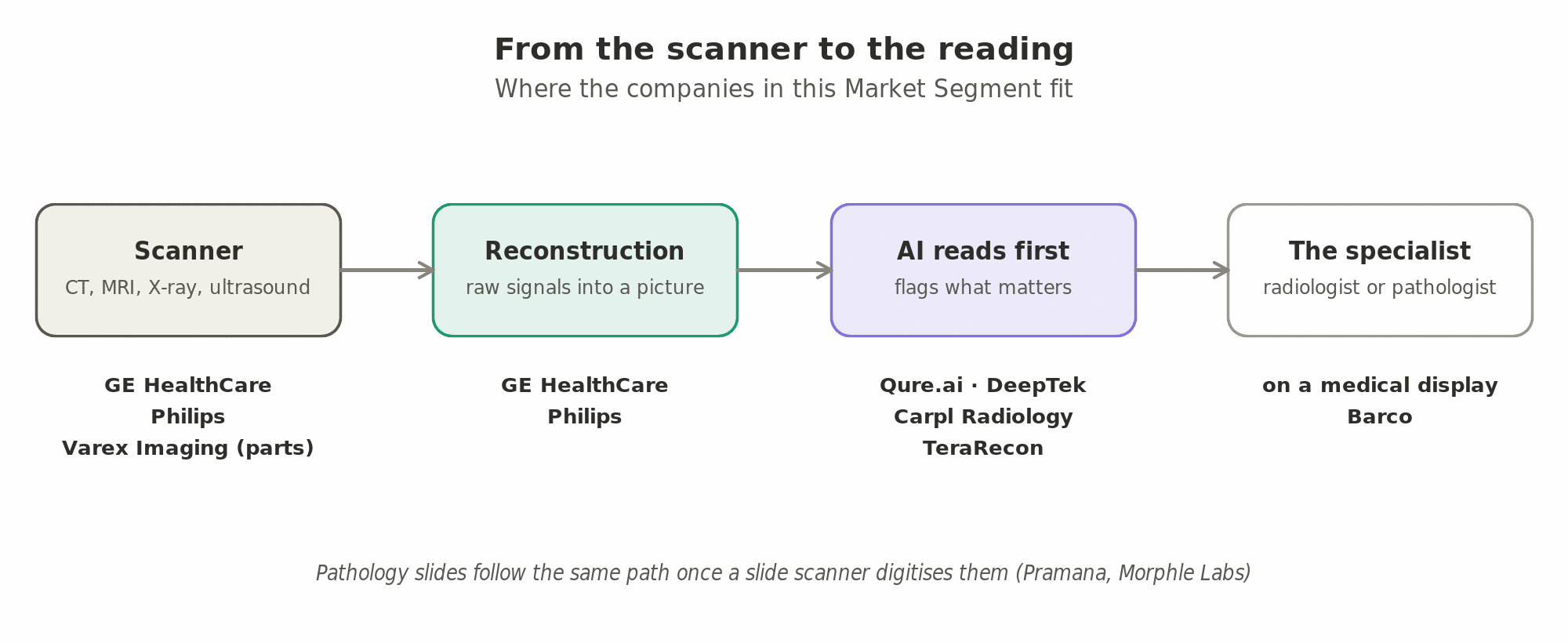
From the scanner to the reading: the scanner takes the image (GE HealthCare, Philips, with parts from Varex Imaging), software reconstructs raw signals into a picture, AI reads it first and flags what matters (Qure.ai, DeepTek, Carpl Radiology, TeraRecon), and the specialist reads it on a medical display (Barco); pathology slides follow once scanned (Pramana, Morphle Labs).From the scanner to the reading: the scanner takes the image (GE HealthCare, Philips, with parts from Varex Imaging), software reconstructs raw signals into a picture, AI reads it first and flags what matters (Qure.ai, DeepTek, Carpl Radiology, TeraRecon), and the specialist reads it on a medical display (Barco); pathology slides follow once scanned (Pramana, Morphle Labs).

This Market Segment has two sub-segments:

The scanners: the machines and the displays that make the image. The image read by a model: the software that helps the specialist read it.

Keep reading, free

Two more sections are on this page: The scanners and The image read by a model. Sign in to read them here, in full.

Continue with Google
  • The scanners
  • The image read by a model
The scanners CT, MRI, X-ray and ultrasound systems, imaging components, diagnostic displays

Back to the X-ray machine in Bihar from the start of this Market Segment. If it is a GE HealthCare or Philips machine, much of its software was written in Bengaluru.

GE HealthCarewith engineers in Bengaluru, has the most job postings in this Market Segment, and in Industry Vertical 24. It makes CT and MRI scanners, X-ray and ultrasound machines, and patient monitors. Its Bengaluru campus, the John F. Welch Technology Centre, is among its largest engineering sites anywhere. There it builds the software inside its machines, the image reconstruction that turns raw signals into a picture, and the AI. Philipswith engineers in Bengaluru, makes the other large range of scanners, ultrasound machines and monitors. It has a large innovation campus of its own in Bengaluru. Varex Imagingwith engineers in Pune, makes parts that go inside other companies' machines: X-ray tubes, and flat-panel detectors that capture the image. (For its detectors, it also appears in Market Segment 35.4, Analog, power and microcontroller chipmakers, in Industry Vertical 35, Semiconductors and chip design.)

Two companies covered mainly in other Market Segments bring the pieces around the scanner:

Barcowith engineers in Delhi, is here for the medical-grade displays on which radiologists read images. (More on it in Market Segment 36.3, Enterprise devices and professional AV equipment, in Industry Vertical 36, Electronics and devices.) ZEISS Indiawith engineers in Bengaluru, brings precision optics. (More on it in Market Segment 37.11, Machine vision and quality inspection, in Industry Vertical 37, Manufacturing tech.)
The image read by a model AI for radiology, AI platforms and viewers, advanced visualisation, digital pathology, retinal imaging

Back to the farmer's X-ray from the start of this Market Segment, and the AI that read it.

Qure.aiwith engineers in Bengaluru, is India's best-known company for AI that reads medical images. Its models read chest X-rays and CT scans for tuberculosis, lung nodules and strokes, in dozens of countries. They are used in screening programmes where there is no radiologist. DeepTekwith engineers in Pune, sells AI and a reading workflow to radiology practices. Carpl Radiologywith engineers in Delhi, sells a platform through which a hospital runs AI from many different companies in one image viewer. TeraReconwith engineers in Bengaluru, sells advanced 3D visualisation, which turns scans into 3D models, and an AI platform, to radiologists.

Two companies make pathology digital. Digital pathology means scanning a glass slide into a high-resolution image, so pathologists and AI models can read it on a screen.

Pramana and Morphle Labsboth with engineers in Bengaluru, build the scanners that digitise pathology slides.

One company works on the eye:

Remidiowith engineers in Bengaluru, makes a portable eye camera. Its built-in AI screens for diabetic eye disease, which damages the back of the eye, right where the patient is.

One company covered mainly in another Market Segment belongs here too:

Clariowith engineers in Bengaluru, is here for reading scans in clinical trials. (More on it in Market Segment 25.3, Clinical trial software, in Industry Vertical 25, Pharma and life sciences.) The scan read before the radiologist sees it.

AI for imaging has more approved products than any other area of medical AI. In countries without enough radiologists, it reads first and sorts the cases, which is called triage. So the urgent case is seen first, and the normal one is reported quickly. India's imaging AI companies built this for the shortage at home, and now sell it abroad.
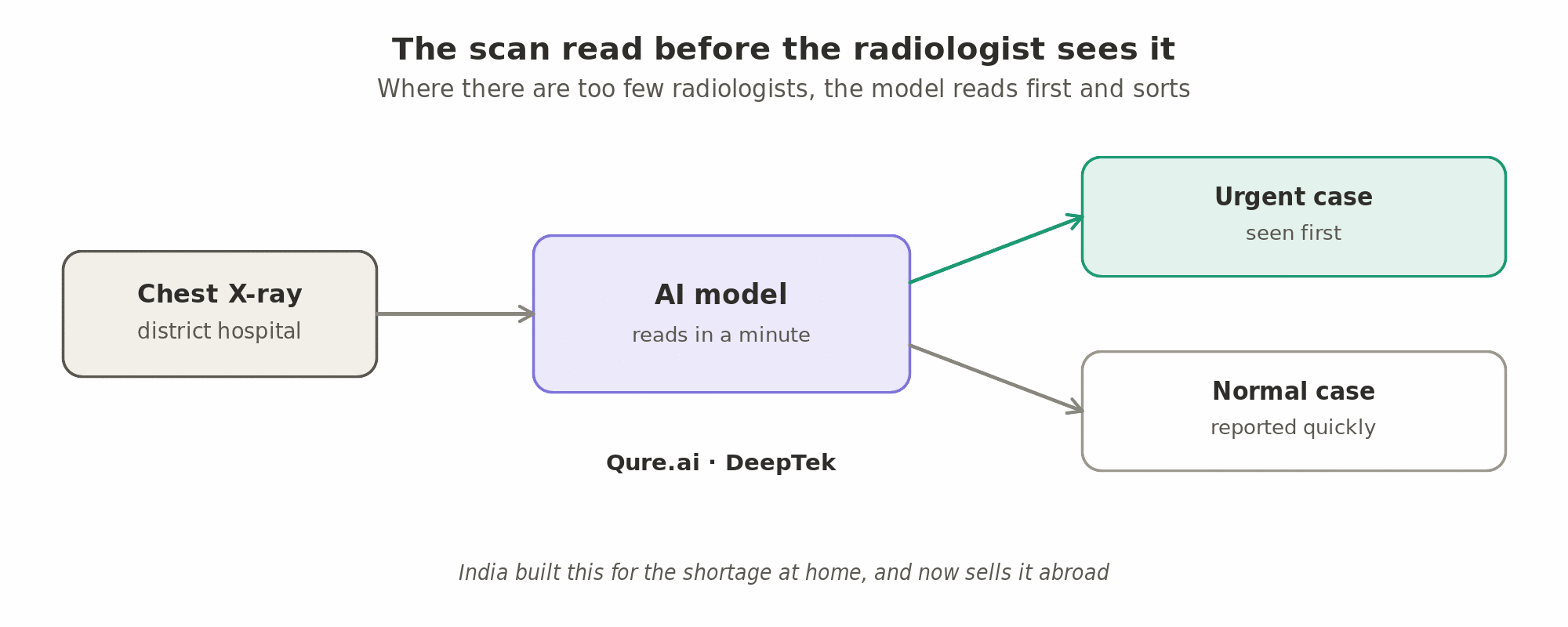
The scan read before the radiologist sees it: in a district hospital with no radiologist, an AI model reads the chest X-ray in a minute and sorts it, so the urgent case is seen first and the normal one is reported quickly (Qure.ai, DeepTek).The scan read before the radiologist sees it: in a district hospital with no radiologist, an AI model reads the chest X-ray in a minute and sorts it, so the urgent case is seen first and the normal one is reported quickly (Qure.ai, DeepTek). So the farmer's X-ray from the start of this Market Segment may well have been taken on a machine whose software was written in Bengaluru. And it was read first by an AI model, in a hospital with no radiologist.
Who they hire

Who these companies hire, and for what, is on What hospital, diagnostics and medical device companies hire for.

Privacy Terms Refunds and cancellation Shipping and delivery © 2026 ingrid.fyi · Payments by Razorpay
You're browsing as a guest. Sign in free to follow links for five minutes, once an hour.