ingrid.fyi India's software hiring trends, explained.
Sign in to ingrid.fyi with Google
Your Google account
name@gmail.com
Continue with Google
Home / Product companies / VIII · Gaming, streaming and media / Streaming and broadcast / VFX studios and media production technology
On this page
VFX studios and media production technology Making the picture and the sound, in the studio and the effects house Think of the flood that sweeps through a city in a film, the dragon in a fantasy series, or a stadium crowd that was never filmed. All of these are made on computers. Many of the artists who make them for Hollywood films work in Mumbai, Bengaluru, Hyderabad and Chennai. India has become one of the world's largest places where visual effects are made.

How a film or series is made

Pre-production: the script, the planning and the casting of actors. Production: the shooting. Post-production: everything after the shoot. The film is edited and visual effects are added. The colour of each shot is adjusted and the sound is mixed. Then the final version is prepared for cinemas, TVs and phones. That last step is called mastering.

Visual effects. Visual effects, or VFX, are images made or changed on a computer. Some are simulations: software works out how water, fire or smoke would really move. Some are digital creatures, built and animated by artists. Filmed shots and computer-made layers are then combined into one picture. A large film can need thousands of artists. So each studio builds its own pipeline: software that passes each shot from artist to artist, tracks every version, and lets directors review the work.
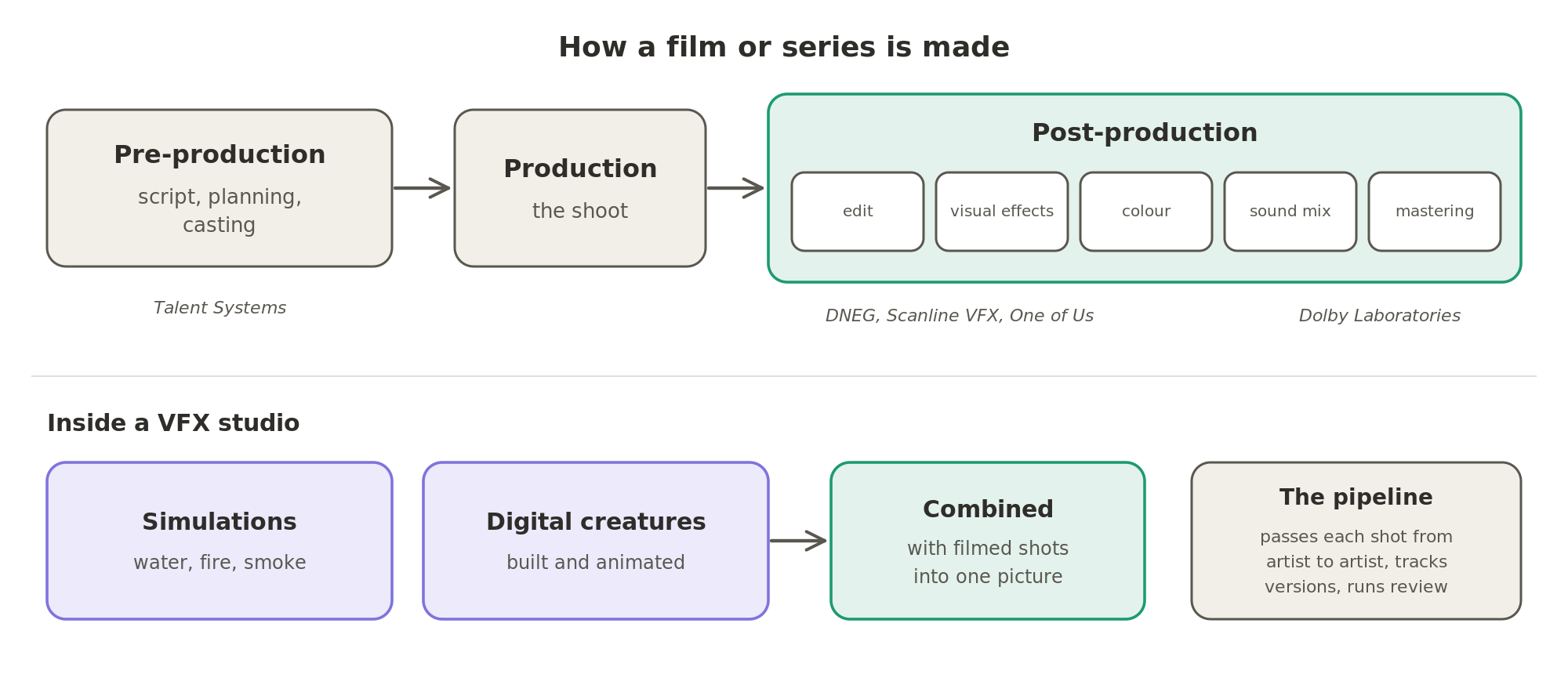
A film or series moves from pre-production to the shoot to post-production, where it is edited, given visual effects, colour and sound, and mastered; inside a VFX studio, simulations and digital creatures are combined with filmed shots through the studio's pipeline.A film or series moves from pre-production to the shoot to post-production, where it is edited, given visual effects, colour and sound, and mastered; inside a VFX studio, simulations and digital creatures are combined with filmed shots through the studio's pipeline.

How VFX studios earn. Film studios and streaming services hire VFX studios, usually for a fixed price per film or series. The work is competitive and earns little on each job. So it tends to move where it costs less, which is one reason so much of it is done in India.

Virtual production. Actors can now be filmed in front of huge LED screens that show a computer-made background. Game engines draw the background in real time, and it moves as the camera moves. (More on game engines in Market Segment 31.1, Game development studios, in Industry Vertical 31, Gaming.)
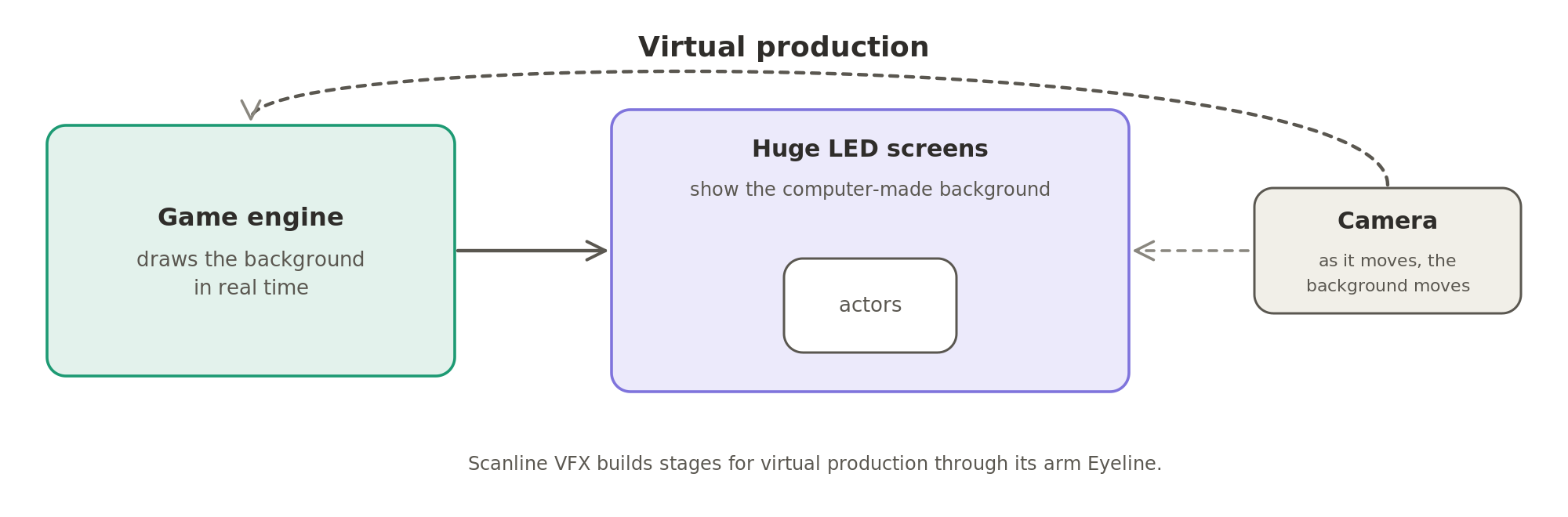
In virtual production, a game engine draws the background on huge LED screens behind the actors, and the background moves as the camera moves.In virtual production, a game engine draws the background on huge LED screens behind the actors, and the background moves as the camera moves.

Formats for sound and picture. Some companies own the formats in which films are heard and seen, such as surround sound, and pictures with brighter highlights and deeper shadows. They license their technology to the makers of cinema equipment, TVs and phones, and earn a fee for each device.

Dubbing. Many Indian films are released in several languages at once. A dubbed film has always looked dubbed, because the actors' lips do not match the new words.

Every company named here has posted software engineering jobs in India. Famous companies that don't actively hire software engineers in India are left out.

Keep reading, free

One more section is on this page: Formats, visual effects, dubbing and casting. Sign in to read it here, in full.

Continue with Google
  • Formats, visual effects, dubbing and casting
Formats, visual effects, dubbing and casting

Sound and picture formats

Dolby Laboratorieswith engineers in Bengaluru, makes Dolby Atmos and Dolby Vision, the sound and picture formats used in cinemas, TVs and phones. Dolby Atmos makes sound seem to come from all around, and from above. Dolby also makes the codecs and tools with which films are mastered in these formats. A codec is the software that compresses and decompresses sound or video.

Visual-effects studios

Scanline VFXnow part of Netflix, with engineers in Hyderabad, makes visual effects for films and series. It has its own simulation software for water and fire. Its arm Eyeline builds stages for virtual production. DNEGwith engineers in Bengaluru, is one of the world's largest visual-effects studios. Most of its artists work in India. It builds its own pipeline and review software. One of Uswith engineers in Bengaluru, makes high-end effects and digital creatures.

Dubbing with AI

NeuralGaragewith engineers in Bengaluru, makes VisualDub. It changes an actor's lip movements to match a dubbed language, so that a film dubbed into Tamil or Spanish looks as though it was shot in that language.

Casting

Talent Systemswith engineers in Hyderabad, runs casting platforms, through which productions find actors and audition them.

One company here makes the shows themselves instead

Giramillewith engineers in Bengaluru, makes films, shows and songs for children. (More on it in Market Segment 32.1, OTT and live streaming platforms.) The dub that moves the lips.

A film dubbed into another language has always looked dubbed. AI models now change the actor's mouth to match the new words. More and more, they also copy the actor's own voice to speak them. Indian films are often released in five languages at once. For India, this changes how far a film can travel.

That is the business of making the picture and the sound: visual-effects studios, the formats films are heard and seen in, and new AI tools for dubbing. India has become one of the world's largest places where visual effects are made.
Who they hire

Who these companies hire, and for what, is on What streaming and broadcast companies hire for.

Privacy Terms Refunds and cancellation Shipping and delivery © 2026 ingrid.fyi · Payments by Razorpay
You're browsing as a guest. Sign in free to follow links for five minutes, once an hour.