ingrid.fyi India's software hiring trends, explained.
Sign in to ingrid.fyi with Google
Your Google account
name@gmail.com
Continue with Google
Home / Product companies / V · Fintech / Wealthtech and capital markets / Hedge funds and high-frequency trading
On this page
Hedge funds and high-frequency trading Firms that trade with their own money, and make the trade their product Go back to the ten shares that the engineer in Pune bought in Market Segment 20.1, Exchanges, clearing and trading platforms. Who sold them to her? Quite possibly not a person at all. It may have been a trading firm's computer, which offers to buy and sell those shares all day long, and earns a tiny amount on each trade.

Most of the finance world handles other people's money, for a fee. The companies in this Market Segment are different. They trade to make money directly, and the trade is their product. They come in two kinds:
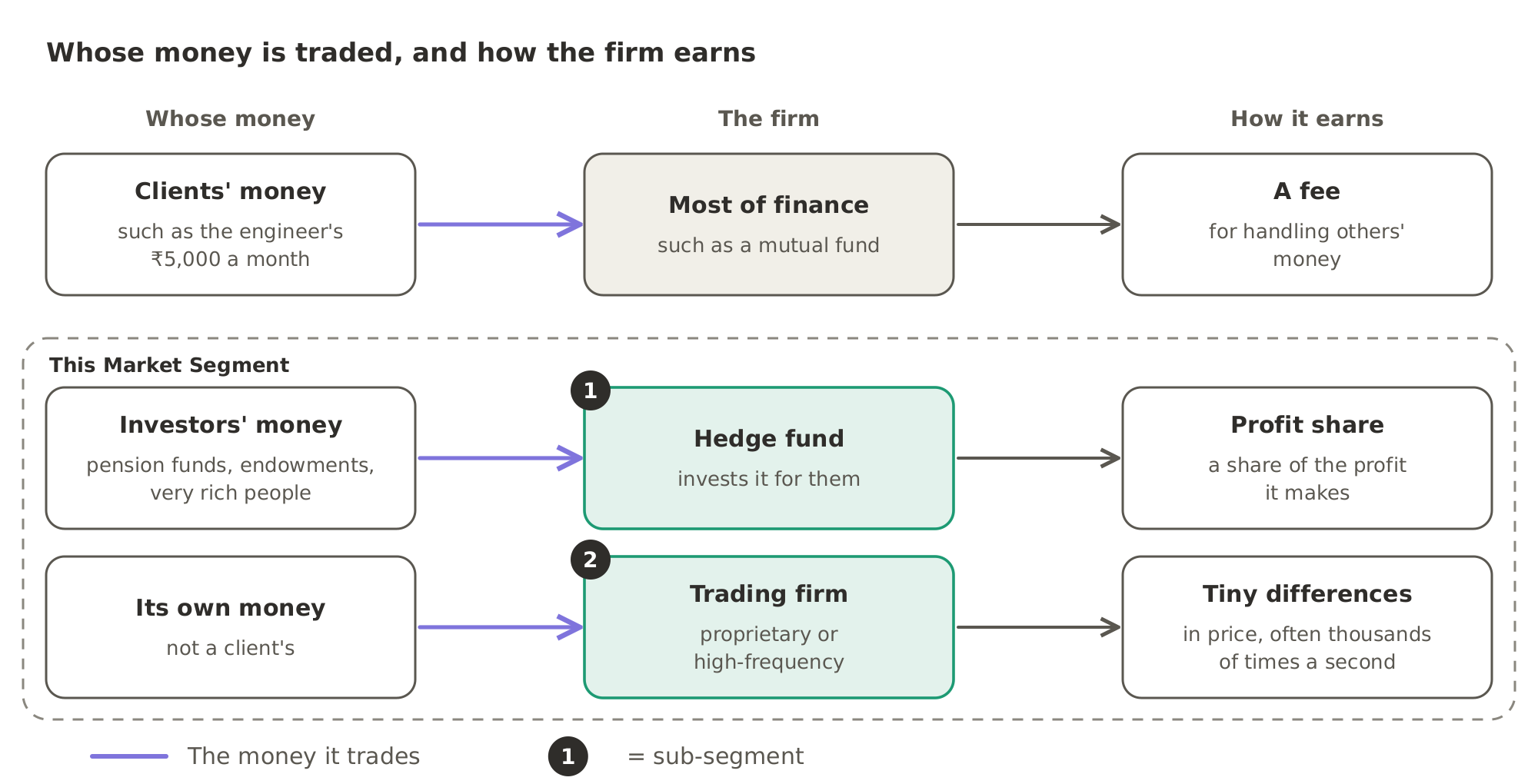
Hedge fundsinvest money for pension funds, endowments and very rich people. An endowment is the investment fund of a university or a charity. A hedge fund keeps a share of the profit it makes. Proprietary and high-frequency trading firmstrade with their own money, often thousands of times a second. They make money on tiny differences in price. Proprietary trading means trading with the firm's own money, not a client's. High-frequency trading means trading very fast and very often, using computers. Most of finance, such as a mutual fund, handles clients' money and earns a fee. A hedge fund invests the money of pension funds, endowments and very rich people and keeps a share of the profit, while a proprietary or high-frequency trading firm trades its own money and earns on tiny differences in price; these two are the sub-segments of this Market Segment.Most of finance, such as a mutual fund, handles clients' money and earns a fee. A hedge fund invests the money of pension funds, endowments and very rich people and keeps a share of the profit, while a proprietary or high-frequency trading firm trades its own money and earns on tiny differences in price; these two are the sub-segments of this Market Segment.

Both kinds hire more mathematicians and engineers than almost anyone else. Several have built large research and technology centres in India. One of them has been here for three decades.

Every company named here has posted software engineering jobs in India. Famous companies that don't actively hire software engineers in India are left out.

This Market Segment has two sub-segments:

The hedge funds The high-frequency traders

Keep reading, free

Two more sections are on this page: The hedge funds and The high-frequency traders. Sign in to read them here, in full.

Continue with Google
  • The hedge funds
  • The high-frequency traders
The hedge funds Multi-strategy, quantitative, macro and systematic hedge funds, family office investing

The engineer's ₹5,000 a month goes into a mutual fund, in Market Segment 20.2. A hedge fund is a different kind of fund. It is open only to large investors, such as pension funds, and it is free to use more kinds of trades. Hedge funds differ in how they decide what to trade:

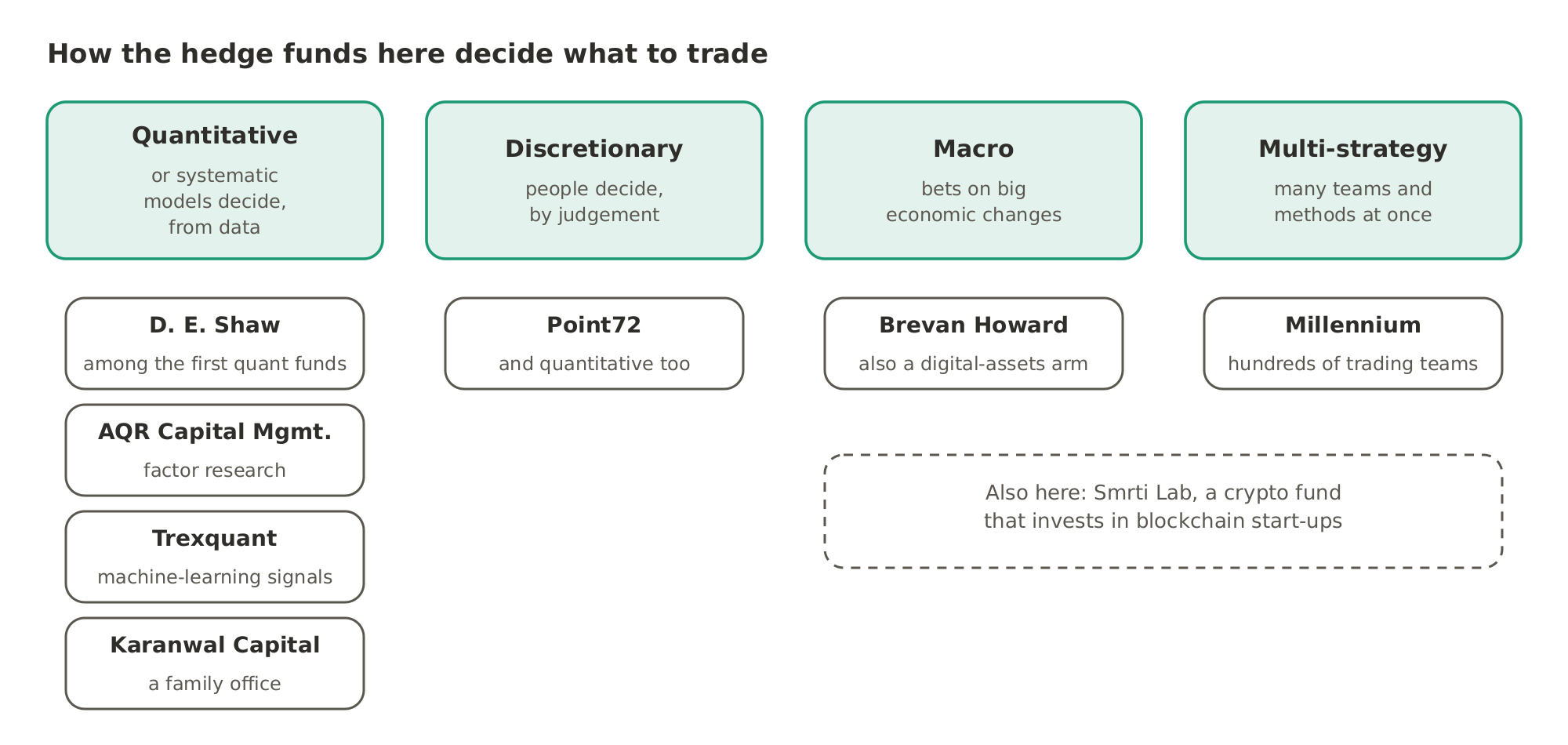
Quantitative or systematicfunds let mathematical models decide, based on data. Discretionaryfunds let people decide, using their own judgement. Macrofunds bet on big economic changes, such as interest rates or currencies. Multi-strategyfunds run many different teams and methods at once.

These are the hedge funds here:

Millenniumwith engineers in Bengaluru, has the most job postings in this Market Segment. It runs one of the world's largest multi-strategy hedge funds. It has hundreds of independent trading teams, each with its own money to trade and its own limits. Its Bengaluru centre builds the technology and research platforms that the teams share. D. E. Shawwith engineers in Hyderabad, Bengaluru and Delhi NCR, was among the first quantitative hedge funds. It has had a technology and research presence in India since the 1990s. Arcesium also grew out of it. (More on Arcesium in Market Segment 20.2, Asset management and fund administration software.) Point72with engineers in Bengaluru, runs both discretionary and quantitative strategies from its Bengaluru centre. AQR Capital Managementis a systematic fund built on academic factor research. A factor is a trait that research has linked to returns over time, such as a company being cheap compared with its earnings. Brevan Howardwith engineers in Bengaluru, is a macro fund, with a separate arm that invests in digital assets. Trexquant Investmentwith engineers in Delhi NCR, runs systematic strategies. They are built from thousands of signals found by machine learning. A signal is a pattern in the data that may predict a price move. Karanwal Capitalwith engineers in Mumbai, invests one family's money using systematic strategies. A firm like this is called a family office. Smrti Labwith engineers in Hyderabad, runs a crypto fund, and invests in blockchain start-ups. The hedge funds on this page, sorted by how they decide what to trade: D. E. Shaw, AQR Capital Management, Trexquant Investment and Karanwal Capital are quantitative or systematic, Point72 is discretionary and quantitative, Brevan Howard is a macro fund and Millennium is multi-strategy. Smrti Lab runs a crypto fund.The hedge funds on this page, sorted by how they decide what to trade: D. E. Shaw, AQR Capital Management, Trexquant Investment and Karanwal Capital are quantitative or systematic, Point72 is discretionary and quantitative, Brevan Howard is a macro fund and Millennium is multi-strategy. Smrti Lab runs a crypto fund.
The high-frequency traders Proprietary and high-frequency trading, market making, low-latency systems

Back to the ten shares from the start of this Market Segment. The firm whose computer sold them to the engineer is called a market maker. A market maker always offers both to buy and to sell. It earns the small gap between its buying price and its selling price. Speed matters more than anything here. The systems are built for low latency, meaning very little delay, down to microseconds: millionths of a second.
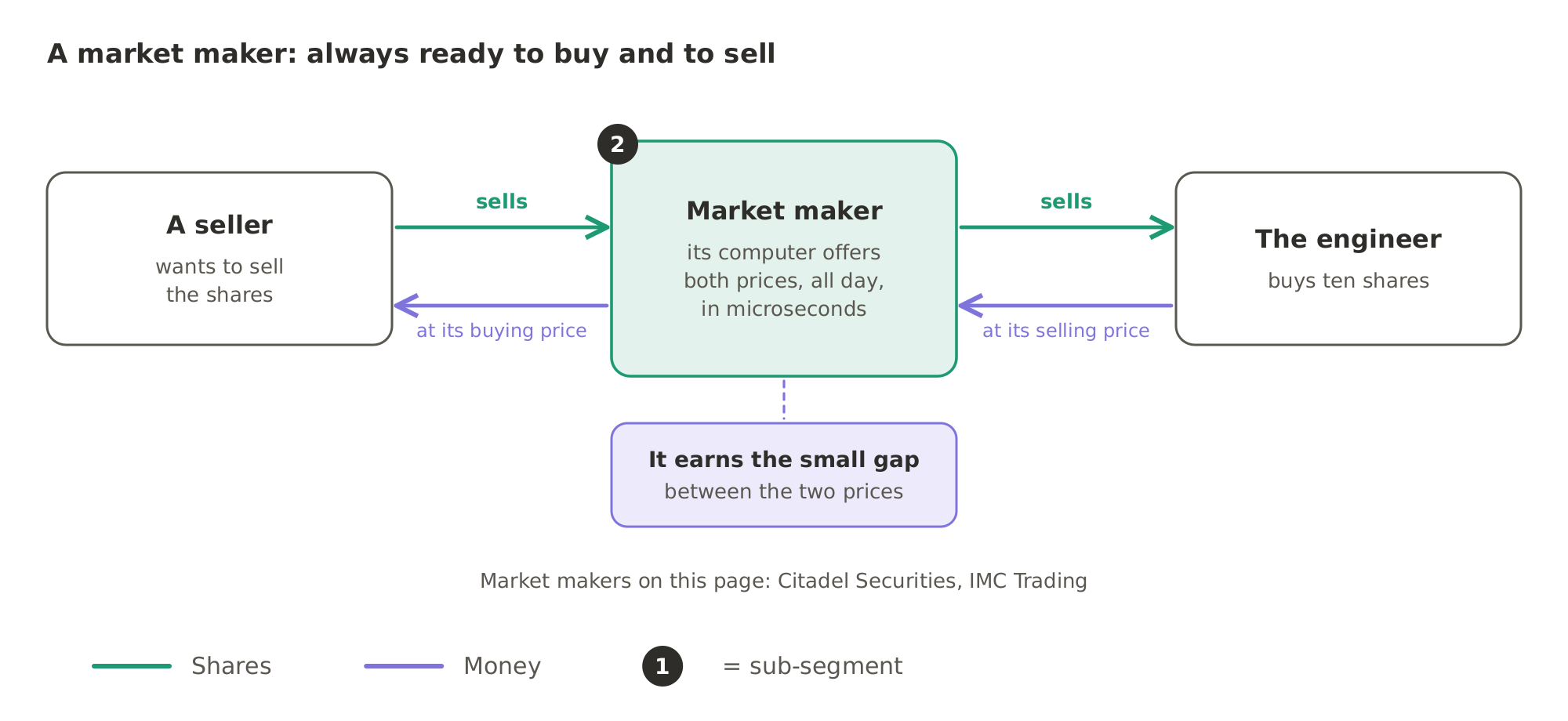
A market maker's computer always offers both to buy and to sell: it buys shares from a seller at its buying price and sells them to a buyer such as the engineer at its selling price, and earns the small gap between the two. Citadel Securities and IMC Trading are the market makers on this page.A market maker's computer always offers both to buy and to sell: it buys shares from a seller at its buying price and sells them to a buyer such as the engineer at its selling price, and earns the small gap between the two. Citadel Securities and IMC Trading are the market makers on this page. Graviton Research Capitalwith engineers in Delhi NCR, is an Indian high-frequency trading firm, founded in Gurugram. Its systems trade on Indian and global exchanges, in microseconds. QI-CAP Investmentswith engineers in Bengaluru, builds low-latency trading systems and quantitative models. Citadel Securitieswith engineers in Delhi NCR and Mumbai, is one of the largest market makers in the world. It is on the other side of a large share of the share trades made by ordinary American investors. IMC Tradingwith engineers in Mumbai, is a Dutch market maker. It trades in India's options market, the largest in the world by number of contracts. An option is a contract that gives the right, but not the duty, to buy or sell something at a fixed price by a certain date. India's options market.

India's exchanges now trade more equity options contracts than any other market in the world. Most of them are traded by retail traders, meaning ordinary individuals. The global market makers and high-frequency firms have come to trade against them. The regulator has tightened the rules on retail options trading. The firms in this Market Segment are the ones most affected by where those rules end up.

That is trading with their own money. A market maker's computer may well have sold the engineer her ten shares. And the hedge funds and trading firms here build much of the technology behind such trades in India.
Who they hire

Who these companies hire, and for what, is on What wealthtech and capital markets hires for.

Privacy Terms Refunds and cancellation Shipping and delivery © 2026 ingrid.fyi · Payments by Razorpay
You're browsing as a guest. Sign in free to follow links for five minutes, once an hour.