The exchanges and the post-trade
Exchanges and trading venues, clearing and settlement, post-trade processing, proxy voting
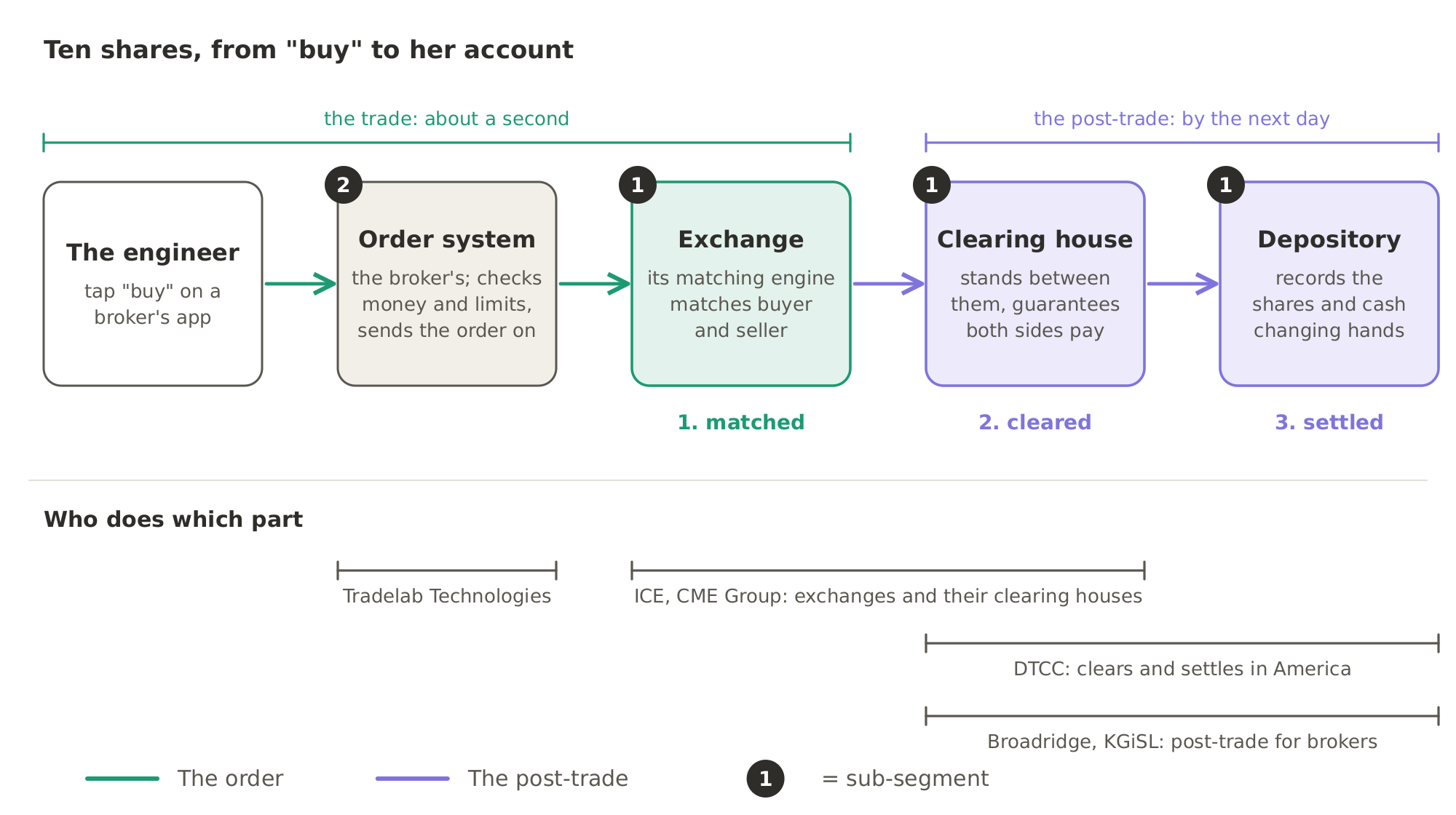
Back to the engineer's ten shares from the start of this Market Segment. Her trade was matched, cleared and settled by institutions like the ones here. Most of them work in American and global markets, and build much of their software in India.
The Depository Trust & Clearing Corp (DTCC)has engineers in Hyderabad and Chennai, and the most job postings in this Market Segment. It clears and settles almost every share and bond traded in America: trillions of dollars a day. Its Hyderabad and Chennai centres build much of the software that does it.
CME Groupwith engineers in Bengaluru, runs the world's largest derivatives exchange, and its clearing house. A derivative is a contract whose value depends on something else, such as a futures contract or an option. CME's derivatives are based on interest rates, currencies, commodities and stock market indices.
ICEwith engineers in Pune and Hyderabad, owns the New York Stock Exchange. It also owns futures exchanges and clearing houses around the world.
Tradewebwith engineers in Bengaluru, runs electronic marketplaces where institutions trade bonds and interest-rate swaps with each other. In an interest-rate swap, two parties agree to exchange interest payments, for example a fixed rate for a changing one.
Broadridgeprocesses the trades of banks and brokers after they are made. It also runs proxy voting, through which shareholders vote at a company's meetings without attending. Broadridge has engineers in Bengaluru, and so does Broadridge India, another company of the same group.
KGiSLa company from Coimbatore with engineers in Bengaluru, sells settlement and back-office software to brokers in Asia. Back-office software handles the accounts and records behind the trades.
The trading software
Order and risk management systems, trading platforms, execution algorithms, low-code for capital markets
Back to the broker's app where the engineer tapped "buy". Behind the app sits an order management system. It records each order, checks it against the customer's money and limits, and sends it to the exchange.
Tradelab Technologieswith engineers in Bengaluru, builds the order management, risk and trading platforms behind many Indian brokers' apps. It also builds matching engines, the software an exchange runs to match buyers with sellers.
Trading Technologieswith engineers in Pune, sells the professional futures trading screen used by banks and trading firms.
Genesis Globalwith engineers in Bengaluru, sells a low-code platform on which banks build their own trading applications. Low-code means building software mostly by configuring ready-made parts, with little hand-written code.
The engineer bought ten shares. A pension fund may need to sell a million. Selling them all at once would push the price down. So the fund uses an execution algorithm: software that splits a large order into many small ones, and trades them at the best prices over time. It also measures what the trade cost.
BestEx Researchwith engineers in Bengaluru, and Quantitative Brokers sell execution algorithms.
Equiti Groupwith engineers in Bengaluru, is a broker in the Middle East, Africa and Britain, with its own trading platform. It trades currencies and contracts for difference (CFDs). With a CFD, a trader bets on a price moving up or down, without owning the asset.
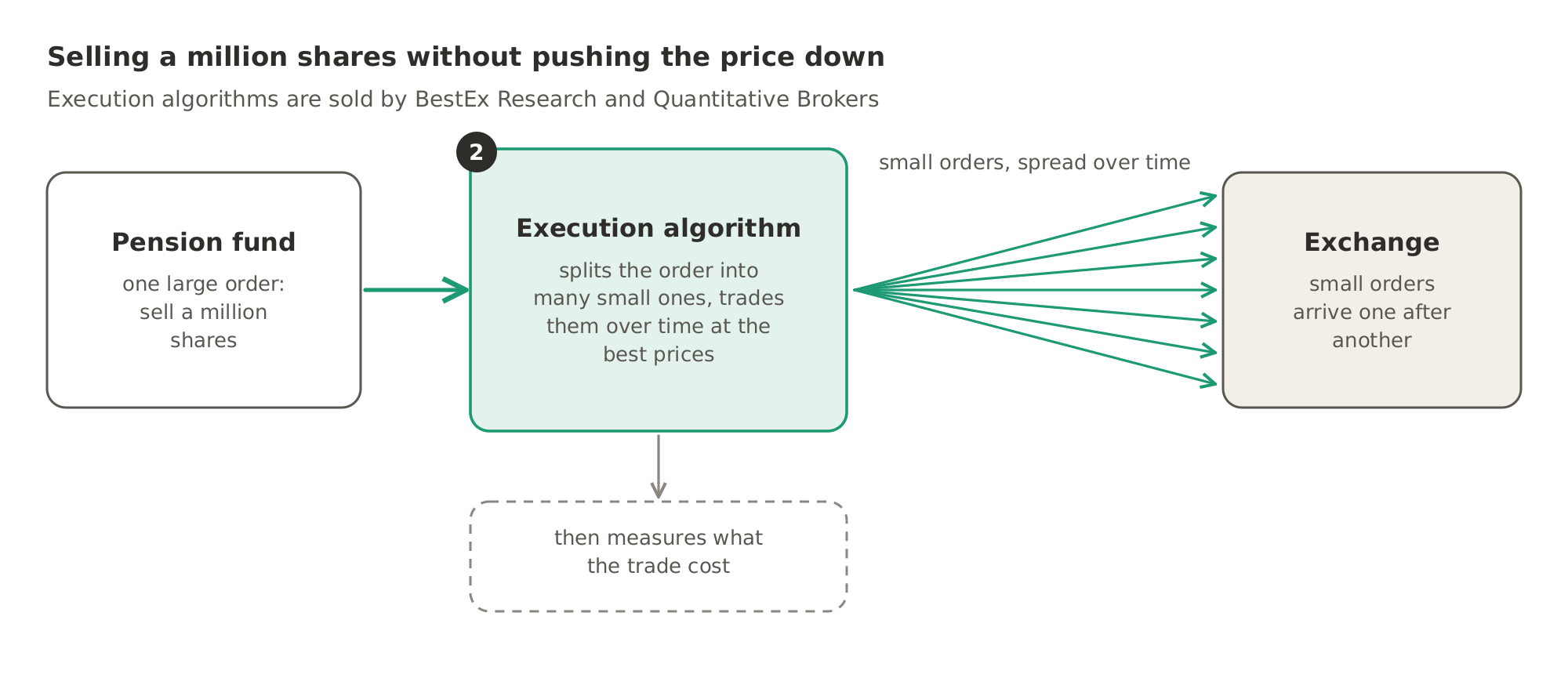 An execution algorithm takes a pension fund's order to sell a million shares, splits it into many small orders and sends them to the exchange over time at the best prices, then measures what the trade cost. BestEx Research and Quantitative Brokers sell this software.
Private markets and valuations
Private asset valuation and portfolio monitoring, cap tables, clean-energy project finance
An execution algorithm takes a pension fund's order to sell a million shares, splits it into many small orders and sends them to the exchange over time at the best prices, then measures what the trade cost. BestEx Research and Quantitative Brokers sell this software.
Private markets and valuations
Private asset valuation and portfolio monitoring, cap tables, clean-energy project finance
The engineer's ten shares trade on an exchange, so their price is known every second. Shares in private companies, and many loans, never trade on an exchange. Someone has to work out what they are worth. These are called private markets.
73 Stringswith engineers in Bengaluru, values the private companies and loans that private-equity and private-credit funds hold. Private equity means investing in companies that are not traded on a stock market. 73 Strings uses an AI model to read these companies' reports.
Eqvistawith engineers in Delhi NCR and Mumbai, manages start-ups' cap tables. A cap table is the record of who owns what share of a private company. If the engineer's employer is a start-up that gives her shares, her shares are recorded in a cap table like this.
One company here is covered mainly in another Market Segment:
CapeZerowith engineers in Bengaluru, sells software for financing American clean-energy projects. (More on CapeZero in Market Segment 40.4, Energy market analytics and trading software, in Industry Vertical 40, Energy and climate tech.)
Settlement in a day, then in an instant.
In 2024, America moved to settling trades on the day after they are made. India had moved to next-day settlement a year earlier, and is now testing settlement on the same day. The shorter the cycle, the more of the plumbing must run in real time. Settlement with tokens on a blockchain is the version that settles instantly. (More on tokens in Market Segment 17.7, Crypto and digital assets, in Industry Vertical 17, Payments.)
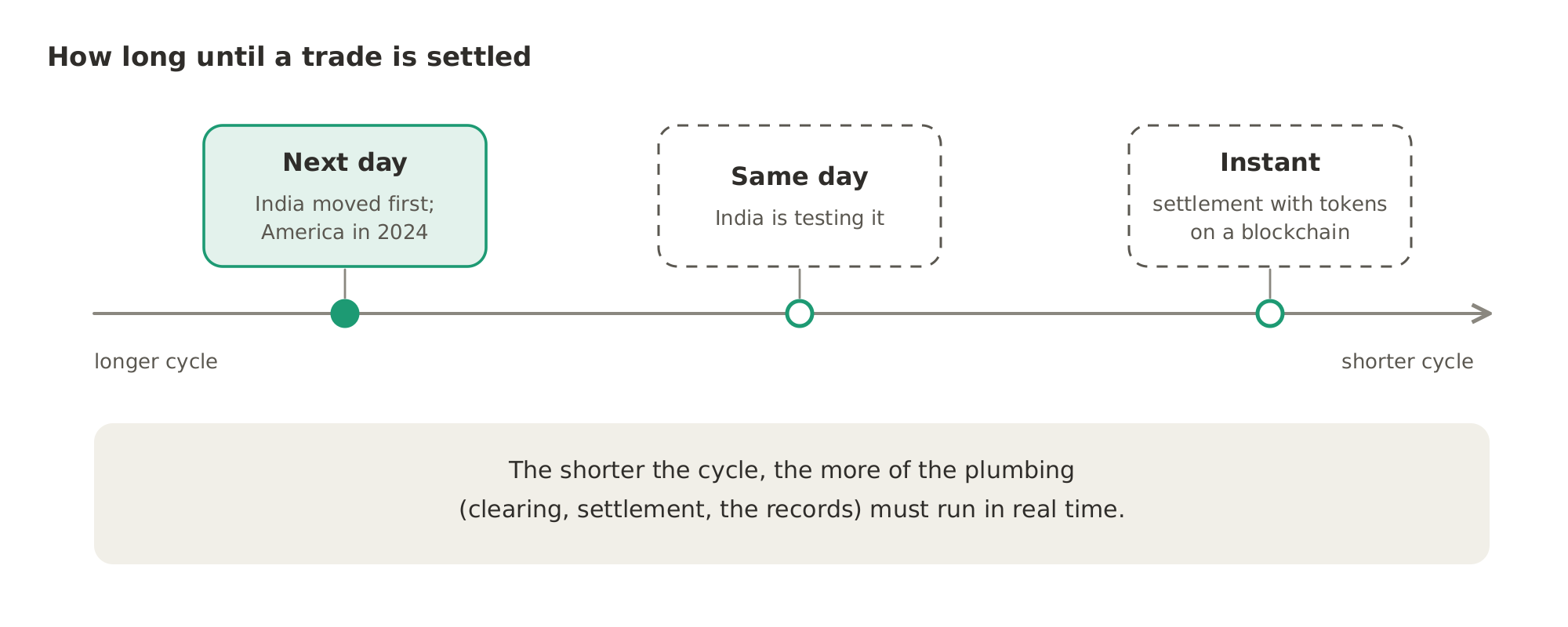 The settlement cycle is getting shorter: India and then America moved to settling trades on the next day, India is testing settlement on the same day, and settlement with tokens on a blockchain would be instant. The shorter the cycle, the more of the plumbing must run in real time.
That is the plumbing under every trade. The engineer's ten shares were matched on an exchange, guaranteed by a clearing house and recorded by a depository, all through software, much of it built in India.
The settlement cycle is getting shorter: India and then America moved to settling trades on the next day, India is testing settlement on the same day, and settlement with tokens on a blockchain would be instant. The shorter the cycle, the more of the plumbing must run in real time.
That is the plumbing under every trade. The engineer's ten shares were matched on an exchange, guaranteed by a clearing house and recorded by a depository, all through software, much of it built in India.