Take the running shoes from Market Segment 13.1 again. Say you did buy them in the end. To the shoe shop, you may still look like four different people:
An email addressfrom when you signed up on its website.
A phone numberfrom when you paid at the billing counter of its store.
A device identifiera code that marks your phone inside its app.
A cookiea small file your browser stored when you clicked one of its advertisements.
Until these are joined into one profile, the shop's email, its offer and its advertisement all go to four strangers.
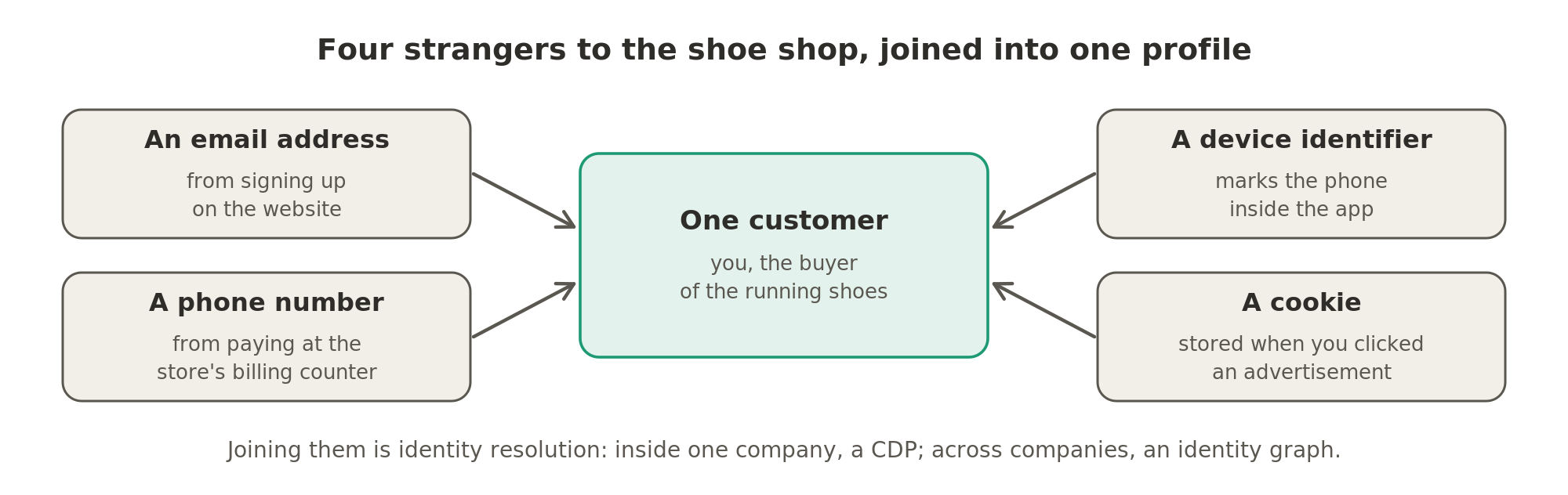 To the shoe shop one buyer looks like four strangers, an email address, a phone number, a device identifier and a cookie, until identity resolution joins them into one profile.
Every Market Segment in Industry Vertical 13, Martech, acts on a customer. This one is about knowing who the customer is. Joining the signals into one person is called identity resolution. Two kinds of companies do it:
Customer data platforms (CDPs)collect the signals inside one company, and join them into one profile per customer.
Identity resolution companiesdo the harder, larger job: joining people across companies. With it, an advertiser can recognise its own customer on a publisher's website, without either company handing the other a list of names. A publisher is any website or app that shows advertisements next to its content, such as a news site.
The matched identity is then used to decide who sees which advertisement. (More on buying the advertisement in Market Segment 34.1, Ad buying platforms (DSPs) and ad networks, in Industry Vertical 34, Adtech.)
Every company named here has posted software engineering jobs in India. Famous companies that don't actively hire software engineers in India are left out.
This Market Segment has two sub-segments, moving from the company's own data outward:
The profile: software that builds one profile per customer from a company's own data
The identity graph: matching people across companies. Most of the engineering jobs in this Market Segment are in one Bengaluru centre, Epsilon's.
The profile
Customer data platforms (CDPs), composable CDPs, first-party data
Back to the four strangers from the start of this Market Segment. A CDP joins them into one profile. It works with first-party data: what the company collected itself, from its own website, app and stores. Two companies here build this profile, and both were founded in Bengaluru.
Lemnisksells a composable customer data platform to banks and insurers. A composable CDP does not keep its own copy of the data. It works on the data where it already sits, in the company's own systems. (More on where that data sits in Market Segment 7.1, Databases and data warehouses, in Industry Vertical 7, Database and storage companies.) Lemnisk collects what a customer does on the website, in the app and at the branch. It joins all of it into one real-time profile, which updates the moment the customer does something. From that profile, it orchestrates the journey, the planned sequence of messages described in Market Segment 13.1. The data stays inside the bank's or insurer's own cloud. Lemnisk hires in Bengaluru.
Zeotapwas founded in Bengaluru and is now run from Germany. It sells a customer data platform to European brands and telecom operators. Identity resolution is built in. So is enrichment: adding more details to the company's own data about each customer. Europe has a strict privacy law, the General Data Protection Regulation (GDPR). Zeotap grew up under that law, and built it into the platform's design. (More on privacy software in Market Segment 4.8, Data security and privacy, in Industry Vertical 4, Cybersecurity.) Zeotap hires in Bengaluru.
The identity graph
Identity resolution, data onboarding, audience activation, data clean rooms
Now the shoe shop wants to show you an advertisement on a news website. The shop knows your email address. The news site knows you as a logged-in reader. Neither can simply hand its list to the other. Privacy law forbids it, and neither wants to give away its customers.
The companies in this sub-segment match people across companies without either side seeing the other's list. Their main tool is an identity graph: a very large map that links the email addresses, phone numbers, devices and postal addresses that belong to the same person.
Epsilonis a data-marketing company owned by Publicis Groupe. Its identity graph, CORE ID, links the devices, email addresses and postal addresses of most American adults to a real person. Epsilon's Bengaluru centre is one of the largest the company has. It builds the identity engine. It also builds the programmatic media platform that spends against it. Programmatic means buying advertisements automatically through software, often in auctions that take a fraction of a second. And the centre builds the messaging that follows. (Epsilon also appears in Market Segment 34.1, Ad buying platforms (DSPs) and ad networks, in Industry Vertical 34, Adtech.)
LiveRampis the company that made data onboarding a business. Data onboarding takes a brand's customer list, kept in its own systems, and matches it to people's identities online through LiveRamp's identity graph. The brand can then reach those customers with advertisements, without either side seeing the other's data. LiveRamp also sells data clean rooms. In a clean room, two companies compare their customers without exchanging them. It is the privacy-era version of the same idea. LiveRamp hires in Hyderabad.
One company here is covered mainly in another Market Segment:
Zeta Globalhas its own deterministic identity graph underneath its marketing platform. Deterministic means it joins records only when they share an exact identifier, such as the same email address, instead of guessing from patterns. (More on Zeta Global in Market Segment 13.1, Marketing automation and customer engagement platforms.)
The clean room.
The cookie that joined identities across the web is going away, and privacy law forbids handing over lists. The clean room is how identity resolution survives. Inside it, two companies match their customers in a sealed computation, and each learns only the overlap between them. LiveRamp's and Epsilon's products are being built toward it.
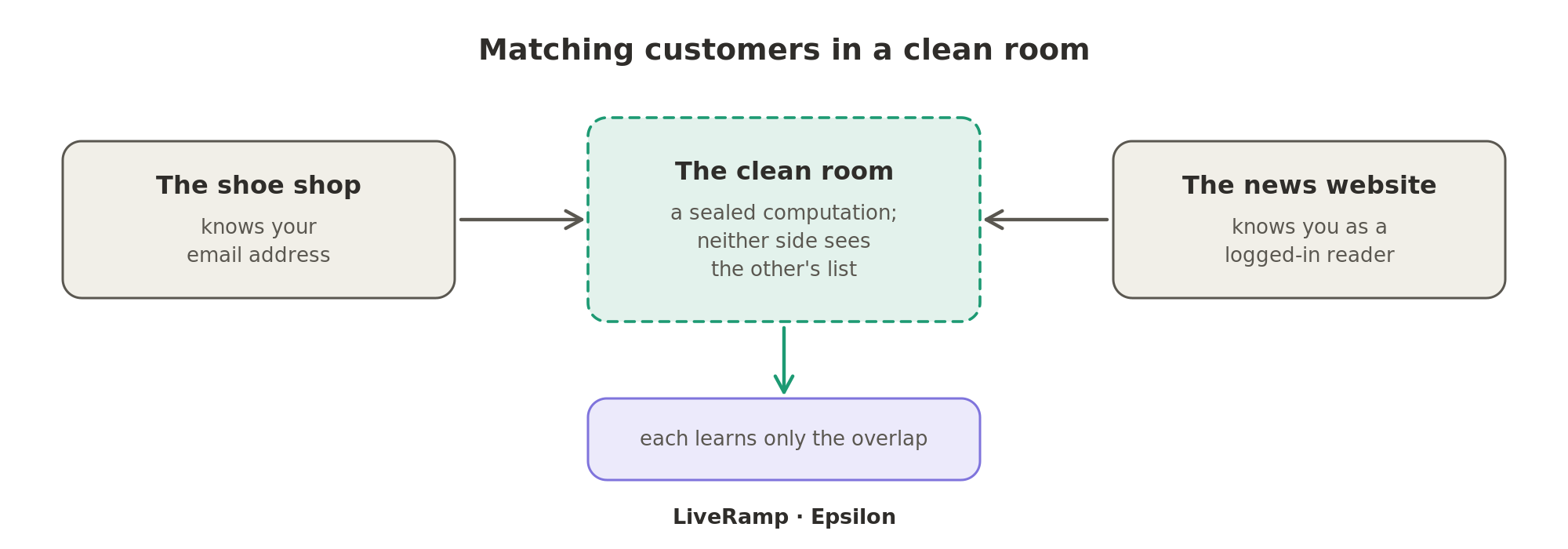 The shoe shop and the news website each put their customers into a clean room, a sealed computation in which neither sees the other's list, and each learns only the overlap.
That is how the shoe shop learns that its four strangers are one person, you. And it is how the shop finds you again on a news website, without anyone handing over a list of names.
The shoe shop and the news website each put their customers into a clean room, a sealed computation in which neither sees the other's list, and each learns only the overlap.
That is how the shoe shop learns that its four strangers are one person, you. And it is how the shop finds you again on a news website, without anyone handing over a list of names.