Back to you, from Market Segments 12.4 to 12.7. It is your first week in the new job. The company's learning system has assigned you four courses: data privacy, workplace conduct, security awareness and the company's own product. When you first open the sales team's CRM, a small pop-up guide walks you through it, one click at a time.
Once people are hired, they have to be taught:
- the compliance course that everyone clicks through
- the product training a sales team needs before a launch
- the leadership programme for new managers
- in IT services, where many freshers start their careers, the constant retraining that lets an engineer on the bench, between projects, move from one technology to the next
This Market Segment is about the software of company learning. It also covers the question that comes after it: which skills does the company have, and which will it need? The buyers are companies' HR and learning teams.
Two companies make up most of this Market Segment, and both chose India. Cornerstone's centres in Hyderabad and Pune build the largest company-learning platform in the world. And Whatfix, founded in Bengaluru, created the category of digital adoption.
Some companies sell courses to individuals rather than to employers, such as Coursera, Udemy and upGrad. They are covered in Market Segment 42.5, Upskilling platforms and coding bootcamps (in Industry Vertical 42, Edtech).
Every company named here has posted software engineering jobs in India. Famous companies that don't actively hire software engineers in India are left out.
This Market Segment has two sub-segments:
The learning platform and the guide inside the software: the systems that host, assign and track courses. Also the newer product that teaches an employee to use an application while they are using it.
The skills and the plan: the skill lists and forecasts through which a large employer knows what its workforce can do.
The learning platform and the guide inside the software
Learning management and experience platforms, learning content, simulations, digital adoption
Back to your four courses from the start of this Market Segment. They live in a learning management system: the software that hosts courses, assigns them to employees, and tracks who has finished them. The newer kind, a learning experience platform, also recommends courses, the way a streaming service recommends a film.
Cornerstone OnDemandwith engineers in Hyderabad and Pune, has the most job postings in this Market Segment. It is the largest company-learning platform in the world. Large employers host, assign and track training in it. It bought EdCast, an Indian-founded company, and with it the learning-experience layer that recommends courses. Its Hyderabad centre is one of its largest engineering sites.
Skillsoftwith engineers in Hyderabad, sells a library of courses and its Percipio platform to the same customers. It also sells SumTotal, a learning suite it bought.
Disprzfounded in Chennai, with engineers there, sells a learning platform to large Indian companies. It focuses on their frontline staff: the shop-floor and field workers who learn on a phone.
HowNowwith engineers in Mumbai, is a British learning experience platform, with AI that maps each employee's skills.
Four small Bengaluru companies make the courses themselves:
KNOLSKAPEsells game-like simulations for leadership and sales training.
Content Enablerssells courses in trade compliance, built for each job role.
Ideaonbuilds custom online courses for each client.
RockEDbuilds a mobile learning app.
Back to the pop-up guide in the CRM, from the start of this Market Segment. That guide is a different kind of teaching. It lives inside the application, and walks you through the CRM or the ERP step by step, while you use it. The training happens at the moment you need it, not in a course. The industry calls this digital adoption.
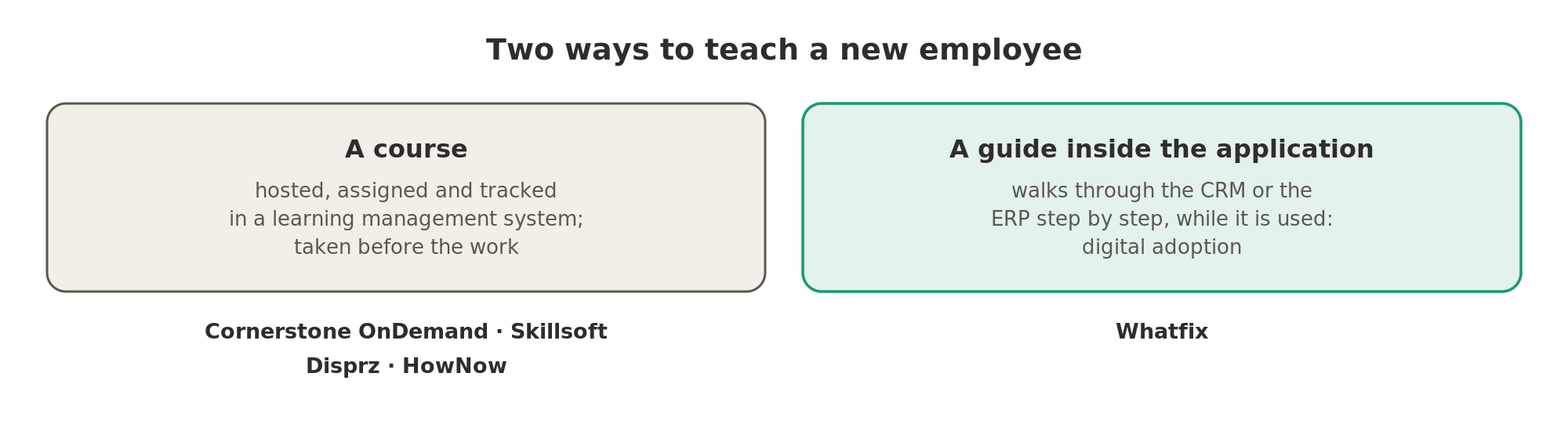 A course is hosted, assigned and tracked in a learning management system, while digital adoption guides the employee through an application step by step while they use it.
Whatfixfounded in Bengaluru in 2014, with engineers there, has the second most job postings in this Market Segment. It created the category of digital adoption. Its Bengaluru centre is most of the company. (It also appears in Market Segment 16.3, Work management and knowledge platforms, in Industry Vertical 16, IT management and workplace tools, where the applications it guides people through are covered.)
The course that writes itself.
A course is hosted, assigned and tracked in a learning management system, while digital adoption guides the employee through an application step by step while they use it.
Whatfixfounded in Bengaluru in 2014, with engineers there, has the second most job postings in this Market Segment. It created the category of digital adoption. Its Bengaluru centre is most of the company. (It also appears in Market Segment 16.3, Work management and knowledge platforms, in Industry Vertical 16, IT management and workplace tools, where the applications it guides people through are covered.)
The course that writes itself.
Learning content used to be expensive to make and slow to change. Now an AI model drafts the course from the product's documentation, the simulation from a scenario, and the in-app guide from the screen. Cornerstone's, Disprz's and Whatfix's products are all doing this. The learning platform is becoming the system that creates the lesson at the moment a skill gap appears.
The skills and the plan
Skills taxonomies, talent supply chain, workforce planning and labour-market intelligence
Now picture a friend of yours who joined a large IT services firm. Their project has just ended, so they are on the bench. The firm has to decide which new project they will join, and which new skill they must learn first. Across tens of thousands of engineers, that is a planning problem. The companies in this sub-segment answer it.
A skill taxonomy is the company's master list of skills, and of who has which. The talent supply chain is the industry's name for matching a services firm's people to the projects it has won. It also means planning ahead for the skills its future deals will need.
Prismforcefounded in Bengaluru, with engineers there, sells a talent supply chain suite built for the IT services industry. It includes the skill taxonomy, an internal marketplace that matches engineers on the bench to projects, and a forecast of the skills that upcoming deals will need. Its customers are the firms covered in the services-world collection. It is the most Indian product in this Market Segment.
Draupalso in Bengaluru, sells labour-market intelligence behind the plan: data on which skills are being hired where, and at what cost. It sells this to the same firms, and to their clients' workforce planners.
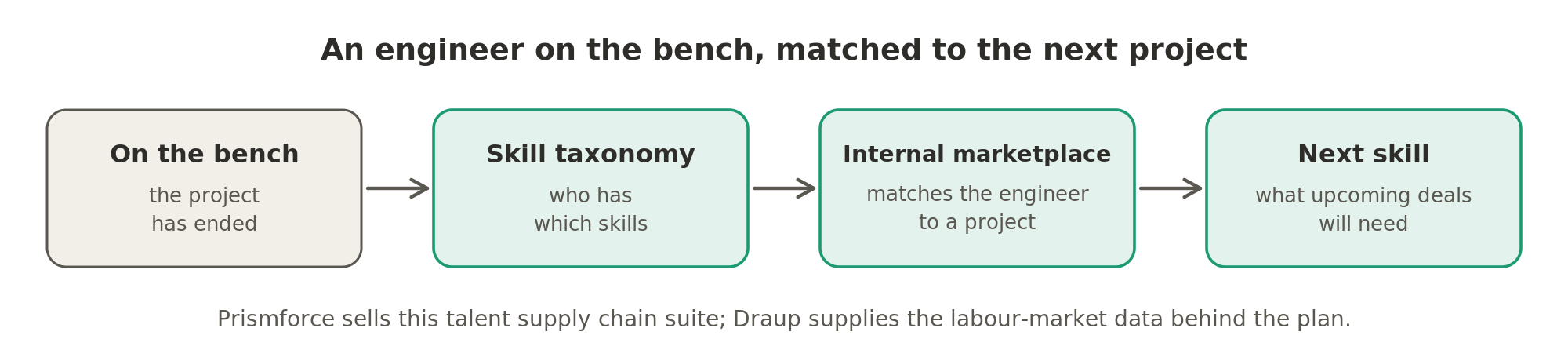 When an engineer's project ends, the skill taxonomy records what they can do, an internal marketplace matches them to a new project, and a forecast shows which skill upcoming deals will need.
So you, in your first week, took your courses in a learning platform and learned the CRM from a guide inside it. And when your friend's project ended, planning software decided what they would learn next.
When an engineer's project ends, the skill taxonomy records what they can do, an internal marketplace matches them to a new project, and a forecast shows which skill upcoming deals will need.
So you, in your first week, took your courses in a learning platform and learned the CRM from a guide inside it. And when your friend's project ended, planning software decided what they would learn next.