Say you are looking for your first job. On a job site, you see an advertisement for a software engineer at a large American company's centre in Hyderabad. You click it, and land on the company's career site. You upload your CV and answer a few questions. A chatbot messages you to book a screening call. Two weeks later, you are called for an interview.
Before a person exists in the people system of Market Segment 12.1, HR, payroll and workforce management software, they exist in a pipeline:
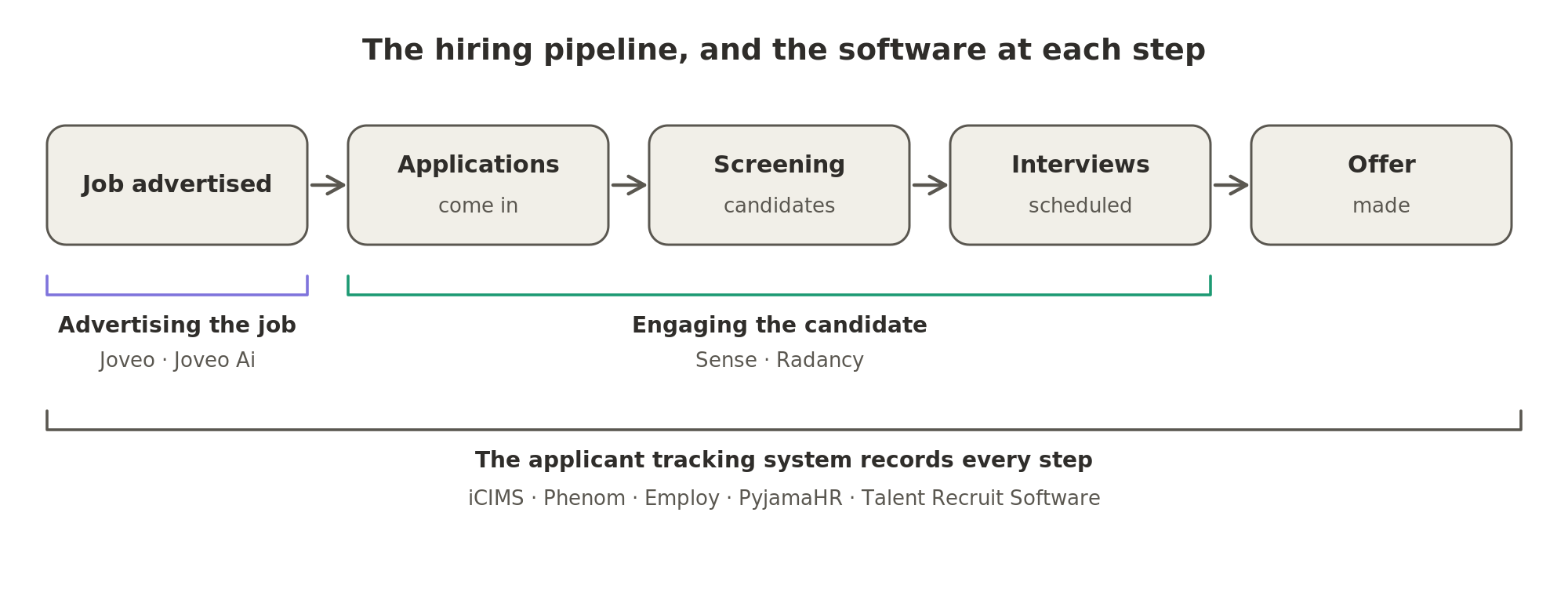 A hire moves from the job advertisement through applications, screening and interviews to an offer; advertising software buys the advertisement, engagement software fills the wait, and the applicant tracking system records every step.
- a job is advertised
- applications come in
- candidates are screened
- interviews are scheduled
- an offer is made
The software that holds that pipeline is called an applicant tracking system, or ATS. It is the one product in Industry Vertical 12 that almost every recruiter, and most candidates, have used. Its buyers are companies' recruiting teams. The work around it, attracting candidates to the company, is called recruitment marketing.
Every company named here has posted software engineering jobs in India. Famous companies that don't actively hire software engineers in India are left out.
This Market Segment has two sub-segments, and ends with a link to advertising. They run from the inside out, the opposite of the order a candidate meets them:
The applicant tracking system: the system of record for every hire.
Engaging the candidate: the messaging, chatbots and career sites that keep a candidate interested between the click and the interview.
Advertising the job: how the job advertisement is bought in the first place. The companies here buy it automatically, the way online display advertising is bought.
The applicant tracking system
Applicant tracking, career sites, candidate screening, recruitment CRM
Back to your application from the start of this Market Segment. It lands in the company's applicant tracking system, next to thousands of others for the same job. The recruiter screens them there, moves candidates from stage to stage, and records every decision. A career site is the company's own jobs website. A recruitment CRM keeps track of candidates over time, the way a sales team tracks customers.
iCIMSwith engineers in Hyderabad, is one of the two largest applicant tracking systems for large employers in the United States. The largest employers receive millions of applications a year in it. A career site and text messaging have been added on.
Phenomwas founded by Indian engineers. Its Hyderabad centre is its largest, though it has only a few job postings there. It sells the layer around the tracking system that shapes the candidate's experience. That layer includes a career site that recommends jobs, a chatbot that answers the candidate, automatic interview scheduling, and the recruiter's CRM.
Employwith engineers in Bengaluru, is the holding company of Jobvite, Lever and JazzHR. These three tracking systems were bought together, and are now sold as one.
Two Indian companies serve the Indian market:
PyjamaHRa small Bengaluru company, sells a tracking system with automated screening and video interviews, for Indian start-ups and mid-sized companies.
Talent Recruit Softwarein Bengaluru, sells the same to large Indian companies and to staffing companies, the firms that supply contract and temporary workers to other companies.
Engaging the candidate
Candidate engagement and messaging, recruitment chatbots, talent acquisition clouds
Back to you, from the start of this Market Segment, two days after you applied. Between the application and the interview, most candidates hear nothing at all. The companies in this sub-segment fill that silence. In your case, it was the chatbot that messaged you to book the screening call.
Sensewas founded by Indian engineers. It has engineers in Bengaluru, and the second most job postings in this Market Segment. It sells automated messaging, a conversational chatbot, and a CRM for candidates, called a talent CRM. It built them first for staffing companies, whose recruiters handle thousands of candidates at once. Its Bengaluru centre is a large share of the company.
Radancywith engineers in Bengaluru, sells a talent-acquisition cloud for large employers. It includes the career site, the programme that rewards employees for referring friends, and the recruitment marketing that puts the employer's name in front of candidates.
You're reading as a guest. Sign in free to follow links for five minutes, once an hour.
Sign in
Advertising the job
Connector to Market Segment 34.2, Publisher ad monetisation platforms (SSPs), in Industry Vertical 34, Adtech
Back to the job advertisement you saw at the start of this Market Segment. Someone paid for it to appear in front of you, and the way they paid has changed.
The old way was to pay a job board a flat fee for each listing. The new way is called programmatic job advertising. An employer's job openings are advertised across hundreds of job boards and websites at once. An algorithm bids for each application, at the price that application is worth. It borrows the technique that online display advertising uses, where each ad is bought in a live auction.
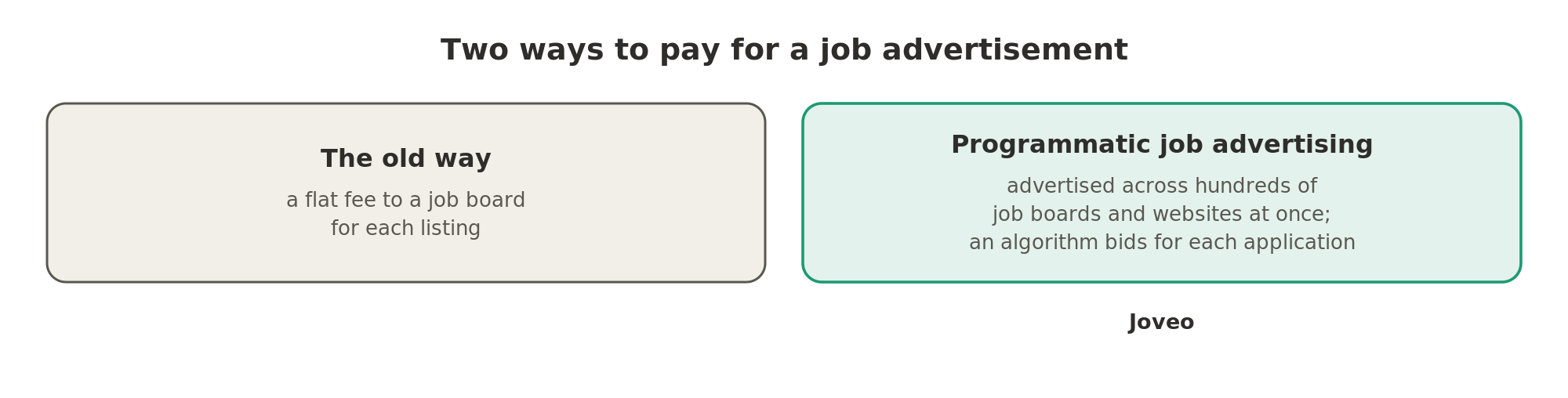 The old way paid a job board a flat fee for each listing, while programmatic job advertising places the opening across hundreds of sites and has an algorithm bid for each application.
Joveowas founded by Indian engineers, and has engineers in Bengaluru. It sells programmatic job advertising, with candidate engagement and analytics on top. It also appears in Market Segment 34.1, Ad buying platforms (DSPs) and ad networks (in Industry Vertical 34, Adtech), beside the software that advertisers use to buy ads automatically, which it resembles.
Joveo Aiis a second name of the same company, with engineers in Bengaluru and Hyderabad. Together, the two have the most job postings in this Market Segment.
The old way paid a job board a flat fee for each listing, while programmatic job advertising places the opening across hundreds of sites and has an algorithm bid for each application.
Joveowas founded by Indian engineers, and has engineers in Bengaluru. It sells programmatic job advertising, with candidate engagement and analytics on top. It also appears in Market Segment 34.1, Ad buying platforms (DSPs) and ad networks (in Industry Vertical 34, Adtech), beside the software that advertisers use to buy ads automatically, which it resembles.
Joveo Aiis a second name of the same company, with engineers in Bengaluru and Hyderabad. Together, the two have the most job postings in this Market Segment.
The auctions and bidding that this technique was borrowed from are covered in Market Segment 34.2, Publisher ad monetisation platforms (SSPs) (in Industry Vertical 34, Adtech).
The job opening bought like an advertisement.
Programmatic buying turned job advertising from a listing into an auction. Joveo's engineering goes into the AI model that sets each bid. It predicts which site will produce a hire for which job.
So your application from the start of this Market Segment passed through all three. An algorithm bid for the advertisement you clicked. A chatbot kept you interested while you waited. And the applicant tracking system recorded every step, until the offer.