Tracking the shipment and tracing the product
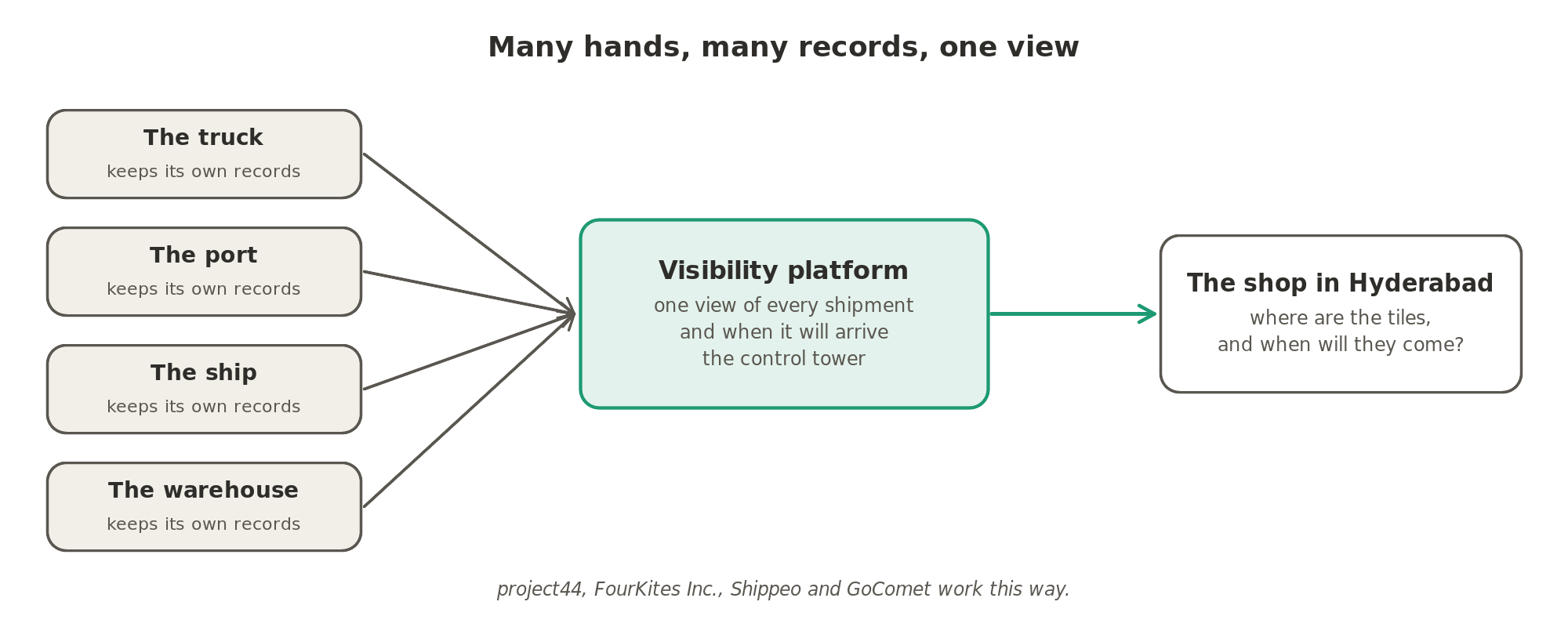
Back to the shop in Hyderabad from the start of this Market Segment. Tracking its tiles is visibility. Tracing a pack of medicine back to the factory that made it is traceability. The first company here does the second.
TraceLinkwith engineers in Pune, has the most job postings in this Market Segment. It runs the network through which pharmaceutical companies serialise and trace every pack of medicine. Serialising means giving each pack its own number. American and other regulators require it. TraceLink also appears in Market Segment 25.5, Pharma manufacturing and quality software (in Industry Vertical 25, Pharma and life sciences).
The next companies track shipments, the way the shop tracks its tiles:
project44with engineers in Bengaluru and Chennai, and FourKites Inc., with engineers in Chennai, track shipments across many carriers and predict when they will arrive. FourKites was founded by an Indian entrepreneur. Large shippers use them as control towers: one screen that shows every shipment, and warns when one is late.
Shippeowith engineers in Bengaluru, does the same in Europe.
GoCometwith engineers in Bengaluru, sells Indian and global shippers three things: buying freight transport, tracking it, and checking the invoices.
The next two work on particular kinds of goods:
Elemicawith engineers in Hyderabad, runs the network through which chemical companies exchange orders and logistics data.
Verdethostraces goods back to their source, to prove that no forest was cut down to produce them. It also appears in Market Segment 40.7, Carbon accounting and sustainability software (in Industry Vertical 40, Energy and climate tech).
Some goods have to stay cold all the way, like medicines, ice cream and vaccines. Keeping them cold from source to door is called the cold chain.
Carrier Refrigerationmakes the refrigeration units on trucks, and the telematics that watch the cold chain. Telematics are devices that send data, such as the temperature inside the truck, back to the office. Carrier Refrigeration also appears in Market Segment 37.9, Building technology and HVAC (in Industry Vertical 37, Manufacturing tech).
Three companies covered mainly in other Market Segments bring sensors and risk data:
Copelandwith engineers in Pune, is here for cold-chain monitoring. It is covered mainly in Market Segment 37.5, Industrial machinery and robotics (in Industry Vertical 37, Manufacturing tech).
ScratchNestwith engineers in Delhi, is here for RFID and temperature loggers. RFID tags are small radio tags fixed to goods, which a reader can scan without seeing them. A temperature logger records the temperature of goods on the way. ScratchNest is covered mainly in Market Segment 37.4, Predictive maintenance and industrial IoT platforms.
Accretewith engineers in Mumbai, is here for supply-chain risk intelligence: warning of risks to a company's suppliers and shipments. It is covered mainly in Market Segment 4.12, Threat intelligence and attack surface management (in Industry Vertical 4, Cybersecurity).
The product that carries its history.
Regulations now require that medicines, food and some raw materials be traced from source to shelf. The European rule on deforestation-free goods extends this to coffee, cocoa and more. A bag of coffee from Coorg sold in Europe will need its history. The visibility networks are becoming evidence for regulators, as much as information for shippers.
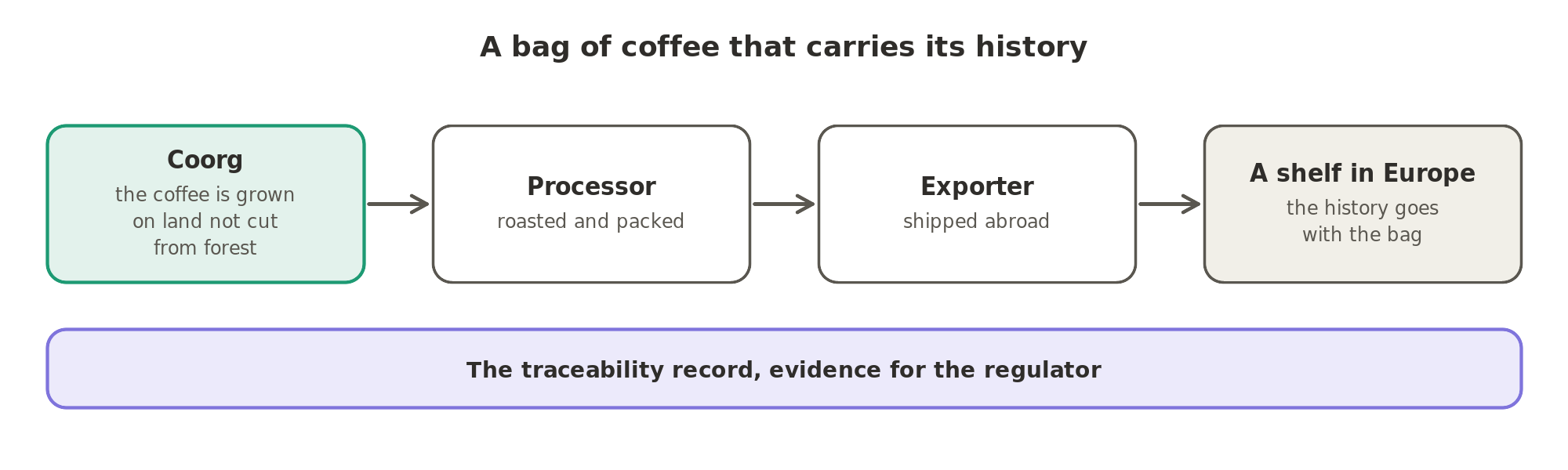 A bag of coffee from Coorg sold in Europe carries its history, from the farm through the processor and the exporter to the shelf, as a traceability record that serves as evidence for the regulator.
That is visibility and traceability: where the shipment is now, and where each product came from. Next, the goods that cross the ocean. (More on them in Market Segment 30.6, Freight forwarding, customs and trade platforms.)
A bag of coffee from Coorg sold in Europe carries its history, from the farm through the processor and the exporter to the shelf, as a traceability record that serves as evidence for the regulator.
That is visibility and traceability: where the shipment is now, and where each product came from. Next, the goods that cross the ocean. (More on them in Market Segment 30.6, Freight forwarding, customs and trade platforms.)