ingrid.fyi India's software hiring trends, explained.
Sign in to ingrid.fyi with Google
Your Google account
name@gmail.com
Continue with Google
Home / Product companies / I · Networking, infrastructure and security / Cybersecurity / Email security and anti-phishing
On this page
Email security and anti-phishing Tricking people, the attacks that start with an email Many break-ins at companies do not start with a clever attack on a software bug. They start with an email. Some emails link to a login page that looks exactly like the company's own. Some come from "the CEO", asking the finance team to move money today. Some are invoices from a regular supplier, sent from an address that is one letter off.

Take that last one. Picture a finance clerk at a 500-person company in Hyderabad. An email arrives from a supplier the company pays every month. It says the supplier has changed banks, and asks for this month's payment to go to a new account. There is no attachment and no strange link. If the clerk pays, the money goes to the attacker.

Attacks like these are called phishing: fake messages built to trick a person into giving away a password or money. When the fake message pretends to come from a boss or a supplier to get money moved, it is called business email compromise, or BEC. Either way, the attacker's target is a person, not a machine. So the defence has to sit where the person is, which is the inbox.

This Market Segment is about the companies that sell that defence. Their buyers are the IT security teams of other companies. Email is one of the most common ways attacks begin, so this Market Segment comes first in Industry Vertical 4, Cybersecurity.

Every company named here has posted software engineering jobs in India. Famous companies that don't actively hire software engineers in India are left out.

The industry had three ideas for stopping these emails, roughly in this order. Each one is a sub-segment:
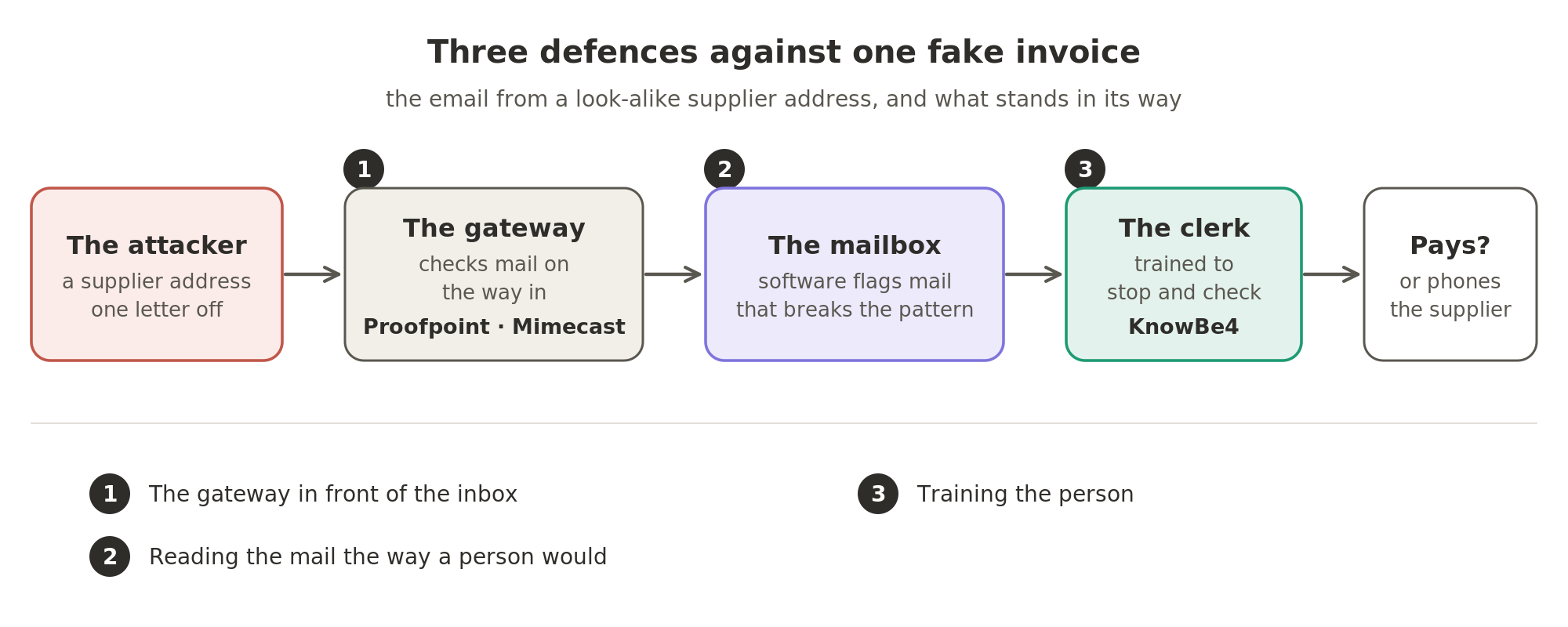
The gateway in front of the inbox: a filter that checks every email before it arrives. Reading the mail the way a person would: software that flags the message that does not fit a person's normal pattern. Training the person: teaching employees to notice the message that got through. Three defences against one fake invoice. The email from a supplier address that is one letter off first meets the gateway, such as Proofpoint or Mimecast, which checks mail on the way in. Then software inside the mailbox flags mail that breaks the normal pattern. Last is the clerk, trained by companies such as KnowBe4 to stop and phone the supplier before paying.Three defences against one fake invoice. The email from a supplier address that is one letter off first meets the gateway, such as Proofpoint or Mimecast, which checks mail on the way in. Then software inside the mailbox flags mail that breaks the normal pattern. Last is the clerk, trained by companies such as KnowBe4 to stop and phone the supplier before paying.

Keep reading, free

Three more sections are on this page: The gateway in front of the inbox, Reading the mail the way a person would, and Training the person. Sign in to read them here, in full.

Continue with Google
  • The gateway in front of the inbox
  • Reading the mail the way a person would
  • Training the person
The gateway in front of the inbox Secure email gateways, protecting the company's name in email (DMARC), and archiving mail

Take the fake invoice from the start of this Market Segment. If the company uses an email gateway, the invoice reaches the gateway first. Here, a gateway means a mail filter, not a payment gateway. The company sends all its incoming mail to the gateway company's servers by changing a DNS setting called the MX record. The gateway checks each message for known malware, bad links and forged senders. It passes on only the ones it finds safe.

The gateway is the older product, and still the bigger business. The companies that built it have all grown into the things a gateway naturally touches:

  • archiving the mail
  • training the people who receive it
  • protecting chat tools like Microsoft Teams and Slack, which now carry as much work as email does

Archiving matters because regulated firms, such as banks and stockbrokers, must keep a copy of their staff's email for the regulator. The gateway already sees every message, so it can keep the copies. (More on archiving in Market Segment 4.14, Governance, risk and compliance (GRC).)

One piece of this business protects the company's name rather than its inbox. It is called DMARC. DMARC is a standard that lets a company publish a rule for every mail server in the world: only these senders may send mail from our domain. A tool to manage DMARC is how a bank stops strangers sending mail in the bank's name. So the gateway guards the company's own inbox, and DMARC guards the company's name in everyone else's.
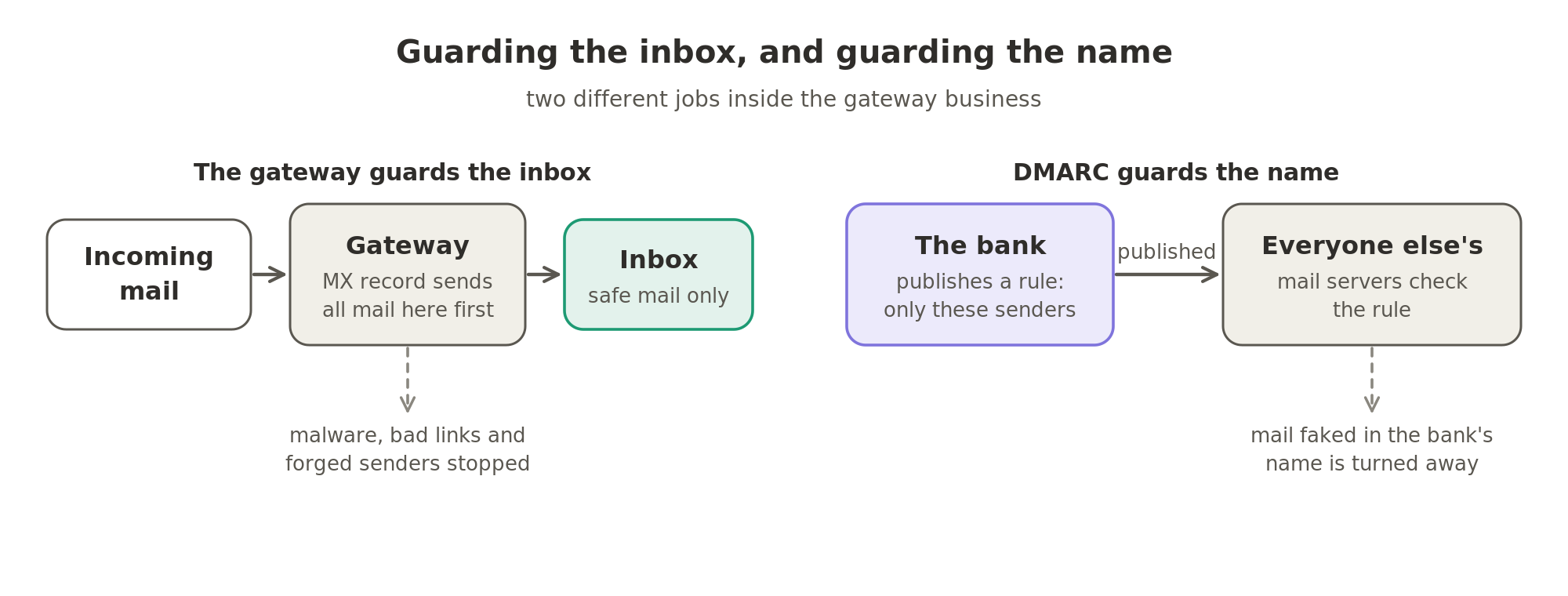
Two jobs inside the gateway business. The gateway guards the inbox: a DNS setting called the MX record sends all incoming mail to it first, and it stops malware, bad links and forged senders. DMARC guards the name: the bank publishes a rule saying only these senders may send its mail, and every other mail server checks that rule and turns away mail faked in the bank's name.Two jobs inside the gateway business. The gateway guards the inbox: a DNS setting called the MX record sends all incoming mail to it first, and it stops malware, bad links and forged senders. DMARC guards the name: the bank publishes a rule saying only these senders may send its mail, and every other mail server checks that rule and turns away mail faked in the bank's name.

Proofpoint, Mimecast, Barracuda and GlobalGuard all have engineers in Bengaluru.

Proofpointis the largest name in this category. It began as an email filter. It then added archiving, awareness training and a cloud access broker, which watches and controls how employees use cloud apps. It is now owned by a private investment firm. Mimecastfrom London, sells the same three things as Proofpoint on a smaller scale: the gateway, the archive and awareness training. DMARC Analyzernow part of Mimecast, is a tool for managing DMARC. Barracudais best known for its email gateway. It also sells the other security products a small business needs. These include a network firewall and a web application firewall, which blocks attacks aimed at a website. (More on its firewall in Market Segment 4.5, Network security, firewalls and SASE.) GlobalGuardformerly called MailGuard, is an Australian email gateway company.
Reading the mail the way a person would API-based email security, business email compromise (BEC), brand impersonation and takedown

Back to the fake invoice from the start of this Market Segment. It is simply a believable request from a believable address. The address is one letter off, but the attacker really owns that look-alike domain. The mail truly comes from the domain it claims, so DMARC has nothing to catch. And a gateway built to scan for malware sees nothing wrong.

A newer idea came once companies moved their email to Microsoft 365 and Google Workspace, the business versions of Outlook and Gmail. The newer companies do not sit in front of the mailbox. They connect to it through Microsoft's or Google's API. From there, they build a profile of how every person in the company normally writes, who they write to and who they pay. Then they flag the message that breaks the pattern. Here, that is a first-time sender asking for money to go to a new bank account.

It also catches a harder case: mail sent from a colleague's real account after an attacker has taken it over. This is called account takeover. (More on protecting the login in Market Segment 4.2, Identity and access management (IAM).)

Abnormal AIformerly Abnormal Security, is the best-known company built on this approach. It has engineering in Bengaluru.

One company here works outside the inbox instead. Think of the first email from the start of this Market Segment, the one that links to a fake login page.

Bolster AIfinds the fake login pages and look-alike domains that phishing mail links to, and gets them taken down. The industry calls this digital risk protection. (More on digital risk protection in Market Segment 4.12, Threat intelligence and attack surface management.) AI on both sides.

Generative AI, the kind behind ChatGPT, now writes phishing mail without the spelling mistakes that used to give it away. Defenders use the same kind of AI to read the tone and intent of every message. Abnormal AI is the company in this Market Segment built for that contest. The gateway companies are adding the same detection to their filters.

You're reading as a guest. Sign in free to follow links for five minutes, once an hour. Training the person Security awareness training and phishing simulation

Back to the fake invoice from the start of this Market Segment. Whatever the filters catch, some mail gets through. Then the last defence is the clerk who pauses before paying and phones the supplier to check. Training employees to pause like this is called security awareness training.

KnowBe4built its company on this. It sells a library of training modules, and a simulator that sends staff fake phishing mail and reports who fell for it. The industry calls this phishing simulation. KnowBe4's product is the one the rest of this market is measured against. In 2024, it also started selling email security, by buying a company called Egress.

Proofpoint and Mimecast, the gateway companies in the first sub-segment, each sell their own version of this training. So the sub-segments group companies by where they started. Several now sell more than one of the three kinds of product.

One company here works on a different answer instead: sending sensitive documents without using email at all.

Concord Technologiessells secure cloud fax and document exchange. A fax sends a scanned page over the phone line. Cloud fax does the same over the internet, with no fax machine needed. American hospitals use it for patient records, because email is not trusted with them. It is a reminder that the oldest answer to unsafe email is a different channel. (More on it in Market Segment 23.3, Healthcare data platforms and interoperability, in Industry Vertical 23, Health insurance and billing.) So the fake invoice from the start of this Market Segment has three defences to get past. The gateway checks it on the way in. Software inside the mailbox notices that it breaks the pattern. And the clerk is trained to stop and check.
Who they hire

Who these companies hire, and for what, is on What cybersecurity hires for.

Privacy Terms Refunds and cancellation Shipping and delivery © 2026 ingrid.fyi · Payments by Razorpay
You're browsing as a guest. Sign in free to follow links for five minutes, once an hour.