ingrid.fyi India's software hiring trends, explained.
Sign in to ingrid.fyi with Google
Your Google account
name@gmail.com
Continue with Google
Home / Product companies / VI · Healthtech and life sciences / Pharma and life sciences / AI drug discovery platforms
On this page
AI drug discovery platforms Finding the molecule that acts on a disease, with software and AI models beside the chemist Picture the cream the skin doctor prescribed to the patient in Texas, in Market Segment 22.1, Electronic health record (EHR) software. Its active ingredient is a molecule. More than ten years earlier, a team of scientists had to find that molecule, among billions that might have worked.

Industry Vertical 25, Pharma and life sciences, is the last one in Domain VI, Healthtech and life sciences. It follows a medicine from the laboratory to the patient. It begins with discovery: finding a molecule that acts on a disease. That work is now done as much on computers as at the laboratory bench:

  • software that models how molecules behave
  • platforms that organise biological data
  • AI models that propose new candidate molecules

This Market Segment is about those tools. Their buyers are drug companies, biotech companies and research laboratories. It is a small Market Segment, with six companies. (More on the AI models underneath in Market Segment 9.1, Foundation model companies, in Industry Vertical 9, AI labs and model platforms.)

Every company named here has posted software engineering jobs in India. Famous companies that don't actively hire software engineers in India are left out.

Keep reading, free

One more section is on this page: What this section holds. Sign in to read it here, in full.

Continue with Google
  • What this section holds
What this section holds

Back to the molecule in the skin cream from the start of this Market Segment. Its discovery would have started from a target: a protein in the body that the disease depends on. The scientists then had to find a molecule that fits that target, the way a key fits a lock.
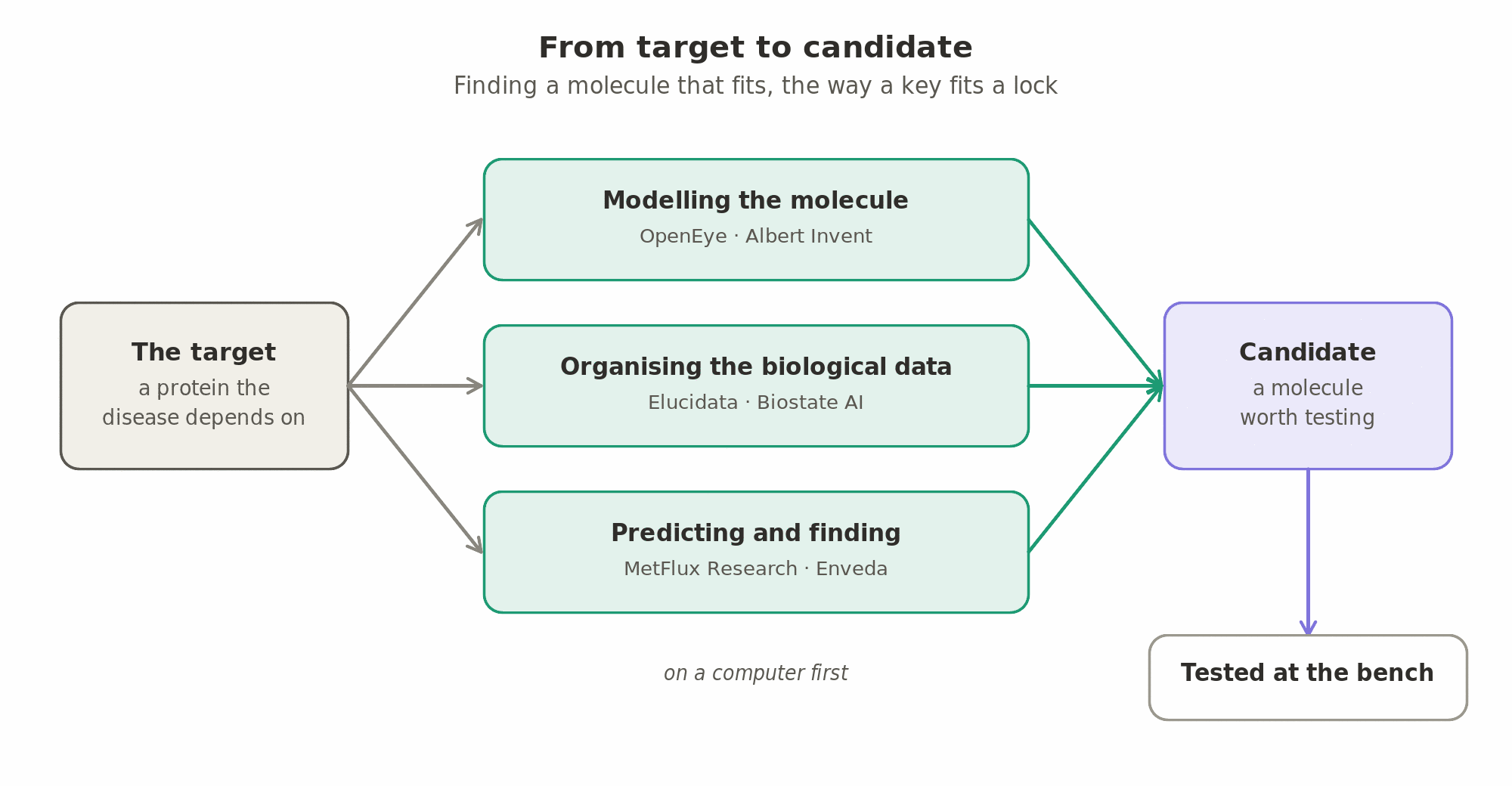
Discovery starts from a target, a protein the disease depends on, and looks for a molecule that fits it the way a key fits a lock: software models the molecule (OpenEye, Albert Invent), platforms organise the biological data (Elucidata, Biostate AI), and models predict and find candidates (MetFlux Research, Enveda), before anything is tested at the bench.Discovery starts from a target, a protein the disease depends on, and looks for a molecule that fits it the way a key fits a lock: software models the molecule (OpenEye, Albert Invent), platforms organise the biological data (Elucidata, Biostate AI), and models predict and find candidates (MetFlux Research, Enveda), before anything is tested at the bench.

Modelling the molecule

OpenEye (Cadence Molecular Sciences)with engineers in Bengaluru, has the most job postings in this Market Segment. It sells the software with which chemists model molecules, and search for ones that fit a target. It is now owned by Cadence, the chip-design software company. (More on Cadence in Market Segment 35.7, Chip design software (EDA), in Industry Vertical 35, Semiconductors and chip design.) Albert Inventwith engineers in Bengaluru, sells an AI platform for chemistry and materials research, from the first experiment to the final recipe of a product, called the formulation.

Organising the biological data

Elucidatawith engineers in Bengaluru, sells Polly. Polly cleans biological and genetic data, and puts it into one consistent form, so discovery teams can use it. Biostate AIsells RNA sequencing, which reads which genes are active in a cell, with an AI assistant to analyse the results.

Predicting and finding

MetFlux Researchwith engineers in Bengaluru, models the human body's processes on a computer, which is called in silico. It uses this to predict how a drug will behave in the body. Envedawith engineers in Hyderabad, uses AI to find new medicines in the chemistry of plants. The molecule designed by a model.

AI models can now predict the 3D shape of a protein, and generate new molecules to fit it. That has moved discovery from screening the molecules that already exist to designing ones that do not. The first drugs designed by AI are now in clinical trials. The open question is whether they succeed more often than drugs found the old way.
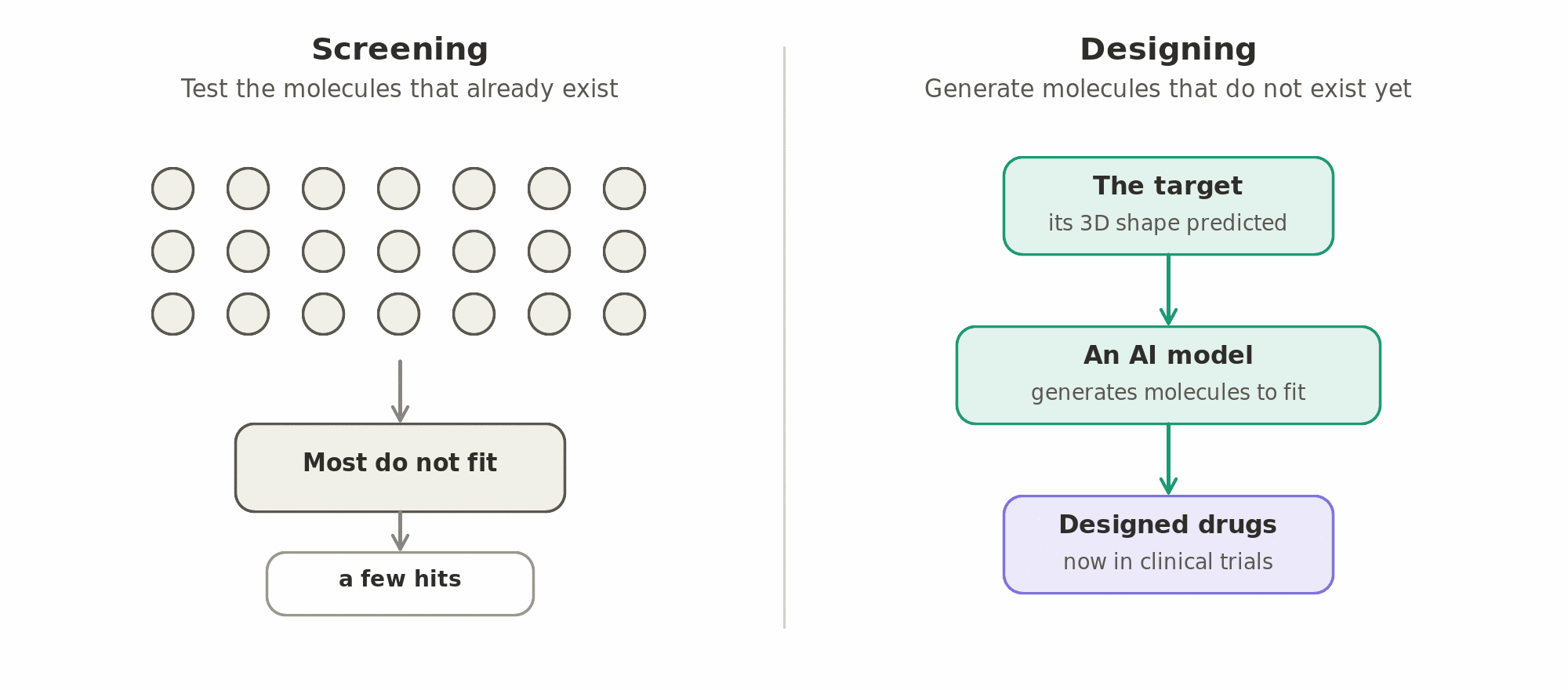
Screening tests the molecules that already exist against a target; designing has a model predict the target's 3D shape and generate new molecules to fit it.Screening tests the molecules that already exist against a target; designing has a model predict the target's 3D shape and generate new molecules to fit it. So the molecule in the patient's skin cream from the start of this Market Segment began as a search among billions. Today that search starts on a computer, with software that models the target, the data and the candidates, before anything is tested at the bench.
Who they hire

Who these companies hire, and for what, is on What pharma and life sciences companies hire for.

Privacy Terms Refunds and cancellation Shipping and delivery © 2026 ingrid.fyi · Payments by Razorpay
You're browsing as a guest. Sign in free to follow links for five minutes, once an hour.