ingrid.fyi India's software hiring trends, explained.
Sign in to ingrid.fyi with Google
Your Google account
name@gmail.com
Continue with Google
Home / Product companies / VI · Healthtech and life sciences / Digital health / Remote patient monitoring (RPM)
On this page
Remote patient monitoring (RPM) Watching the body remotely, through sensors, ECGs and the specialists who read them Picture a small clinic in a town in Karnataka, with no heart specialist. A man walks in with chest pain. The clinic records his ECG, the tracing of the heart's electrical signals. The ECG is sent over the internet, and a heart specialist's reading comes back within minutes. After his treatment in a city hospital, he goes home wearing a small patch that keeps watching his heart.

A growing share of medical measurement now happens outside the clinic:

  • the glucose sensor on the arm
  • the ECG taken with a phone
  • the patch that watches a patient sent home from hospital
  • the hormone test done at home

The devices send their readings to software that alerts a doctor. More and more often, an AI model reads the signal itself. This is called remote patient monitoring.
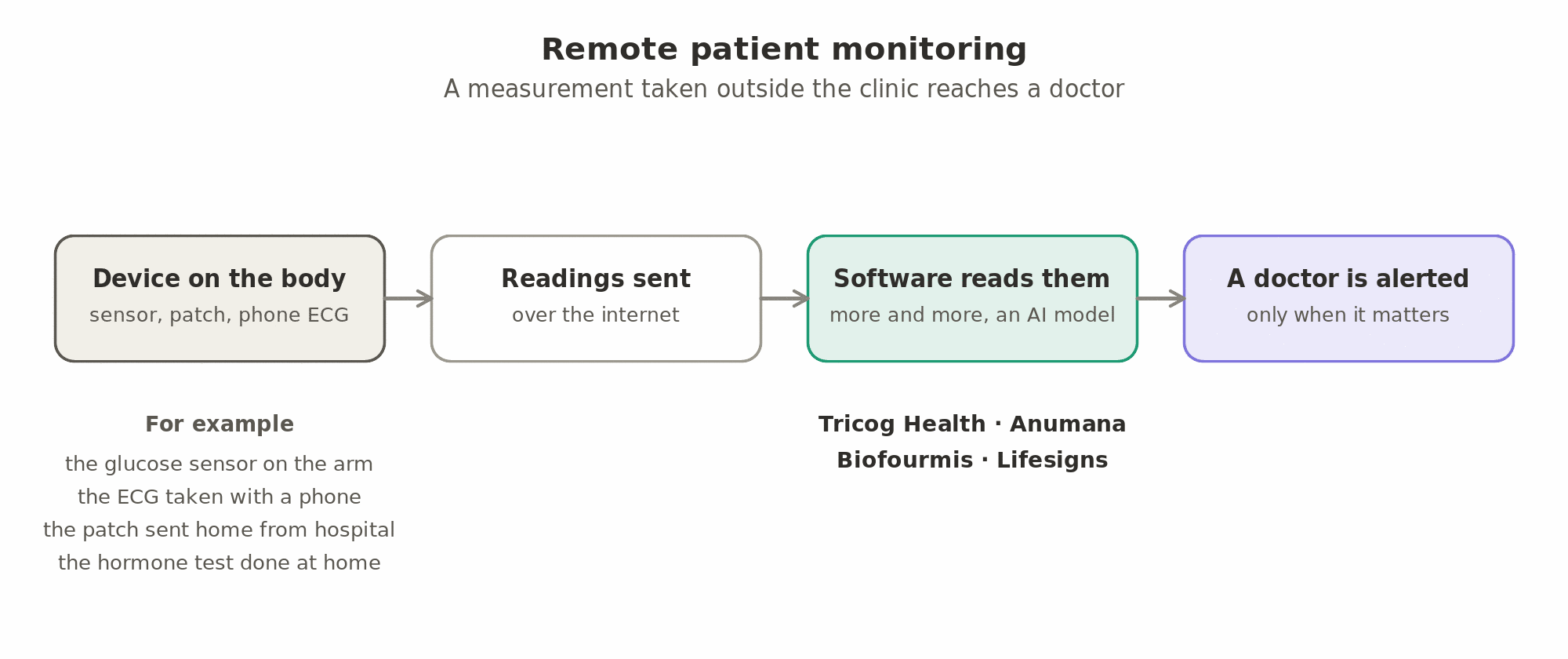
Remote patient monitoring: a device on the body, such as a glucose sensor, a phone ECG, a patch or a home hormone test, sends its readings over the internet to software that reads them, more and more often an AI model, and a doctor is alerted when it matters.Remote patient monitoring: a device on the body, such as a glucose sensor, a phone ECG, a patch or a home hormone test, sends its readings over the internet to software that reads them, more and more often an AI model, and a doctor is alerted when it matters.

This Market Segment is about the companies that make the devices and the software. Their buyers are hospitals, clinics and patients themselves.

Every company named here has posted software engineering jobs in India. Famous companies that don't actively hire software engineers in India are left out.

Keep reading, free

One more section is on this page: What this section holds. Sign in to read it here, in full.

Continue with Google
  • What this section holds
What this section holds

Blood sugar

Dexcommakes continuous glucose monitors. Its sensor reads blood sugar every few minutes, and its apps are built partly in Bengaluru. Dexcom Deutschland GmbHis a second name of the same company. It has engineers in Bengaluru, and the most job postings in this Market Segment. (It also appears in Market Segment 24.4, Medical device makers, in Industry Vertical 24, Hospitals, diagnostics and medical devices.)

The programmes built on these sensors are covered in Market Segment 22.5, Chronic disease management and digital therapeutics.

The heart. Back to the man with chest pain from the start of this Market Segment.
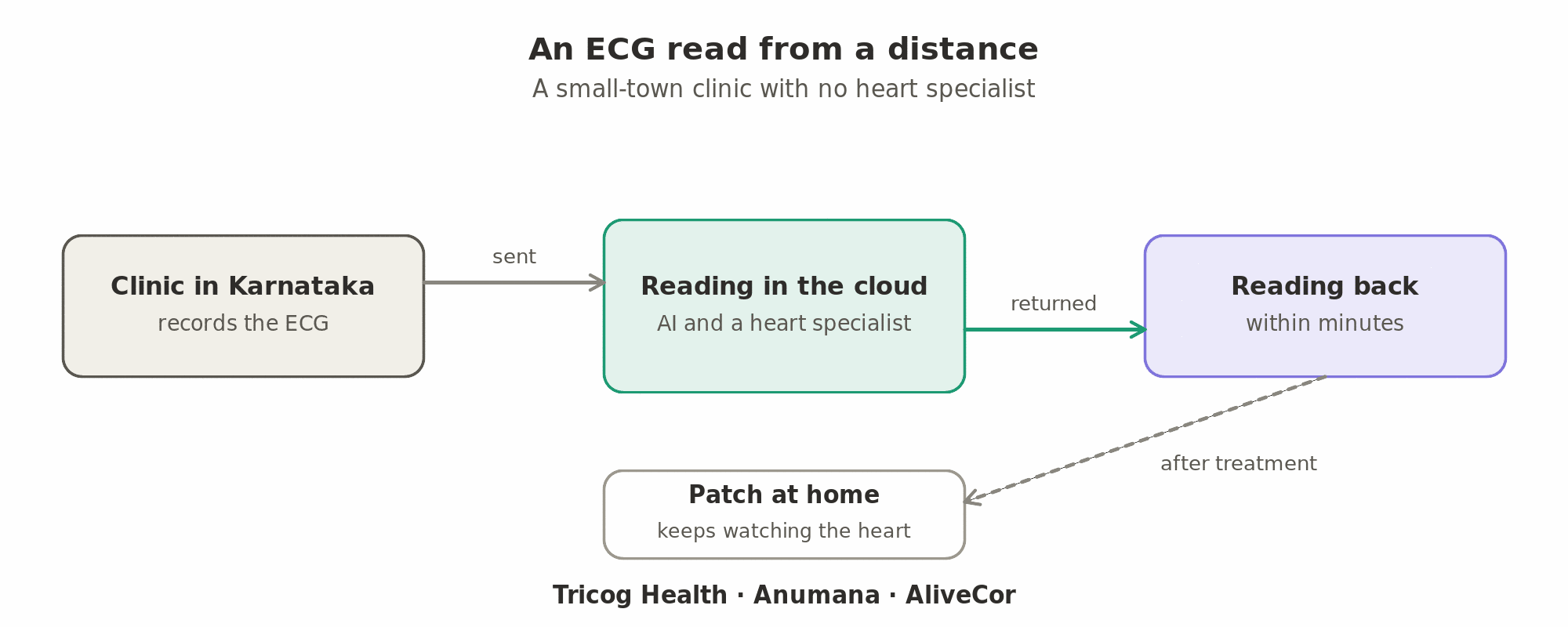
Tricog Healthwith engineers in Bengaluru, reads ECGs and echocardiograms in the cloud, for clinics across India and beyond. An echocardiogram is an ultrasound scan of the heart. Tricog gives a heart specialist's reading in minutes, to places that have no heart specialist. Anumanawith engineers in Bengaluru, sells AI that finds heart disease in an ordinary ECG. AliveCorwith engineers in Bengaluru, makes KardiaMobile, a personal ECG device that records the heart's rhythm through a phone. It also makes the website through which doctors review the recordings. An ECG read from a distance: a small clinic in Karnataka with no heart specialist records the ECG and sends it to the cloud, where AI and a heart specialist read it and return the reading within minutes; after treatment, a patch keeps watching the heart at home (Tricog Health, Anumana, AliveCor).An ECG read from a distance: a small clinic in Karnataka with no heart specialist records the ECG and sends it to the cloud, where AI and a heart specialist read it and return the reading within minutes; after treatment, a patch keeps watching the heart at home (Tricog Health, Anumana, AliveCor).

The patient at home or on the ward. Back to the patch the man wore home.

Biofourmis and Lifesignsboth with engineers in Bengaluru, watch patients at home or on the hospital ward, with sensors worn on the body. Masimomakes pulse oximeters, which measure the oxygen in the blood through a fingertip, and hospital monitors. The other companies here measure their own devices against Masimo's.

One company covered mainly in another Market Segment belongs here too:

Spacelabs Healthcarewith engineers in Hyderabad, is here for its ambulatory monitors: monitors a patient wears while moving about. (More on it in Market Segment 24.4, Medical device makers, in Industry Vertical 24, Hospitals, diagnostics and medical devices.)

Other measurements

Initowith engineers in Bengaluru, tracks fertility hormones at home, through a phone. India Health Linkputs health-screening kiosks in places that have no clinics. Nexstembuilds brain-computer interfaces that read brain signals from outside the head, without surgery. The signal read by a model.

The devices produce more data than any doctor can review. So AI models now read the ECG, the glucose curve and the vital signs, such as pulse and blood pressure. They flag what matters, and predict what will happen next. Regulators have begun approving these models as medical devices in their own right. Tricog and Anumana are built on that change.

So the man from the start of this Market Segment was measured twice from a distance. A specialist he never met read his ECG from a small-town clinic. And a patch kept watching his heart after he went home.
Who they hire

Who these companies hire, and for what, is on What digital health companies hire for.

Privacy Terms Refunds and cancellation Shipping and delivery © 2026 ingrid.fyi · Payments by Razorpay
You're browsing as a guest. Sign in free to follow links for five minutes, once an hour.