ingrid.fyi India's software hiring trends, explained.
Sign in to ingrid.fyi with Google
Your Google account
name@gmail.com
Continue with Google
Home / Product companies / II · Cloud platforms and developer tools / Devtools companies / AI coding tools
On this page
AI coding tools The AI that writes and reviews the code The three Market Segments before this one covered:

This Market Segment is about a change running through all three at once: the AI model that writes the code. (More on the AI models themselves in Market Segment 9.1, Foundation model companies, in Industry Vertical 9, AI labs and model platforms.)

In a few years, this model has gone through four stages:
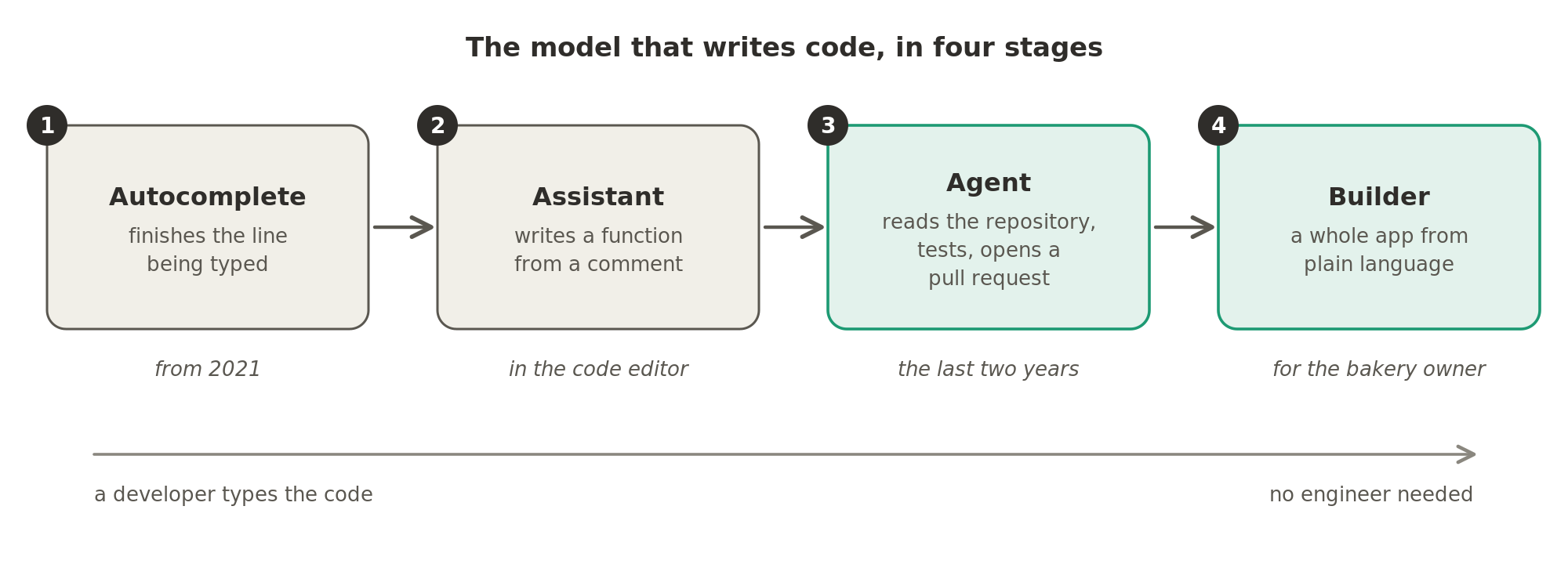
Autocomplete. It began in 2021 by finishing the line of code a developer was typing. An assistant in the code editor. It could then write a whole function from a comment, such as "check that the phone number has 10 digits". An agent. In the last two years, it has become an AI agent: software that uses a language model, the kind of AI behind chatbots, to take actions on its own. The agent is given a task, such as "fix the wrong balance shown after a payment". It reads the repository, writes the change, runs the tests and opens a pull request. A pull request is a proposed change that other developers review before it joins the main code. A builder. At the far end, it produces a whole working application from a description in plain language, for someone who cannot write code at all. Think of a bakery owner in Jaipur who wants an app for taking orders, and has no engineers. The model that writes code has moved through four stages: autocomplete that finishes a line, an assistant that writes a function from a comment, an agent that reads the repository and opens a pull request, and a builder that makes a whole app from plain language with no engineer needed.The model that writes code has moved through four stages: autocomplete that finishes a line, an assistant that writes a function from a comment, an agent that reads the repository and opens a pull request, and a builder that makes a whole app from plain language with no engineer needed.

This is the fastest-moving category in this collection, and one of the smallest. It has six young companies, all founded in the last few years, and all with engineers in India.

Every company named here has posted software engineering jobs in India. Famous companies that don't actively hire software engineers in India are left out.

The small number says where the engineering happens, not how big the industry is. The tools most developers actually use are made by companies that are not covered here. GitHub Copilot, from Microsoft, is covered elsewhere. (More on it in Microsoft, in the big-tech collection.) Cursor, Replit, Lovable, Cognition and Windsurf are not covered in this Market Segment.

This Market Segment has one sub-segment. It reads the six companies as one story: from the assistant that reviews a change, to the agent that builds the whole product.

Keep reading, free

One more section is on this page: From reviewing the change to building the product. Sign in to read it here, in full.

Continue with Google
  • From reviewing the change to building the product
From reviewing the change to building the product

The story begins with the model inside the way teams already work. Take the pull request that fixes the wrong balance, from the start of this Market Segment. Before a human reviews it, a model can read it first.

CodeRabbitwith engineers in Bengaluru, sells AI code review. It reads every pull request as it is opened. It comments on the bugs, the style and the cases the developer missed, and it summarises the change for the human reviewer. So its product fits into the existing toolchain rather than replacing it. (More on the toolchain in Market Segment 6.1, DevOps and CI/CD tools.)

The rest of this sub-segment is the model writing the software itself.

Emergentwith engineers in Bengaluru, sells an autonomous coding platform. Autonomous means its agents work without a person guiding each step. They take a description, write the application, maintain it, generate its tests and deploy it. Emergent is a clear example of the agent sold as a product. (More on tests in Market Segment 6.2, Software testing platforms.) Blitzya Boston-area company with engineers in Pune, sells the same idea to large companies. Its autonomous platform takes on large pieces of software that have been specified in detail, rather than a prototype, a first rough version. Blink.newis a small start-up with engineers in Bengaluru, backed by Y Combinator, a well-known programme that funds young start-ups. It is a smaller version of the same idea: a full-stack app builder. Full-stack means it builds both the screens the user sees and the server and database behind them. It generates the code, and wires in payments and a database. Its customer is a founder with an idea and no engineers, like the bakery owner from the start of this Market Segment.

There is an older way to build an app with little code, called low-code. (More on it in Market Segment 10.3, RPA, process mining and low-code platforms, in Industry Vertical 10, ERP and business automation.)

Two companies apply the model to a narrower kind of code:
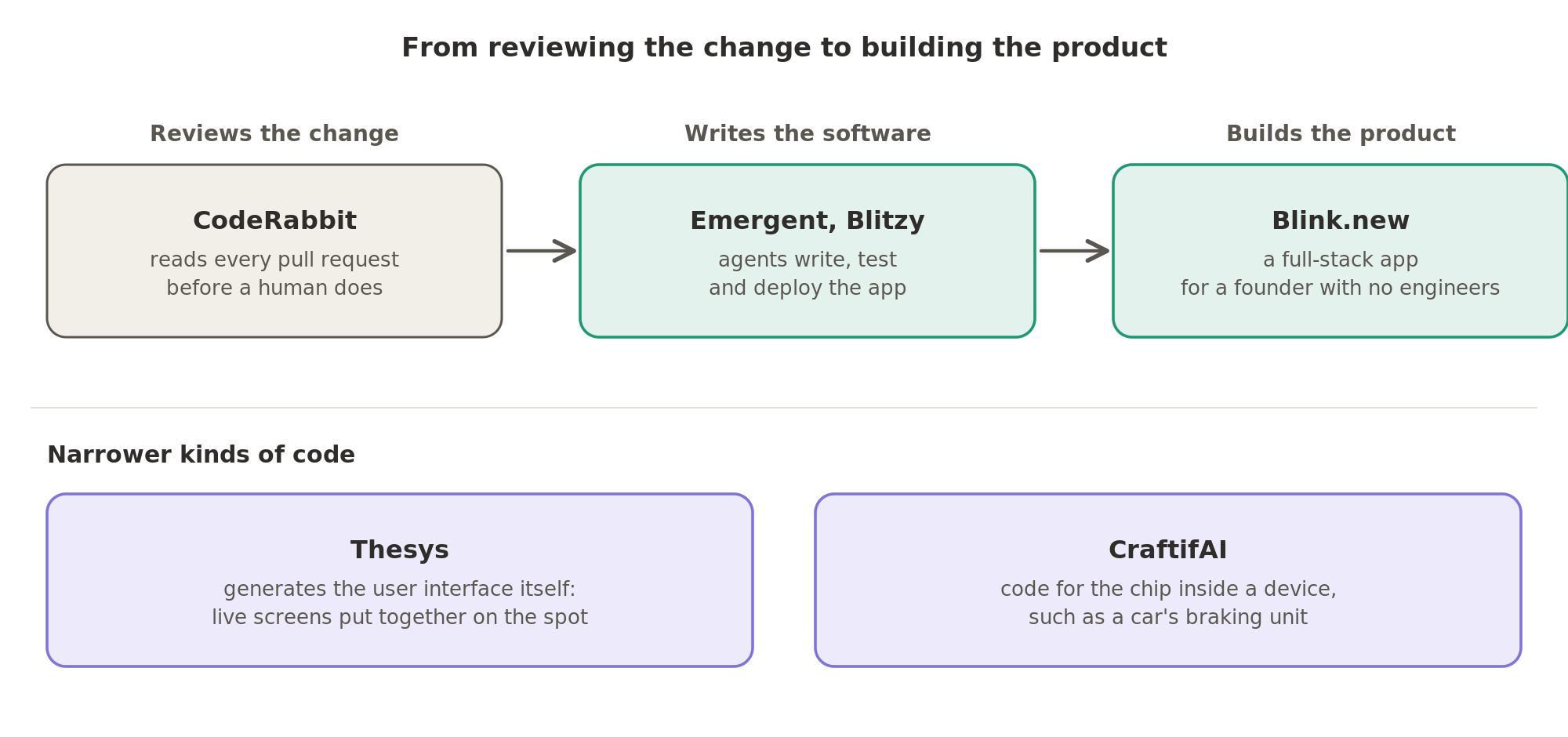
Thesyswith engineers in Bengaluru, generates the user interface itself. Instead of a chat window, its product lets an application show live, interactive screens. A model puts these screens together on the spot, in response to what the user asks. This is what a generated application looks like from the inside. CraftifAIa young Bengaluru company, points the agent at embedded systems. Embedded software runs on the chip inside a device, such as a washing machine or a car's braking unit. CraftifAI generates code optimised for a particular chip. It also helps a hardware team design the software and the hardware together. This is a part of programming that the general AI coding assistants serve poorly. Companies here sit along that path, from reviewing every change before a human does, to agents that write and deploy the software, to building the whole product for a founder; others write narrower kinds of code, such as the user interface itself or the code for a chip inside a device.Companies here sit along that path, from reviewing every change before a human does, to agents that write and deploy the software, to building the whole product for a founder; others write narrower kinds of code, such as the user interface itself or the code for a chip inside a device. This whole Market Segment.

Every company here is at the frontier of its own business. They share the question the whole industry is asking. How much of the work in Market Segment 6.1 can be handed to the model? And what does the engineer do with the rest? Hiring in India suggests the answer is being worked out mostly elsewhere. It is happening in the Indian centres of the large tool makers. It is also happening in global capability centres (GCCs): the engineering centres that large foreign companies run in India for their own work. (More on these centres in the GCC collection.) The companies here are the attempt, from inside India, to be part of it.

That is the AI that writes the code. It reviews the change, writes the software, and builds whole apps for people who cannot code.
Who they hire

Who these companies hire, and for what, is on What devtools companies hire for.

Privacy Terms Refunds and cancellation Shipping and delivery © 2026 ingrid.fyi · Payments by Razorpay
You're browsing as a guest. Sign in free to follow links for five minutes, once an hour.