Picture a patient in Texas who visits a skin doctor about a rash. The doctor opens the patient's record on a screen. It shows past illnesses, current medicines and an allergy to one antibiotic. The doctor types a note, orders a blood test and prescribes a cream. At the front desk, the bill is produced from the same record.
Domain VI, Healthtech and life sciences, begins with this record, which every visit leaves behind. It is called the electronic health record, or EHR. It holds a patient's history: the diagnoses, the medicines, the test results and the doctor's notes. It is also the system a clinic or hospital runs on. The doctor writes in it, the nurse follows the orders in it, and the bill is produced from it.
In America, the government has pushed almost every clinic and hospital to use one, so the market is enormous. A large share of the software is built in India. The buyers are clinics, hospitals and other care providers, mostly American.
Every company named here has posted software engineering jobs in India. Famous companies that don't actively hire software engineers in India are left out.
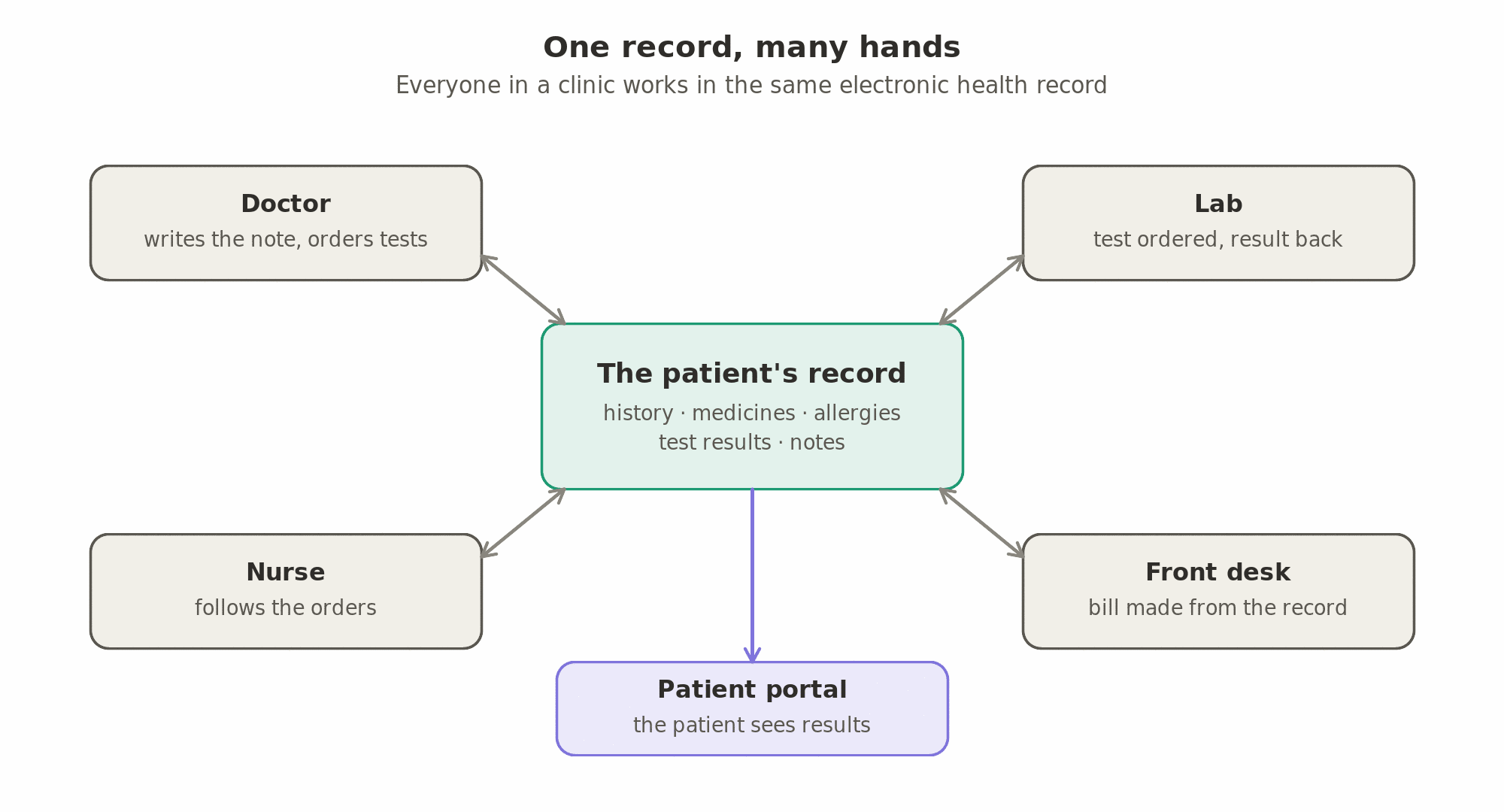 One record, many hands: the doctor writes the note and orders tests in the patient's record, the nurse follows the orders, the lab receives the test and sends the result back, the front desk produces the bill from it, and the patient sees results through the patient portal.
This Market Segment has two sub-segments:
The clinic's and the hospital's record: records sold to general and specialist doctors, urgent-care clinics and hospitals.
Behavioural health and long-term care: records for mental-health, addiction and home-care services, which have needs of their own.
The clinic's and the hospital's record
Specialty and ambulatory EHRs, practice management, urgent care, procedure documentation, hospital EHRs
Back to the skin doctor from the start of this Market Segment. A doctor's clinic, run as a business, is called a practice. Care given without a hospital stay is called ambulatory care. Around the record sits practice management: the software that books appointments, bills patients and takes payments.
Records for specialist practices:
ModMed and ModMed Indiaits Indian company, together sell the record of American specialist practices: skin doctors, eye doctors and bone surgeons. Practice management, billing and payments come with it. Both have engineers in Hyderabad, and ModMed India has the most job postings in this Market Segment. Their Hyderabad centre builds most of the product.
Experitywith engineers in Bengaluru, sells the record of urgent-care clinics: walk-in clinics for problems that cannot wait, but are not emergencies.
Provationwith engineers in Bengaluru, records procedures and anaesthesia.
Integra Connectsells the record of cancer and urology practices.
Records for general practices and hospitals:
Veradigmformerly Allscripts, with engineers in Pune, sells the ambulatory record and the patient portal of many American practices. A patient portal is the website where patients see their own results and appointments.
Altera Digital Healthwith engineers in Pune, carries the hospital records that were once Allscripts': Sunrise and TouchWorks.
athenahealthwith engineers in Bengaluru and Chennai, sells a cloud record, with billing and patient engagement, to American practices.
Greenway Healthwith engineers in Bengaluru, sells the same to smaller practices.
Newer and smaller companies:
Athelaswith engineers in Bengaluru and Delhi, sells a record built around AI from the start. It includes billing, and ambient dictation: software that listens to the visit and writes the note.
Edvak EHRwith engineers in Hyderabad, sells an AI-native record for outpatient clinics.
Mynx Softwareswith engineers in Delhi, sells records for chiropractors and general clinics.
One company covered mainly in another Market Segment belongs here too. Take the blood test the skin doctor ordered.
Quest Diagnosticswith engineers in Hyderabad, is here for Quanum, the software through which doctors order its tests and receive the results. (More on it in Market Segment 24.2, Diagnostics and lab testing, in Industry Vertical 24, Hospitals, diagnostics and medical devices.)
Behavioural health and long-term care
EHRs for behavioural health, addiction treatment, home care and post-acute care, and care management
Now picture the same patient's grandmother. After a hip operation, a nurse visits her at home every week for months. Her care has no single visit to record. It has a long series of them, by many carers, in many places. The same is true of mental-health care and addiction treatment, which the industry calls behavioural health. Care after a hospital stay is called post-acute care. These services need records of their own.
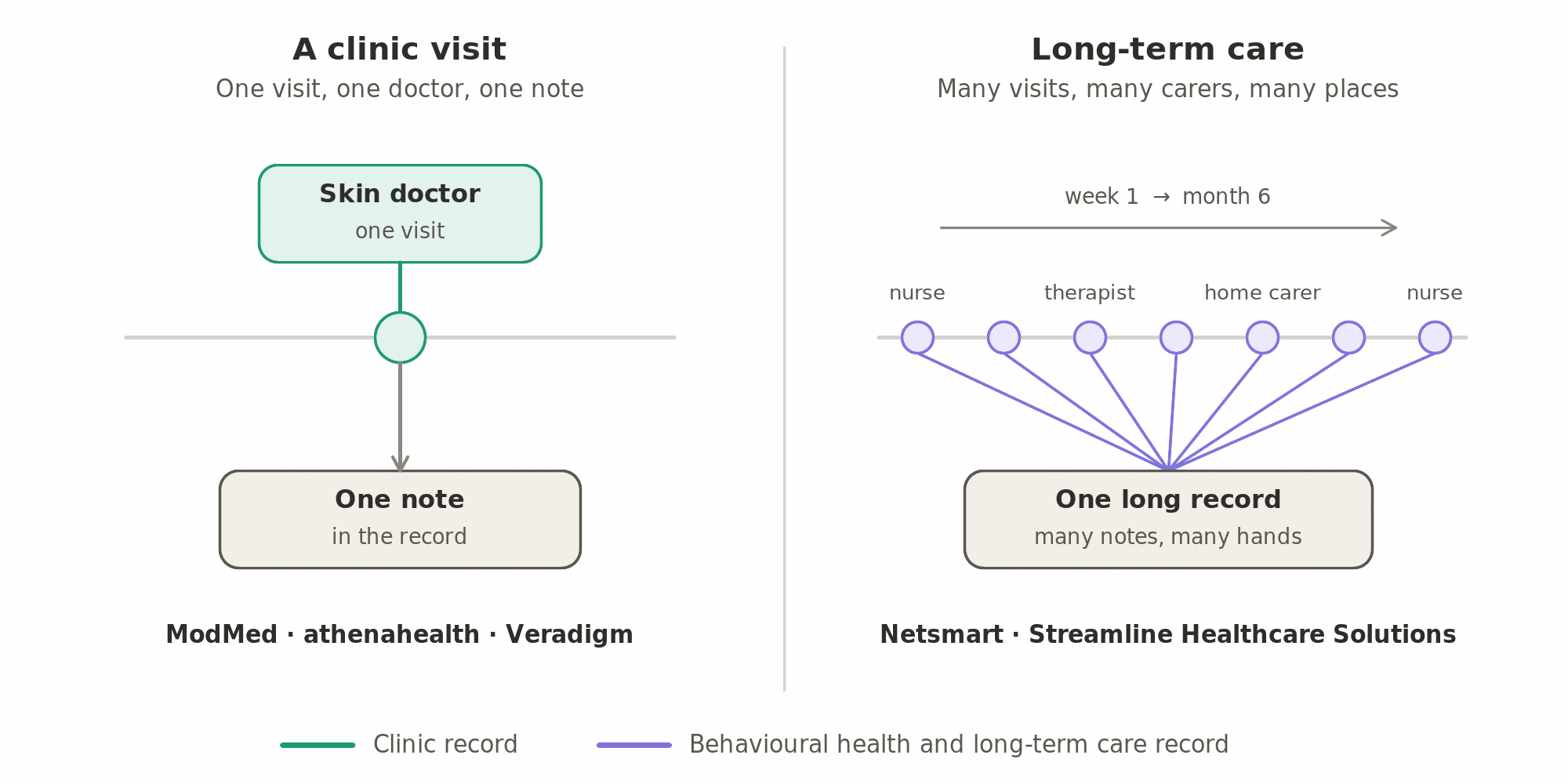 A clinic visit leaves one note from one doctor in the record (ModMed, athenahealth, Veradigm), while long-term care leaves many notes from nurses, therapists and home carers over months in one long record (Netsmart, Streamline Healthcare Solutions).
Netsmartwith engineers in Bengaluru, sells the record of American behavioural-health, addiction and home-care providers. It includes Bells, its AI scribe, which writes the carer's notes.
Simple (Netsmart) and Netsmart Indiaare two more names of the same company, both with engineers in Bengaluru.
Streamline Healthcare Solutionswith engineers in Bengaluru, sells SmartCare, another behavioural-health record.
AaNeelsells care management and interoperability to care providers and to insurers, which the industry calls payers. Interoperability means letting different record systems exchange a patient's data.
The record that listens.
A clinic visit leaves one note from one doctor in the record (ModMed, athenahealth, Veradigm), while long-term care leaves many notes from nurses, therapists and home carers over months in one long record (Netsmart, Streamline Healthcare Solutions).
Netsmartwith engineers in Bengaluru, sells the record of American behavioural-health, addiction and home-care providers. It includes Bells, its AI scribe, which writes the carer's notes.
Simple (Netsmart) and Netsmart Indiaare two more names of the same company, both with engineers in Bengaluru.
Streamline Healthcare Solutionswith engineers in Bengaluru, sells SmartCare, another behavioural-health record.
AaNeelsells care management and interoperability to care providers and to insurers, which the industry calls payers. Interoperability means letting different record systems exchange a patient's data.
The record that listens.
The electronic record turned doctors into typists. Studies find that doctors spend as long in the record as with patients. The record of the next decade listens to the visit, writes the note, suggests the orders, and works out the billing codes. Every company in this Market Segment is adding that assistant. Other companies sell it as a product of its own. (More on them in Market Segment 22.2, AI medical scribes and clinical documentation.)
So the patient from the start of this Market Segment leaves a record behind at every visit. The skin doctor's clinic runs on one kind of record. The grandmother's months of home care run on another. Much of the software behind both is built in India.