Take the fan maker in Coimbatore from Market Segment 10.1, ERP and business accounting software. Its accounts team is growing, and it needs two more clerks to check supplier documents and answer dealers' questions. Instead of hiring them, it could hire an AI agent. An agent is AI software that is given access to the company's systems and a goal, and does the work on its own.
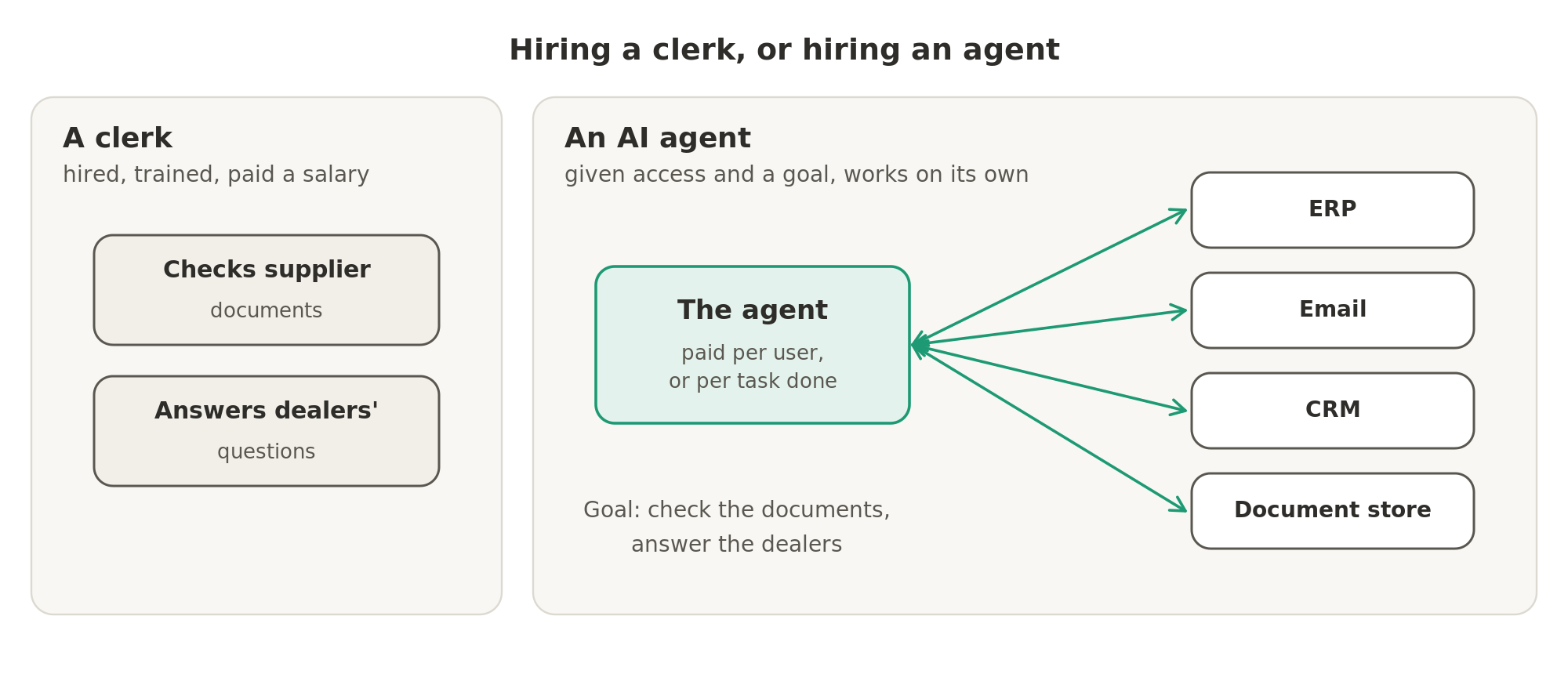
The companies in this Market Segment sell such agents as a replacement for a role or a team: the analyst, the support desk, the back-office clerk. A company pays for them per user, or per task done, and plugs them into the systems of the earlier Market Segments. Their buyers are companies of every kind.
Agents built for one department are covered with that department:
- agents that talk to customers, in Market Segment 15.2, Conversational AI for customer service
(in Industry Vertical 15, Customer service and CX) - agents that write code, in Market Segment 6.4, AI coding tools
(in Industry Vertical 6, Devtools companies)
This Market Segment covers the general-purpose ones: platforms that promise an AI employee for any job.
This is a Market Segment of very small companies: 16 of them. All but one were founded in India, and most have fewer than a dozen people. That is what a very young category looks like. Two other Market Segments are worth reading beside it:
- Market Segment 9.2, MLOps and LLMOps platforms
(in Industry Vertical 9, AI labs and model platforms) , sells the infrastructure these companies build on. - Market Segment 10.3, RPA, process mining and low-code platforms, is where the automation companies are all now selling agents too.
Every company named here has posted software engineering jobs in India. Famous companies that don't actively hire software engineers in India are left out.
This Market Segment has two sub-segments:
Keep reading, free
Two more sections are on this page: The agent as a worker and The app maker. Sign in to read them here, in full.
Continue with Google- The agent as a worker
- The app maker
Back to the fan maker from the start of this Market Segment, and the two clerks it did not hire. The companies in this sub-segment sell the agent that would do their work.
The rest of this sub-segment is the category's early field. Each company presents itself as a builder of AI agents, or AI employees, for companies. They are early bets, not yet established businesses.
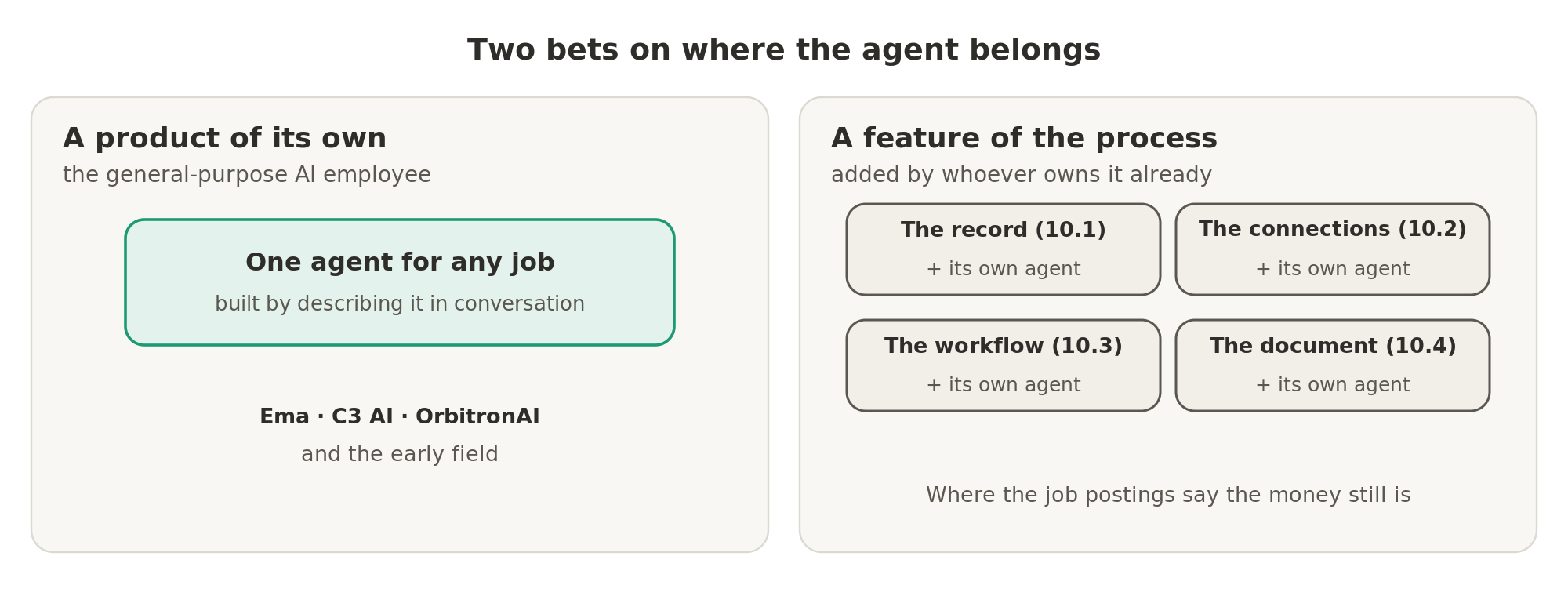
The question this Market Segment asks is whether the agent is a product at all. It may instead be a feature that every company in Market Segments 10.1 to 10.4 adds, as most already have. Ema's bet is that the general-purpose AI employee is a category of its own. The automation companies' bet is that the agent belongs to whoever already owns the process. For now, the job postings say the money is still mostly with the established companies.
Back to the fan maker from the start of this Market Segment. Its sales head needs a slide deck for next week's dealer meet. That needs no enterprise platform, just an AI app that makes the deck.
Two small Bengaluru companies stand for this other end of the Market Segment: the AI app that anyone can use.
Neither sells to large companies. They are here because this Market Segment covers the general-purpose app maker as well as the enterprise agent.
So the fan maker from the start of this Market Segment could hire an AI agent to do a clerk's work. Or it could use an AI app to make a sales deck. Whether that agent is a new kind of product, or a feature of the software the fan maker already runs, is the question this young category has yet to answer.
Who these companies hire, and for what, is on What ERP and business automation companies hire for.