Unlock an iPhone with your face, and a lot happens in under a second. A camera maps your face. A chip that Apple designed checks it against a stored pattern. The operating system, iOS, opens the phone. Later, you ask Apple Maps for directions and pay for an app on the App Store. Apple made the phone, the chip, the software and the services, and it has engineers in India working on parts of them.
Apple was founded in 1976 by Steve Jobs and Steve Wozniak, in California. It began by making personal computers. It is based in Cupertino, California.
Apple opened an engineering centre in Hyderabad in 2016, to work on Apple Maps. It also has engineers in Bengaluru. Apple says less in public about its teams than the other big tech companies do.
Apple also makes many of its iPhones in India, through manufacturing partners such as Foxconn and Tata Electronics. That is factory work, not software engineering, and it is not covered here.
Every name listed here has posted software engineering jobs in India.
What Apple sells, and to whom
Apple is different from the other big tech companies in one way. It makes most of its money by selling devices, not software or ads. Most of its customers are people, not companies.
Apple earns its money in two main ways:
devicesthe iPhone, which brings in the largest share, and the Mac, the iPad, the Apple Watch and AirPods
servicesa share of what people pay for apps on the App Store, and subscriptions such as iCloud storage, Apple Music and Apple TV+
What makes Apple unusual is that it builds almost every layer itself:
The devicesdesigned by Apple.
The chips inside themApple designs its own processors, such as the M-series chips in the Mac, built on Arm's processor design.
The operating systemsiOS for the iPhone, and macOS for the Mac.
The apps and servicesthat run on them, such as Maps, Siri, iCloud and the App Store.
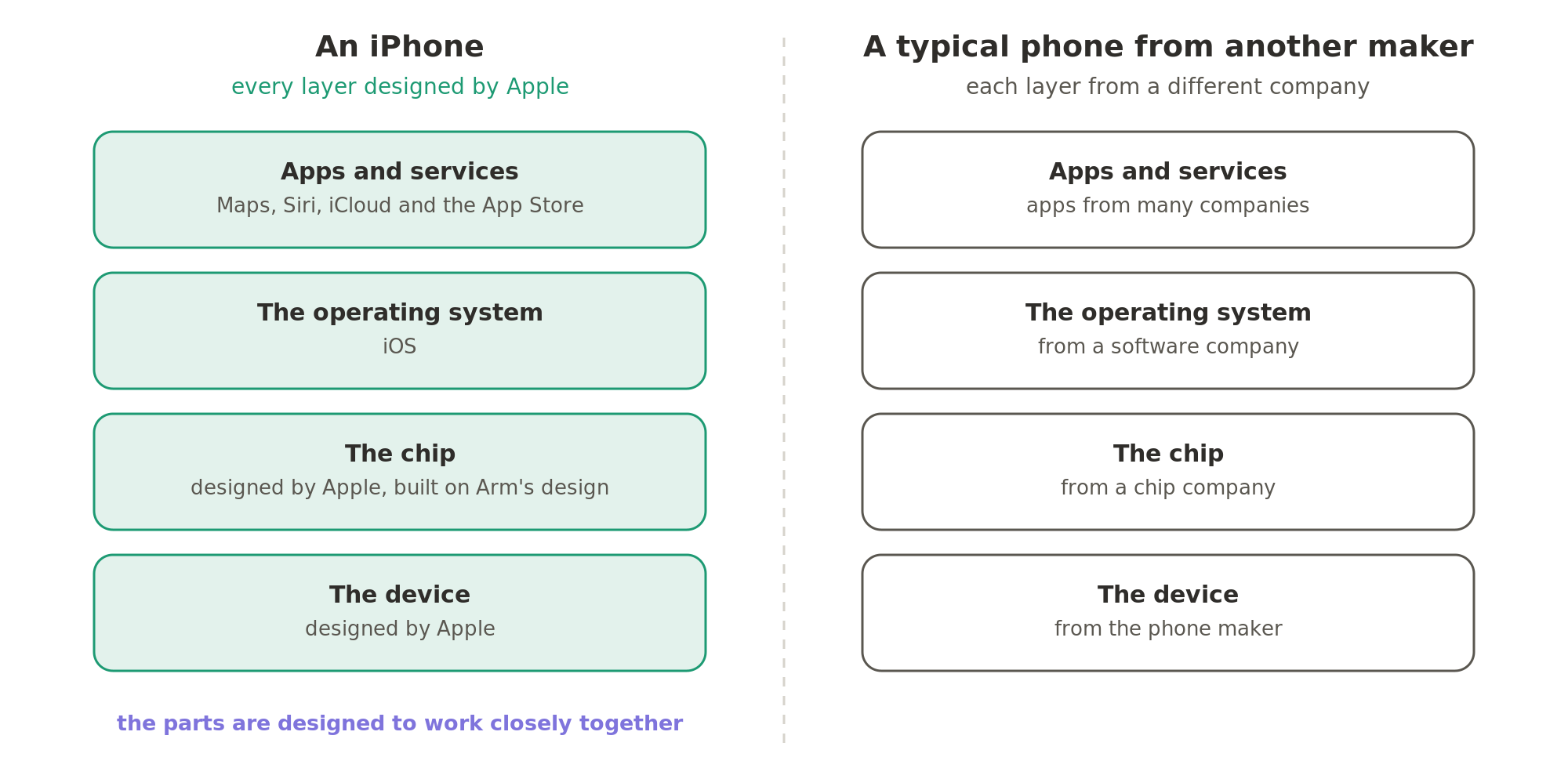 On an iPhone, Apple designs every layer: the device, the chip inside it, the operating system and the apps and services on top. On a typical phone from another maker, each layer comes from a different company, which is why Apple's parts can be designed to work more closely together.
Because Apple controls every layer, the parts are designed to work closely together. This is the main reason people choose, and pay more for, Apple's devices.
What it builds in India
Apple's engineers in India work on parts of its software and services. Maps was the first. The Hyderabad centre was set up to build and improve Apple Maps, and its Indian teams have since grown into other software and services.
You're reading as a guest. Sign in free to follow links for five minutes, once an hour.
Sign in
Where its products are explained
Some of what Apple makes is also made by other companies. The product-companies collection explains how each kind of product works, through those companies:
Apple MapsMarket Segment 8.4, Mapping and location intelligence platforms, in Industry Vertical 8, Analytics and data providers.
Apple's chips, built on Arm's designMarket Segment 35.2, Semiconductor IP companies, in Industry Vertical 35, Semiconductors and chip design.
Managing Apple devices at workMarket Segment 16.2, Virtual desktops (VDI) and digital employee experience, in Industry Vertical 16, IT management and workplace tools.
Apple Music and Apple TV+Market Segment 32.1, OTT and live streaming platforms, in Industry Vertical 32, Streaming and broadcast.
The names it hires under
Apple hires in India under one name:
Applethe company's own name
AI on the device.
Apple has added AI features to the iPhone and the Mac, under the name Apple Intelligence. Where it can, Apple runs this AI on the device itself, rather than in the cloud. That keeps the user's data on the phone, which Apple presents as a privacy advantage. It is also why Apple's own chips matter so much to its AI.
That is Apple: devices, chips, software and services, all built by one company, with engineers in India working on its software and services.